


By Friday Idachaba
A German electrical engineering expert, Prof. Ralf-Dieter Rogler, has urged Nigeria to make massive investments in power generation, transmission, distribution and specialised engineering education to address its persistent electricity crisis.
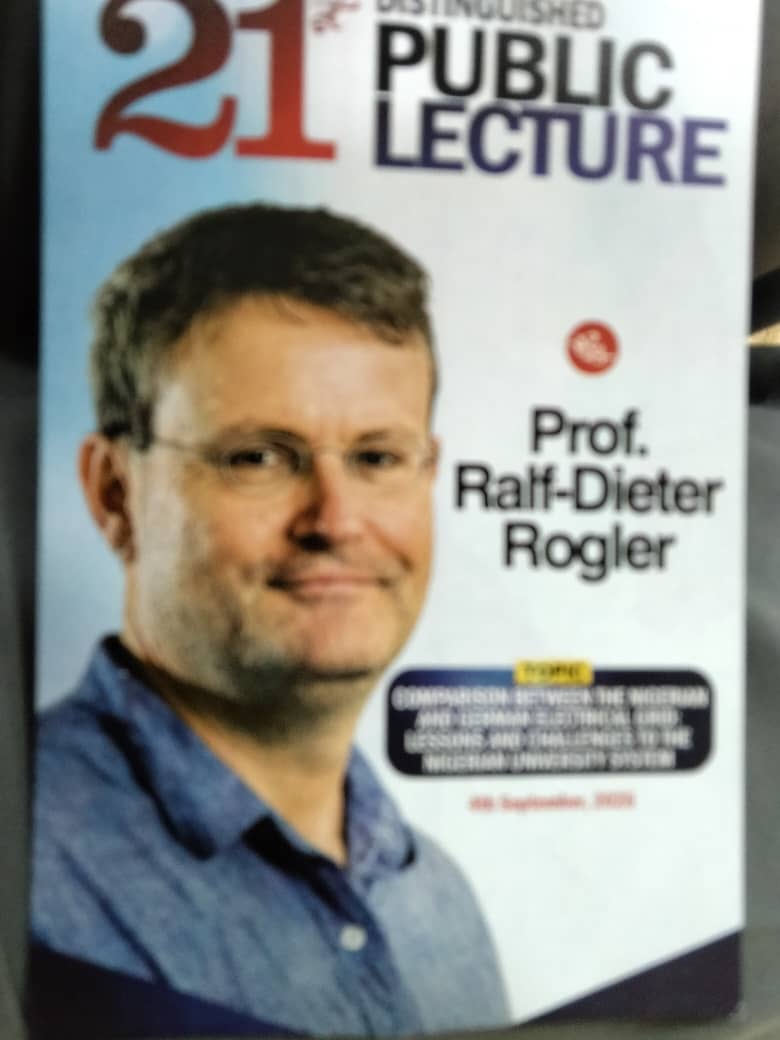
Rogler, Chair of Switchgear Technology, Faculty of Electrical Engineering, Hochschule für Technik und Wirtschaft (HTW) Dresden, Germany, made the call at the weekend while delivering a Distinguished Public Lecture at the Federal University Lokoja (FUL).

The lecture, titled “Comparison Between the Nigerian and German Electrical Grid: Lessons and Challenges to the Nigerian University System,” was held at the university’s Felele Campus.
Rogler said Nigeria’s installed generation capacity of about 6.4 gigawatts was grossly inadequate for its estimated 243 million population, while poor transmission infrastructure and inadequate maintenance further weakened the electricity system.
He noted that Nigeria has only about 3,000 kilometres of high-voltage overhead transmission lines, despite being roughly three times the size of Germany, which has a population of about 83.5 million.
According to him, Germany’s extensive interconnected grid enables electricity to be transmitted efficiently from generation centres to areas of high demand.
He said the disparity was also evident in power reliability, noting that the average German household experiences about eight minutes of electricity interruption annually, compared with about 2,800 minutes for Nigerian households.
“Nigeria’s major challenge is inadequate generation,” Rogler said, adding that the shortage forces electricity providers to ration available power through load-sharing and load-shedding.
He said addressing the crisis would require “fundamental investments” in generation, transmission, distribution, equipment and maintenance.
Rogler also highlighted Germany’s transition from coal, gas and other conventional energy sources to renewables, particularly wind and solar.
He, however, said the intermittent nature of renewable energy made energy storage and modern transmission networks essential to ensuring reliable supply.
He cited Germany’s planned high-voltage direct-current (HVDC) overlay grid, designed to transmit renewable energy from generation centres to major consumption areas, as an example of the scale of investment required to modernise a national power system.
On engineering education, Rogler said Nigerian universities must produce more highly skilled engineers, particularly in specialised fields such as switchgear technology, power electronics and computing.
He said Germany had about 2.2 million engineers compared with Nigeria’s estimated 80,000, stressing that Nigeria needed to significantly strengthen technical and engineering education to build the expertise required to transform its power sector.
Rogler urged Nigerian youths and universities to embrace education, innovation and engineering, describing reliable electricity and quality education as fundamental to economic development.
He expressed optimism about Nigeria’s future, citing its youthful population as a major advantage if properly educated and equipped with relevant skills.
The Vice-Chancellor of FUL, Prof. Gbenga Solomon Ibileye, said the university was ready to collaborate with German institutions to strengthen power systems, renewable energy initiatives and engineering education.
Ibileye said such partnerships would help build local capacity and expose students and researchers to global expertise in energy and engineering.
