


By Lamara Garba
The transformation of Bagauda Community Primary School in Bebeji Local Government Area of Kano State is more than the story of a new school building. It is a story of commitment, compassion, sacrifice and collective action, built around the determination of one man, the intervention of a woman who chose to care and a community that discovered the strength to change its own circumstances.
On Thursday, September 10, 2026, the Women Farmers Advancement Network (WOFAN), in partnership with the people of Bagauda, commissioned a new community primary school, replacing a dilapidated structure that had for years struggled to provide a suitable environment for teaching and learning.

The project, financed through farmers’ savings, community contributions and targeted organisational support, is part of WOFAN’s broader agriculture and financial inclusion interventions for women, youths and persons with disabilities under its “We Can Work” initiative. But the story of how the school came into existence goes beyond the conventional narrative of an organisation providing assistance to a community.
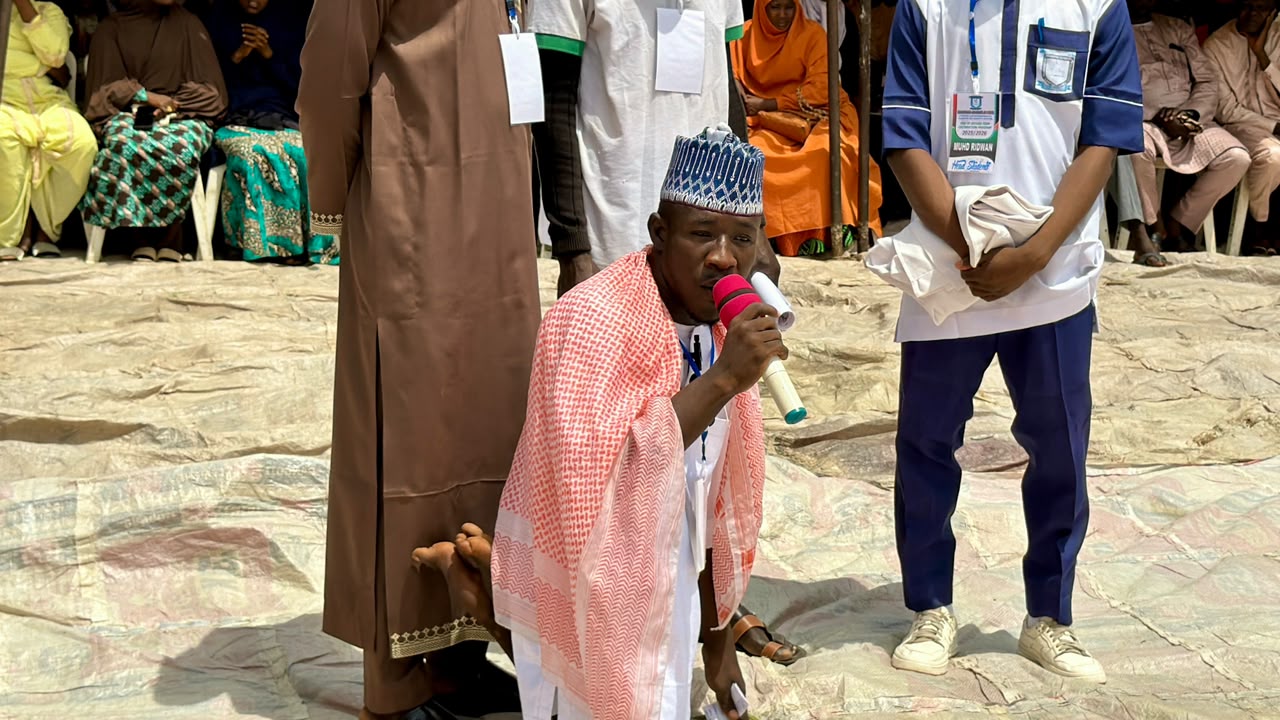
At the centre of the story is Malam Abubakar Idris Yusha’u, a person living with disability who, despite the difficulties associated with his condition, travelled nearly 20 kilometres from Kura Town to Bagauda to teach children as a volunteer.
While many people would have considered the distance, the poor condition of the road and his physical disability sufficient reasons to stay away, Idris chose to serve. He did not wait for government employment, financial incentives or public recognition before offering his service. He simply saw children who needed a teacher and decided to make himself available.
His decision was a quiet act of patriotism, carried out without the publicity that often accompanies public service. Yet that act would eventually attract the attention of WOFAN Global Advocate and Executive Director, Dr Salamatu Garba, and become one of the important triggers for the transformation of the school and the wider community.
For Dr Garba, the intervention was not conceived as charity in the traditional sense. It grew from WOFAN’s philosophy of empowering communities to become capable of addressing their own challenges. WOFAN had initially supported farmers in Bagauda with grants, farm inputs and simple hand-held equipment, while also linking them to competitive markets. The organisation subsequently trained them to establish and manage savings schemes at group, cluster and super-cluster levels.
As the farmers increased their yields and incomes, they also increased their capacity to contribute to the development of their community. The deteriorating school eventually became one of the issues they collectively decided to confront.
“Our entry point was agriculture. We supported farmers with inputs; they increased their yields, made more money, and we trained them on how to save,” Dr Garba said.
The savings and improved economic capacity of the farmers helped create the foundation upon which the community could take responsibility for its own development. Rather than waiting entirely for government intervention, the people of Bagauda began to contribute what they could towards replacing the old school.
WOFAN supplied some of the building materials, while the residents provided the remaining materials and labour under technical and engineering supervision. In this way, the school became not simply a project delivered to the community but a product of the community’s own sacrifice and participation.
The completed school now has six fully furnished classrooms, desks and staff furniture produced by locally trained youths. It also has two staff offices and an office for the head teacher, each with a private toilet, four modern pupil toilets, perimeter barbed-wire fencing and a hand-pump borehole. A feeder road serving the school and neighbouring communities has also been provided as part of the intervention.
More significantly, the community has established a dedicated savings account linked to WOFAN’s multipurpose revolving scheme, through which funds will be mobilised for the operation of the school and the implementation of other development projects.
The arrangement is designed to ensure that the project does not end with the commissioning ceremony. It is intended to create a structure through which the community can continue to contribute, manage its resources and take responsibility for sustaining the facilities it has helped to build.
For Rafaatu Salis, the Women Cluster Leader in Bebeji Local Government Area, this represents a fundamental change in the way the people perceive themselves. “The people of Bagauda are no longer seeing themselves as dependents; they are seeing themselves as problem solvers,” she said.
That statement captures perhaps the most important lesson of the Bagauda experience. Development is not sustainable when communities are permanently treated as passive recipients of assistance. The most enduring interventions are those that give people the confidence, skills and resources to participate in solving the problems that affect their lives.
The Chairman of Bebeji Local Government Area, Alhaji Ali Ibrahim, commended WOFAN and the people of Bagauda for their efforts and pledged to build a junior secondary school beside the new primary school. He also donated N500,000 to the school’s community account, further strengthening the financial foundation established for its continued operation.
A representative of Jaiz Bank, Bulayaminu Inuwa Yakasai, said the school would be onboarded onto the bank’s platform to enable it to manage contributions effectively, while teachers and community members would have access to financial inclusion programmes under the Jaiz-WOFAN partnership covering finance, capacity building and guarantees.
The intervention has also created an opportunity to demonstrate how financial inclusion, community savings and social development can work together. Rather than viewing education as an isolated sector requiring external funding, the Bagauda model connects education to the economic empowerment of the people who use and sustain it.
Dr Salamatu Garba has consistently emphasised that education remains one of the most enduring legacies any society can leave for future generations. Her approach at Bagauda was therefore not simply to construct classrooms, but to create a system in which the community would develop a sense of ownership, accountability and responsibility for the school.
She also donated N3 million to the planned school account and called for stronger Parent-Teacher Association structures and other stakeholder committees that would help ensure the continued management and development of the institution.
The story of Idris gives the intervention an even deeper human dimension.
As the pioneer volunteer teacher, Idris had been teaching children in circumstances that would discourage many others. Living with disability and travelling almost 20 kilometres from Kura Town to Bagauda, he demonstrated that physical limitations do not necessarily determine the limits of a person’s usefulness, ambition or willingness to serve.
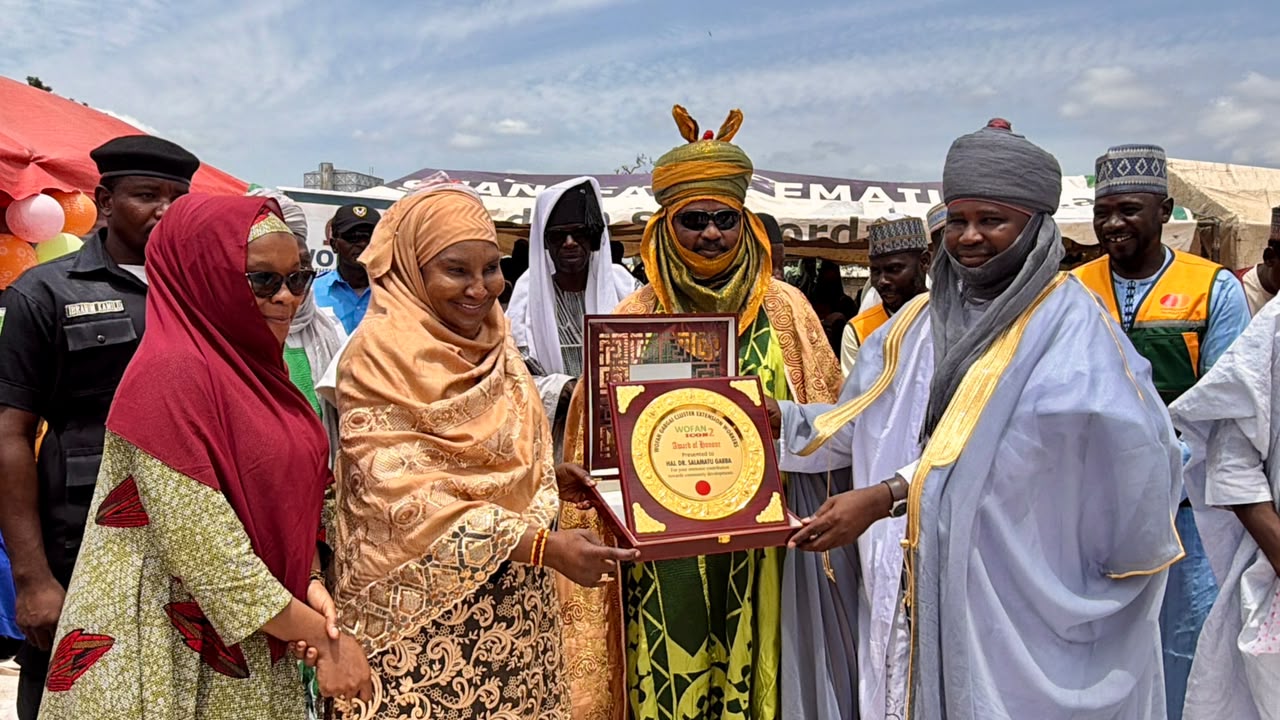
His commitment eventually received recognition from WOFAN. The organisation provided him with a customised motorbike and helped him secure employment as a member of the teaching staff, giving him not only mobility but also the dignity of meaningful work.
For Idris, the support represented much more than material assistance. It was an affirmation that persons with disabilities can contribute meaningfully to society when given the opportunity and the support required to do so.
There was an emotional moment during the gathering when Idris could no longer hold back his tears as he acknowledged the transformation that had taken place. Standing before the people and guests who had gathered to witness the commissioning of the school, he recognised that what had begun with his lonely journey to teach children had grown into something much bigger than he could have imagined.
His tears were not simply an expression of emotion; they captured the human meaning of the entire intervention. The teacher who once travelled quietly to Bagauda to teach children had become part of a story that brought together farmers, women, youths, traditional rulers, government officials, financial institutions and a development organisation around a common purpose.
The lesson is difficult to miss. Idris did not allow disability to become an excuse for indifference, just as the people of Bagauda did not allow poverty or the poor condition of their school to extinguish their desire for a better future.
This is why people like Idris deserve to be recognised by government and society. Nigeria needs to develop mechanisms for identifying and supporting citizens who demonstrate exceptional commitment to their communities, particularly those who serve under difficult circumstances without waiting for recognition.
A special scholarship that enables Idris to further his education at a leading university would therefore be more than a reward for one man. It would be an investment in an example and a powerful message to young Nigerians and persons with disabilities that service, sacrifice and patriotism are values worthy of recognition and support.
Such recognition would also help change the narrative around disability. Too often, persons living with disabilities are viewed primarily through the lens of vulnerability and dependency, while their abilities, ambitions and contributions receive far less attention. Idris’s story provides a different perspective: that a person living with disability can become a teacher, a community builder and a source of inspiration to others when given the opportunity to contribute.
The traditional institution also played an important role in mobilising the community and supporting the intervention. The District Head of Bebeji, Alhaji Yusuf Sarki Bayero, and the District Head of Garun Mallam, Alhaji Muhammad Daniya Ibrahim, commended the project and their support for the advocacy and mobilisation efforts that helped bring the initiative to fruition.
The commissioning ceremony brought together members of the WOFAN ICON2 project board, traditional rulers, the Bebeji Local Government Education Secretary, Directors of the Nigerian Law School and the National Institute for Hospitality and Tourism, representatives of neighbouring communities and other guests from within and outside Kano.
Their presence reflected the wider significance of the project. What began as a local education challenge had become an example of what can happen when different sectors and individuals connect their efforts around a common objective.
The Bebeji Local Government Chairman captured this broader significance when he suggested that society would look different if more organisations operated in the manner demonstrated by WOFAN. His observation points to one of the central challenges facing development in Nigeria: government remains indispensable, particularly in providing public infrastructure and basic services, but government cannot and should not be expected to carry the entire burden of development alone.
Communities have knowledge of their needs. Traditional institutions have influence and social capital. Civil society organisations have the flexibility to mobilise and experiment with new approaches. Financial institutions possess resources and expertise, while individuals often have skills and commitment that remain invisible until someone creates an opportunity for them to contribute.
The Bagauda experience shows what becomes possible when these different strengths are brought together.
It also challenges the familiar perception of development as a simple transaction in which an organisation identifies a problem, provides money and leaves. WOFAN’s intervention demonstrates another model in which economic empowerment comes first, communities develop the capacity to save and contribute, and those resources are eventually applied to a shared social need. The result is not merely a building but a stronger sense of ownership.
When people contribute their savings, labour, skills and time to a project, they are more likely to protect it, maintain it and demand accountability from those responsible for its management. The school therefore represents both physical infrastructure and a social contract between the people of Bagauda and those who have invested in their future.
Perhaps the greatest lesson from Bagauda is that transformation does not always begin with enormous resources. Sometimes, it begins with one person who refuses to give up, another who chooses to care, a community willing to sacrifice and a leader prepared to connect those efforts to opportunity.
Malam Abubakar Idris Yusha’u answered the question of what he could do by travelling nearly 20 kilometres to teach children; Dr Salamatu Garba answered it by transforming compassion into action; while the people of Bagauda responded by contributing their labour, savings, skills and resources. The local government, traditional institutions, farmers, women and young people each played their part, demonstrating that meaningful development becomes possible when individual commitment is connected to collective purpose.
That is how a forgotten school becomes a new beginning, how dignity is restored and how communities discover their capacity to shape their own future. The Bagauda experience also shows that development should not be measured only by the structures completed, but by the people empowered, the sacrifices recognised and the opportunities created.
WOFAN has demonstrated through this intervention that when economic empowerment, community ownership, compassion and purposeful leadership come together, even a neglected community can begin to write a different story.
Perhaps the most enduring image from Bagauda will not be the ribbon cut at the commissioning ceremony, but that of Idris, a man living with disability who refused to allow his condition to define the limits of his usefulness. His nearly 20-kilometre journey to teach children, undertaken without fanfare or expectation of reward, became the spark that helped draw attention to a forgotten school and ultimately brought an entire community together.
His story reminds us that disability does not mean inability, poverty does not mean lack of potential and rural location does not mean lack of ambition. What people often need is the opportunity, recognition and support to turn their commitment into lasting impact.
If Nigeria is serious about building a more inclusive and productive society, it must learn to recognise people like Idris while they are still quietly serving, rather than waiting until their stories become remarkable enough to attract public attention. A special scholarship that enables him to further his education at a leading university would therefore be more than a reward for one man; it would be an investment in an example and a powerful message to young Nigerians and persons with disabilities that service, sacrifice and patriotism are values worth celebrating and supporting.
The school now has new classrooms, furniture, offices, toilets, a borehole, fencing and improved access, but its deepest foundation is something that cannot be measured in bricks or cement. It is the commitment of a teacher, the compassion of a leader, the sacrifice of a community and the collective determination to create a better future.
That is how a school becomes more than a school; it becomes a statement of what is possible when people choose to care, to contribute and to work together. And that is how WOFAN is helping to transform society, one community, one family and one life at a time.
Lamara Garba, a veteran journalist, writes from Kano.
