

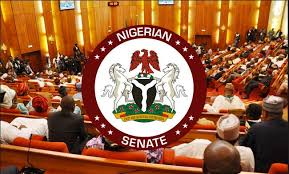
As Nigeria’s National grid collapsed to zero megawatts, senate on Wednesday passed the Electricity Bill 2022 that has empowered States or individuals with capacities to generate their own power and distribute to do so
The bill’s passage came after the consideration of a report by the Committee on Power.
The bill has now paved way for governments to license people who intend to operate mini grid within the state as against the initial situation where
Electricity was on the Concurrent List in the constitution
The bill also will give legal backing to renewable energy generation whereby any individual who decides to generate one megawatt of power using solar as energy source is also provided for.
The Senate expressed the hope that with the bill the power problem would be solved.

“The space is now opened. There is little restriction as to who will generate power and distribute.”
Chairman of the Committee, Senator Gabriel Suswam (PDP, Benue North East), in his presentation, said the bill seeks to, amongst others, provide an Ideal legal and institutional framework to leverage on the modest gains of the privatisation phase of the electricity power sector in Nigeria.
He added that when signed into law, the bill would improve utilisation of generated power through increased investments in new technologies to enhance transmission and distribution of generated power to minimise aggregate value chain loses.
According to the lawmaker, the piece of legislation would “reinvigorate the Institutional framework for the reform of the Nigerian Electricity Supply Industry (NESI) initiated and implemented by the Federal Government.”
He disclosed that the provisions of the bill seeks to promote policies and regulatory measures that would ensure the expansion of power transmission networks in Nigeria in order to address any imbalance in the existing transmission infrastructure.
Suswam noted that the bill would stimulate policy and regulatory measures to scale up efficient power generation, transmission and distribution capabilities of the sector; as well as address technological limitations and outdated infrastructure that are responsible for value chain loses.
The Senate President, midway through consideration of the bill, sought to know the role and operational capacity of banks that had taken over distribution companies (discos) indebted to them.
Responding, Senator Suswam explained that the take-over of entities (Discos) by banks was duly carried out in collaboration with the Nigerian Electricity Regulatory Commission (NER) and Bureau of Public Enterprise (BPE).
According to him, there was a transitional process put in place during the take-over of the Abuja Electricity Distribution Company (AEDC) by the United Bank for Africa (UBA) to ensure efficiency in service delivery.
He noted that such transitional process usually involves the invitation of new investors to scale up generation and distribution capacities.
He further disclosed that the Federal Government had disbursed $100 million (USD) to Siemens to kickstart transmission in the distribution end of the power sector.
On his part, Senator Ahmad Babba-Kaita (PDP – Katsina North), said the faulty way in which Discos were created was largely responsible for their inability to live up to expectations.
He, therefore, advised the federal government to ensure a transparent process in the selection of companies to take-over power generation and distribution across the country.
The Deputy Chief Whip, Senator Aliyu Sabi Abdullahi (APC – Niger North), noted that the aspect of renewable energy in the bill, was given prominence amidst the energy mix.
The Electricity Bill, 2022, after a clause-by-clause consideration of the Committee’s report by the Committee of the Whole, was passed by the upper chamber.
The Senate President, Ahmad Lawan, in his remarks after the passage of the bill, said, “because of its importance and sensitivity, we would like to see a quick concurrence by the House of Representatives, because time is of essence as far as Nigeria is concerned when you talk about electricity and energy supplies in Nigeria.
“So, we would like to see that this bill is fully processed in the National Assembly and sent to the Executive side of government for the consideration for assent by Mr. President.
“We believe that this piece of legislation can change the fortunes of the electricity industry in Nigeria for the better.”
