

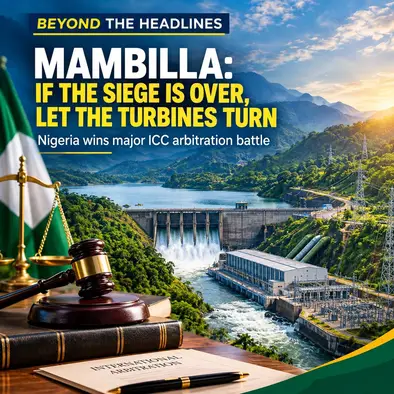

Nigeria’s troubled Mambilla Hydroelectric Power Project has been handed a major legal reprieve after an international arbitration tribunal threw out a $400m claim brought against the Federal Government by Sunrise Power and Transmission Company Limited.
But beyond the financial claim rejected by the International Chamber of Commerce tribunal, the September 17 award has brought renewed attention to how a two-decade contractual dispute contributed to the prolonged delay of a project designed to add 3,050 megawatts of electricity to Nigeria’s power system.
The dispute, according to Attorney-General of the Federation and Minister of Justice, Lateef Fagbemi, began in 2003 and subsequently moved through Nigerian courts and international arbitration.
The financing arrangement for the project with the China Export-Import Bank was also tied to the resolution of the dispute, leaving the project unable to reach financial close for years.
Sunrise had demanded $400m in the latest arbitration, comprising a $200m settlement sum and another $200m default payment, in addition to interest. The company is also pursuing a separate claim of more than $2.7bn.
The latest case, however, ended decisively in Nigeria’s favour.
The tribunal held that the settlement agreement relied upon by Sunrise was not binding on the Federal Government because the former ministers who signed it did not have the requisite authority to commit Nigeria without presidential approval.
It went further, finding that the agreement was tainted by corruption and contrary to Nigerian public policy.
According to Fagbemi, the tribunal found that Sunrise’s principal, Leno Adesanya, had engaged in a longstanding pattern of corrupt dealings involving senior Nigerian government officials connected to the Mambilla project.
The tribunal also found that a corrupt arrangement was reached between Adesanya and officials who signed the settlement agreement that formed the basis of the latest claim.
As a consequence, Sunrise and Adesanya were ordered to shoulder 75 per cent of Nigeria’s legal fees and expenses, with interest on the amount at 10 per cent annually.
The ruling represents a significant reduction in the immediate legal exposure facing Nigeria. But it also exposes the enormous opportunity cost of the prolonged Mambilla controversy.
For more than 20 years, Nigeria has been unable to convert the huge hydroelectric potential of the Mambilla project into electricity for homes, businesses and industries.
The project was conceived as one of the country’s largest power infrastructure schemes, with a planned capacity of 3,050MW of clean hydroelectric power.
Instead, its history has been dominated by contractual disagreements, litigation and arbitration.
Fagbemi said the Federal Government could now move forward without the latest claim hanging over the project, describing the award as a vindication of Nigeria’s position.
He credited President Bola Tinubu with providing the financial and logistical support required for the country’s defence and said the Justice Ministry would continue to defend Nigeria against claims arising from what he described as improperly created contractual obligations.
Yet the arbitration victory is only one part of the Mambilla story.
The real test now is whether the removal of the latest legal obstacle will finally allow Nigeria to resolve the project’s outstanding financing and construction challenges and turn the long-promised megawatts into actual electricity.
After two decades of disputes, Nigerians are still waiting for the power project to move from arbitration rooms to construction sites.