

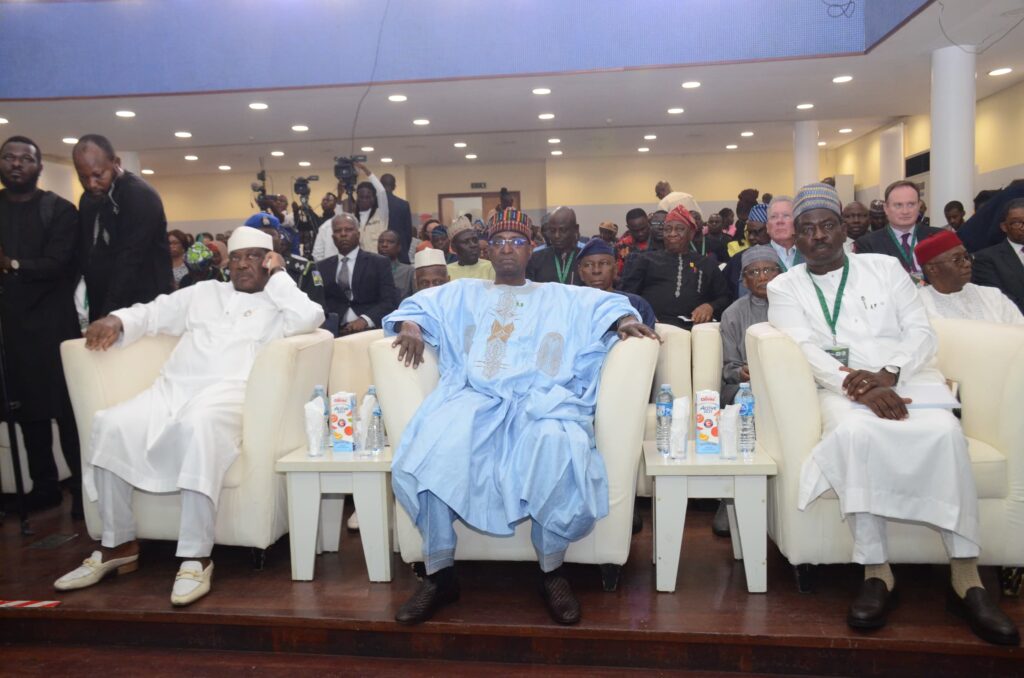

The Federal Government has launched a renewed push to transform Nigeria’s livestock sector into a major economic powerhouse, with the Presidency describing the industry as an untapped “goldmine” capable of driving food security, job creation, rural development and investment.
The Special Adviser to President Bola Ahmed Tinubu on Livestock Development and Co-Chair of the Presidential Livestock Reforms Implementation Committee, Prof. Attahiru M. Jega, OFR, made the call at the 9th All Africa Conference on Animal Agriculture.
Represented by Prof. D. J. U. Kalla, Jega said Nigeria and other African countries must abandon the treatment of livestock as a largely subsistence activity and reposition it as a commercially driven sector capable of competing in regional and global markets.
He spoke against the backdrop of the conference theme, “Repositioning Animal Agriculture for Africa’s Food Security and Global Competitiveness,” which brought together stakeholders to examine ways of converting Africa’s enormous livestock resources into productive and commercially viable enterprises.
Jega said livestock should no longer be viewed merely in terms of cattle, sheep, goats, camels and poultry, stressing that the sector supports an extensive economic ecosystem involving breeding, animal health, feed production, forage, transportation, processing, marketing and value addition.
“Livestock is therefore not a peripheral component of African agriculture; it is a prime mover and fulcrum of inclusive economic transformation,” he said.
From subsistence to a billion-naira opportunity
According to Jega, unlocking the economic potential of livestock is central to the Tinubu administration’s Presidential Livestock Reforms Agenda, designed to create a productive, competitive, climate-resilient and commercially viable industry.
He said the objective was not merely to increase animal production but to build an integrated value chain capable of generating jobs, attracting private capital, improving nutrition and expanding economic opportunities in rural communities.
Jega, however, said achieving the ambition would require a fundamental overhaul of the way livestock production is organised and financed.
He called for a decisive transition “from subsistence to productivity, from fragmentation to value-chain integration, and from potential to investment and competitiveness.”
He identified investment in improved genetics, animal health, feed and forage, water infrastructure, research, innovation, processing facilities, transportation and market development as critical to the transformation.
The presidential aide also stressed the need to strengthen every link in the livestock value chain to ensure that higher production translates into increased income for farmers, pastoralists, processors, traders and investors.
‘Africa has the livestock resources’
Jega said Africa already possesses the biological resources and human capacity needed to develop a globally competitive animal agriculture industry, arguing that the major challenge was converting the continent’s livestock wealth into economic value.
“Africa has the livestock resources. Our task is to convert this biological wealth into nutritious food, decent jobs, resilient livelihoods and globally competitive enterprises,” he said.
He challenged governments, investors, researchers, farmers and other stakeholders to move beyond policy declarations and establish practical partnerships capable of delivering measurable results.
For Nigeria, the push has added significance as the government seeks to expand domestic food production, reduce dependence on imports, create employment and diversify economic opportunities beyond oil.
‘Africa must feed Africa’
Jega also urged African countries to strengthen domestic food systems to meet the continent’s rapidly growing demand for animal protein and livestock products.
He argued that animal agriculture must occupy a central position in Africa’s food-security strategy rather than being treated as a secondary component of agricultural development.
“Africa must feed Africa—and animal agriculture must be at the fulcrum of that transformation,” he declared.
He urged participants to turn the conference into a springboard for concrete action, investment and partnerships, warning that policies and research would have little value unless they translated into measurable improvements across the livestock value chain.
Under the Federal Government’s reform agenda, the ultimate ambition is to convert Nigeria’s vast livestock resources into a modern economic sector capable of feeding the population, creating millions of livelihoods, attracting investment and competing effectively in regional and international markets.
The emerging challenge, therefore, is no longer whether Nigeria possesses the livestock resources to build a major industry, but whether government and private-sector players can convert that enormous potential into sustained productivity, investment and economic returns.