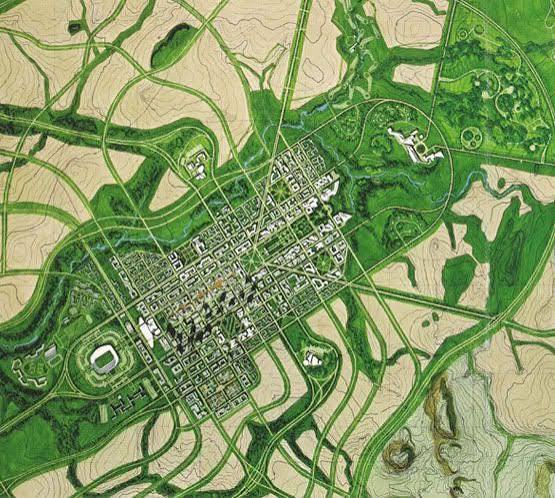
The Human Rights Writers Association of Nigeria (HURIWA) has raised alarm over what it describes as the systematic erosion of the Abuja Masterplan, warning that the Federal Capital Territory’s environmental balance and public infrastructure planning are being undermined by the conversion of designated public spaces into private developments.
In a statement issued in Abuja by its National Coordinator, Comrade Emmanuel Nnadozie Onwubiko, HURIWA said the trend, driven by authorities of the Federal Capital Territory Administration (FCTA), represents a “dangerous deviation” from the original vision of Abuja as a planned and environmentally sustainable capital city.
The group expressed concern over what it called the increasing disappearance of green areas across the city, alongside widespread tree felling and the rapid expansion of commercial and residential developments into spaces originally reserved for public use.
It warned that the developments are already contributing to rising temperatures, ecological imbalance, and heightened flood risks within the capital.
A major point of concern raised by the organisation is the reported conversion of Plot 546, Cadastral Zone B03, Wuye District—originally designated in the Abuja Masterplan for a district hospital—into a private residential estate.
The 3.171-hectare site, located near the Wuye Ultra-Modern Market and a police station, is reportedly being developed by a private firm, Full Moon Estate Developers Ltd.
HURIWA said the conversion amounts to a violation of the Abuja Masterplan and a denial of essential healthcare infrastructure to residents of Wuye District, which it noted still lacks adequate public medical facilities despite rapid population growth.
The organisation also raised concerns over alleged patronage networks within land administration in the FCT, suggesting that politically exposed persons and associates of top officials may be benefiting from land reallocations. While it acknowledged that such claims remain unverified, it said they raise serious questions about transparency and due process in land governance.
The group further warned of what it described as a broader pattern of disregard for urban planning principles, where lands originally earmarked for hospitals, schools, playgrounds, and green spaces are being repurposed for private interests.
It noted that such practices could undermine the structural integrity of Abuja and weaken access to essential public services.
HURIWA also drew attention to what it called the shrinking of recreational spaces in several residential districts, alleging that some areas designated for children’s playgrounds have been converted into motor parks and informal commercial outlets.
Beyond immediate land use concerns, the association warned that continued deforestation and unchecked urban expansion could threaten the long-term sustainability of the capital, particularly at a time when many global cities are prioritising green infrastructure to mitigate climate change impacts.
The group called on the National Assembly to intervene, urging lawmakers to halt further conversion of public lands, launch a full investigation into land allocation practices in the FCT, and review compliance with the Abuja Masterplan.
It also called on anti-corruption agencies to investigate allegations of abuse of office, conflict of interest, and diversion of public assets, insisting that any individuals found culpable must be prosecuted and affected lands restored to their original public purpose.
HURIWA demanded the immediate suspension of ongoing construction activities on disputed plots, including the Wuye District hospital site, pending the outcome of investigations. It further urged the restoration of all diverted public lands, particularly those designated for healthcare, education, and environmental protection.
The organisation warned that Abuja risks losing its identity as a planned capital city if current trends continue unchecked, stressing that the integrity of the Federal Capital Territory must not be compromised for private or political gain.
It added that Abuja remains a national asset that must be preserved in line with its original master planning principles.
Abuja Masterplan under strain as HURIWA alleges land diversion, encroachment