


By: Lamara Garba Azare
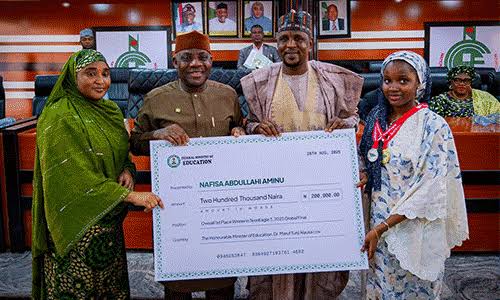
In the theatre of nations, where countries display what they value most, Nigeria once again played the wrong script. On the 28th of August, 2025, the Federal Government stood before the world and, with fanfare, announced a ₦200,000 cash reward for Nafisa Abdullahi, a 17-year-old girl from Yobe State, who had just conquered the globe at the TeenEagle Global English Championship in London.
It should have been a moment of national pride the triumph of intellect, the victory of knowledge, the vindication that Nigerian children, though raised in broken classrooms with tattered textbooks, can still outshine peers from nations where education is richly funded. Instead, the moment was reduced to farce.


The prize was ₦200,000. Not a scholarship. Not a lifelong educational support package. Not even a promise of sustained recognition. Just ₦200,000 money that vanishes before the ink on a bank teller’s slip dries. And shamelessly, the same government invited the girl and her parents to travel all the way from Damaturu to Abuja for the presentation. Anyone who knows the realities of transportation, accommodation, and feeding on such a trip will realise that the ₦200,000 reward barely covers the expenses of the journey itself. By the time they return to Yobe, how much of the so-called “national honour” will be left? This is not recognition. This is mockery.
The insult was sharper because of what came before. Just weeks earlier, the same government gave $100,000 each over ₦160 million to Nigerian athletes who returned victorious from global tournaments. Sportsmen celebrated like kings, while a girl who carried Nigeria’s flag through intellect was treated like a beggar appeased with coins. This contrast is not just unfair. It is a scandal. It is a window into the soul of a government that speaks loftily of education but starves it in practice.
Sports have their place. Football unites nations; athletes inspire. But is it not education that sustains nations long after the cheers in the stadium fade? When Nigeria gave ₦160 million to footballers, it was hailed as generosity. When Nigeria gave ₦200,000 to Nafisa, it exposed a tragic hierarchy of values: here, knowledge is cheap. Here, intellect is disposable. Here, the very foundation of progress is treated as an afterthought.
₦200,000 in today’s Nigeria barely covers a semester’s tuition in a private university. It cannot buy a modest laptop and a year’s reliable internet. It cannot even cover the travel expenses for Nafisa to attend the very competition she conquered, had sponsors not intervened. Meanwhile, ₦160 million is enough to pay for a PhD at Harvard, buy a house in Abuja, and still have funds left to establish a scholarship foundation. This is not about envying athletes. It is about exposing the imbalance in our governance. Why is brawn valued more than brain? Why is intellect seen as unworthy of investment?
This ₦200,000 reward is not just a mistake; it is a philosophy — the philosophy of spectacle over substance. Governments love the visibility of sports victories: stadiums roar, cameras flash, politicians clap. Intellectual triumphs, by contrast, are quieter, less glamorous, and less “profitable” politically. So they are dismissed with tokenism. Yet, it is ideas, not athletics, that build civilizations. Japan rose from the ashes of war not through football, but through science and education. South Korea transformed from poverty to prosperity by grooming engineers, doctors, and innovators. Singapore became a global giant by making education sacred. Nigeria, however, prefers medals to minds, applause to intellect, noise to knowledge.
Imagine if Nafisa’s victory had been met with a life-changing scholarship perhaps to study at one of the world’s leading universities. Imagine if the government had created an “Intellectual Heroes Fund” to support students who conquer global competitions. Imagine if the President himself had hosted her in Aso Rock and told every Nigerian child watching: See what books can do. This is the path to greatness. Instead, Nafisa received ₦200,000 less than what a minister might spend on a single lunch. Her victory, which could have been a rallying point for millions of children, was reduced to a footnote in the news.
Nafisa’s story is not just about her. It is a metaphor for the Nigerian child. In every rural school where pupils sit under leaking roofs, in every city classroom where teachers go unpaid for months, the same message echoes: education is not valued here. How many brilliant youths have fled abroad with their talents because at home they were mocked with crumbs? How many have settled for mediocrity because their society told them that brains don’t matter? When the government presented ₦200,000 to Nafisa, it was not just a gift. It was a signal loud and clear that excellence in education is worth less than a handshake.
Nigerians, long used to disappointment, still found this too much to swallow. Social media exploded with outrage. One father wrote online: “My daughter saw this story and asked me, Daddy, is it better to be a footballer than to be intelligent? I had no answer.” That is the damage done not just the insult to Nafisa, but the discouragement of millions of children who now see that the path of books leads only to mockery.
Elsewhere in the world, intellectual triumphs are immortalized. Pakistan rallied behind Malala Yousafzai, and today she is a Nobel laureate. India celebrates its top students with scholarships and mentorship. Rwanda invests heavily in its brightest minds. Nigeria, by contrast, splashes billions on politicians’ allowances and football banquets, but offers mere tokens to its intellectual heroes.
This is bigger than Nafisa. It is about the soul of Nigeria. A country that trivializes education cannot develop. A country that rewards muscle over mind will remain trapped in mediocrity. A country that mocks brilliance will drive its best and brightest away. What is needed is not token cash rewards but a shift in philosophy a recognition that investing in education is not charity but national survival.
And yet, Nafisa’s victory must not be lost in the scandal. Despite the mockery of ₦200,000, she remains a shining light. She has proven that Nigerian children can rise above poverty and neglect to shine before the world. Her triumph must inspire, not depress. Let every child know: your worth is not determined by the crumbs offered by government. Knowledge is priceless. Brilliance is its own reward.
In the end, it is Nigeria, not Nafisa, that has been shamed. A nation that rewards genius with peanuts has revealed its poverty of vision. But history is clear: nations that neglect education collapse under ignorance, while those that nurture it rise to greatness. One day, Nigeria will remember that it once mocked brilliance with ₦200,000 and perhaps by then, it will understand the true cost of its shame.
1 Comment
The shame of a Nation indeed. And the reaaon why, metaphorically speaking, goats always end up leading the educated ones.
Beautiful write-up!