



Nigeria has officially launched the ECOWAS Youth Empowerment Project (ECOWAS-YEP), a bold initiative designed to tackle unemployment and food insecurity by equipping young people with practical skills in sustainable agriculture, agro-sylvo-pastoralism, and fisheries.
Speaking at the opening ceremony on Friday at the Agricultural Research Council of Nigeria (ARCN), Abuja, the Minister of Agriculture and Food Security, Senator Dr. Aliyu Sabi Abdullahi, represented by his technical adviser, Mohammed Jobdi, described the programme as a “historic milestone for Nigeria and West Africa.””
“This project is not just another training scheme. It is a strategic intervention to confront high youth unemployment, food insecurity, climate change, and the unsustainable exploitation of natural resources,” the Minister said.
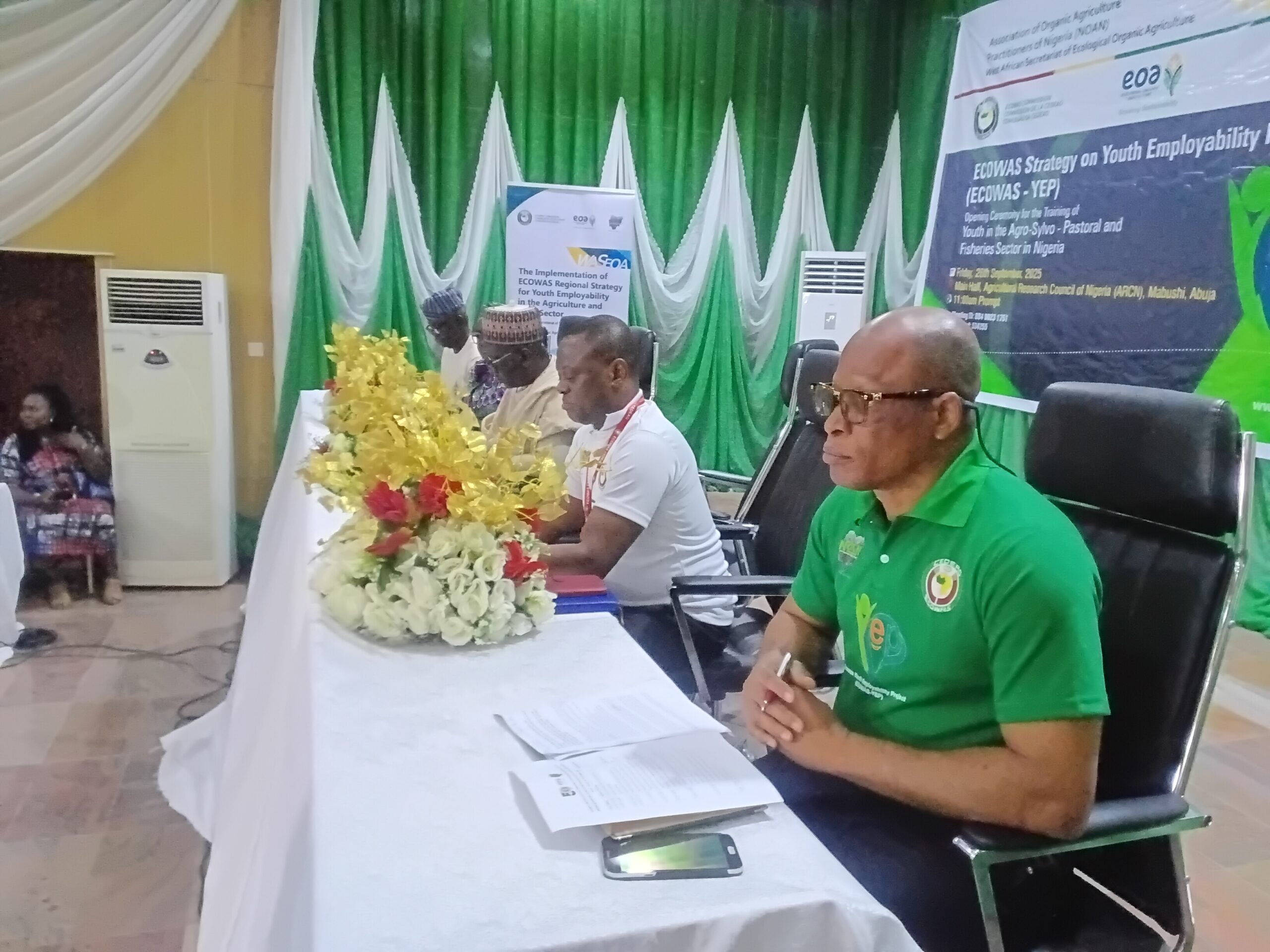
The Minister outlined the Federal Government’s priorities under the programme to include, expanding agroecology and organic agriculture to restore soil fertility, reduce chemical dependence, and open premium export markets and establishing agribusiness incubation hubs across the six geopolitical zones to train and support youth cooperatives.
Others are scaling up eco-friendly fisheries and aquaculture to modernize production, reduce post-harvest losses, and attract young entrepreneurs and strengthen sustainable livestock systems to reduce rangeland degradation and farmer-herder conflicts.


The government, he added, is also promoting agroforestry, climate-smart agriculture, and nutrition-focused food systems to position Nigeria as a regional leader in sustainable farming.
The ECOWAS-YEP is part of the broader ECOWAS Agricultural Policy (ECOWAP) and aligns with the African Union’s Agenda 2063.
Already, over 15,000 youths across West Africa have benefitted from ECOWAS training programmes, with Nigeria now expected to take the lead in scaling impact.
In a direct message to participants, the Minister urged them to seize the opportunity:
“My dear Nigerian youths, this project is for you and about you. You are not just the leaders of tomorrow—you are the protagonists of today. With your creativity and resilience, you can make agriculture attractive, profitable, and sustainable.”
He emphasized that ECOWAS-YEP will provide not only training but also mentorship, start-up resources, and market linkages to help young people transition from job seekers to job creators.
The Minister stressed that success will depend on collaboration, highlighting the roles of NOAN, farmer cooperatives, universities, donor agencies, and local governments in driving sustainability.
Declaring the project officially open, he concluded:
“Together, let us empower our youths, restore our ecosystems, and build a food-secure and sustainable West Africa.”
The President of the Association of Organic Agriculture Practitioners of Nigeria (NOAN), Professor Jude C. Obi described the programme as “more than training—it is a movement to build a generation of digitally savvy, environmentally conscious, and business-minded agripreneurs.”
“From a pool of over 14,000 applicants, 300 hundred of the youths were selected for the first phase of the training.
“Data presented at the event revealed striking insights: 62 per cent of participants are aged 26–35, 44.3 per cent hold at least a bachelor’s degree, and 66.9 per cent already have prior agricultural training.
Nearly all participants—97.7 percent—own smartphones or computers, a fact Obi said would help integrate digital learning and online marketing into the programme.
“Agriculture is no longer a fallback plan or a subsistence occupation. It is a pathway to innovation, entrepreneurship, and national prosperity,” Obi told the gathering, which included senior government officials, ECOWAS representatives, and development partners.
“The trainees themselves are entering diverse fields within organic agriculture: 36.7 percent opted for biological input production, 32.7 percent chose organic crop diversification (notably sesame and ginger), and 30.6 percent selected vegetative propagation of high-value crops.”
According to Obi, what excites the organisers most is that many youths are motivated by community impact, not personal gain.
“They want to mentor peers, build cooperatives, and extend ecological farming practices to thousands more across Nigeria,” he said.
The Commissioner of Economic Affairs and Agriculture of ECOWAS Mrs Massandje TOURE-LITSE, represented by Dr GLE Koffi Emmanuel, Rural Development and Land Gouvernance Programmes Officer said the region’s greatest wealth lies in its youthful population—over 60 per cent of West Africa’s 450 million people are under 30.
“This youthful energy can either become a ticking time bomb or the driver of prosperity,” Traore warned. “Three out of every four young people entering the labour market cannot find decent work. Through agriculture, we have the chance to change that.”
The ECOWAS strategy, he explained, goes beyond temporary fixes.
“It is designed to transform agriculture and agri-food value chains, making them productive, sustainable, and attractive to youth. “By 2030, the Commission expects one in every four new entrants into the job market to find meaningful employment in the agro-sylvo-pastoral and fisheries sectors.
According to him, the plan focuses on six pillars: raising awareness of agricultural opportunities, vocational training and incubation, investment in youth-led enterprises, access to land and markets, settlement support, and promoting agroecology
To back these ambitions, ECOWAS has mobilised significant funding. Between 2024 and 2025, the Commission allocated over $2.38 million in grants to training centres across member states, including Nigeria.
Two priority investment programmes are already underway:
The Youth Employability Programme in agriculture and fisheries, which channels resources into training and enterprise support.
The Local Milk Value Chain Programme, aimed at cutting imports, creating sustainable rural markets, and generating youth jobs in dairy production and processing.
Traore said Nigeria, with its vast agro-ecological diversity and a youth population of over 120 million, is uniquely positioned to lead the way. Already, ECOWAS programmes have trained more than 15,000 young people and supported 27 training centres across the region.
“This is not just a ceremony,” Traore told the audience of government officials, agricultural leaders, and trainees. “It is the start of a transformative journey. When we empower our youth, we are not only creating jobs—we are securing the future of Nigeria and West Africa.”
The Abuja inauguration brought together key stakeholders, including the Federal Ministry of Agriculture and Food Security, the Association of Organic Agriculture Practitioners of Nigeria (NOAN), and other development partners, who pledged support to ensure the programme delivers on its promise.
With the roll-out of YEP, ECOWAS hopes to stem the tide of rural exodus, minimize irregular migration, and position agriculture as a magnet for youth innovation, entrepreneurship, and prosperity.
The inauguration drew dignitaries from the Ministery of Agriculture and Food Security, ECOWAS Director of Agriculture and Rural Development, Mr. Alain Sy Traore and other heads of key agricultural agencies.
Both ECOWAS and Nigeria’s Federal Ministry of Agriculture and Food Security pledged continued support for the programme, which they described as a strategic investment in food security and youth empowerment across the sub-region
For the participants, the message was clear. “This training is your opportunity to rise,” Obi declared. “Step boldly into your role as Africa’s next agricultural leaders.”
With the ECOWAS YEP now underway, organisers say the initiative will not only create employment but also drive a continental shift toward sustainable, organic, and technology-driven agriculture.