

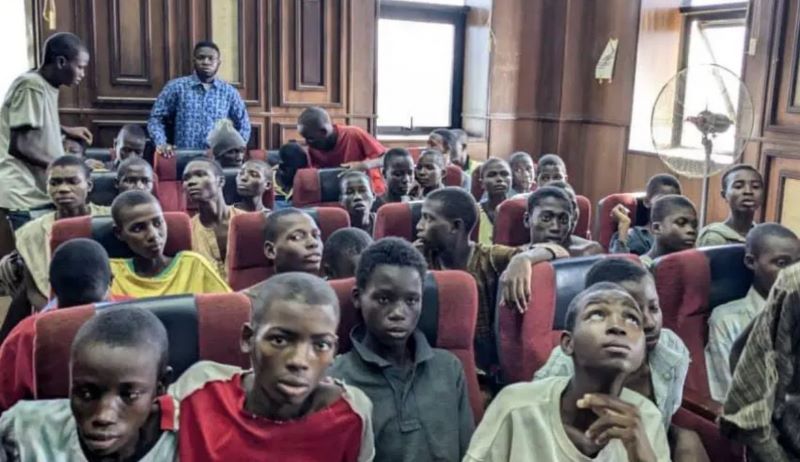

The trial of minors charged with treason for their participation in the #EndBadGovernance protest has ignited significant debate across Nigeria, raising questions about free expression, youth dissent, and the responsibilities of leadership.
These young protesters, reportedly as young as 12, carried a Russian flag and chanted slogans calling for foreign intervention—a symbolic act that has led to serious legal consequences. Critics of the minors’ arraignment have often trivialised their actions, dismissing their calls for Russian President Vladimir Putin to “rescue” Nigeria as mere folly.
However, one doubts if critics would argue same way if the suspects were full grown adults not malnourished minors. Regardless of age the mere act of brandishing Russia’s flag and calling on Putin to rescue Nigeria is ordinarily provocative. However, do those dual actions meet the legal threshold for treason under Nigerian law?
Incidentally, the Attorney General of the Federation (AGF) and Justice Minister, Prince Lateef Fagbemi (SAN) has intervened, requesting the police case file amid growing public concern. His prompt response has been praised by civil society groups, including the Make A Difference Initiative (MAD), which advocates for the rights and welfare of marginalised communities in Nigeria.
The organisation emphasises the importance of a compassionate review of the case, underscoring that these minors are not criminals but rather victims of a broader societal failure. In a statement, MAD remarked, “We must address the conditions of poverty and lack of opportunity that lead young people to these extremes. The solution is in reform, not repression.”
Therefore, the AGF’s review presents a crucial opportunity to adopt a compassionate approach. By recognising that these minors are products of failed leadership and systemic neglect, Fagbemi (SAN) can demonstrate a commitment to justice that prioritises rehabilitation over punishment. The harsh reality is that these children are already facing dire circumstances—hunger, lack of education, and limited skills—which have contributed to their involvement in protests.
To prosecute them for the offence of treason would surely be an overkill and seemingly foist a double jeopardy upon them: they are both victims of neglect by society and government and now face the potential of punitive legal action. Where is the place of restorative justice for a vulnerable group that have since been hard done by?
Under Nigerian law, treason is defined as an intentional act that threatens the sovereignty and stability of the state.
This writer argues that the actions of these minors do not meet this threshold. The mere act of waving a foreign flag, while provocative, cannot and should not be construed as an attempt to subvert the nation’s sovereignty. Instead, these acts should be understood as a desperate cry for help from a generation disillusioned by the status quo.
The legal framing of their actions highlights the need for a nuanced understanding of youth dissent in Nigeria. Rather than treating these minors as criminals, the justice system should acknowledge their grievances and the socio-economic context that has driven them to protest.
The Make A Difference Initiative advocates for addressing these underlying issues rather than penalising the symptoms of a broader societal malaise.
Former Senator Shehu Sani’s recent commentary on the state of the North provides crucial insight into the frustrations driving youth protests. He emphasises the need for self-reflection and accountability within the region, noting that many challenges—ranging from poor educational opportunities to systemic poverty—are rooted in internal dynamics: “Eighty per cent of our problem is ourselves and not anyone outside of ourselves.”
Sani’s critique serves as a powerful reminder that the issues affecting young people in northern Nigeria cannot be divorced from the socio-political failures of past leaders.
As he points out, these minors are not just protesting against the government; they are reacting to a lifetime of neglect and systemic injustice.
As Nigeria’s Chief Law Officer, Prince Fagbemi (SAN) reviews the case against these minors, he has a golden opportunity to redefine the government’s approach to youth activism in Nigeria. The Make A Difference Initiative strongly advocates for treating these children with empathy, viewing them not as criminals but as products of a society that has failed to meet their basic needs. The potential prosecution of these minors threatens to deepen their sense of generational alienation, yet it also provides an opportunity for the government to reconsider its strategies.
Rather than perpetuating a cycle of punishment, the administration has the chance to adopt a balanced “carrot and stick” strategy—offering support and guidance while maintaining accountability.
This dual approach could serve as a catalyst for much-needed reform, fostering an environment where young people feel heard and empowered to effect change, all while remaining aware of the consequences of their actions.
Justice Chukwudifu Oputa, JSC, aptly remarked, “It is good to have the strength of an elephant, but wise to use it as gently as a dove.” This wisdom underscores the importance of exercising power with compassion and understanding, particularly towards the youth. By prioritising rehabilitation and support for these minors while ensuring accountability, the government can foster a more constructive dialogue with its young citizens, acknowledging their grievances and addressing the socio-economic conditions that drive them to protest.
By considering the voices of organisations like the Make A Difference Initiative, Amnesty International and heeding the call for compassionate justice, the AGF can help chart a new course for Nigeria—one that prioritises the well-being of its youth and acknowledges the systemic challenges they face. The message is clear: justice for these minors requires a holistic approach that addresses the root causes of their actions, paving the way for a brighter and more equitable future for all Nigerians.
Lemmy Ughegbe, Ph.D. is a journalist, Child Rights Advocate and Executive Director of Make A Difference Initiative (lemmyughegbeofficial@gmail.com)