

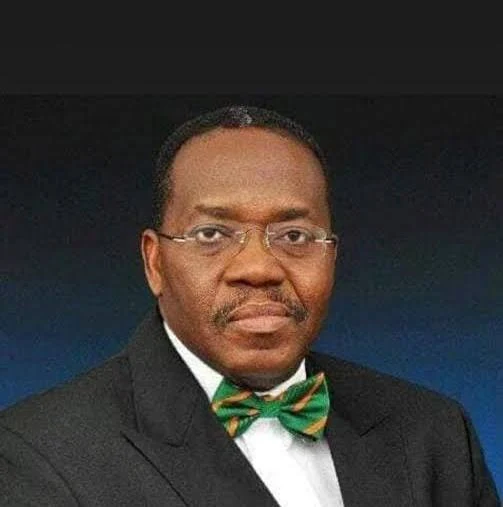

Nigeria’s biggest challenge is not its diversity but a political structure that has concentrated too much power, money and responsibility at the centre, former Nigerian Ambassador Godknows Igali has argued.
Speaking at a national dialogue organised by the Concerned Citizens Assembly on the future of the federation, Igali said Nigeria must urgently rethink its federal arrangement if it is to restore productivity, accountability and sustainable development.
According to him, the country’s founding fathers understood that Nigeria’s diverse regions could only prosper when they had sufficient autonomy to harness their resources and pursue development according to their peculiar strengths.
He blamed the steady erosion of that principle on decades of military rule, which, he said, transformed Nigeria into an excessively centralised federation and weakened the incentive for states to produce wealth.
Igali said Nigeria’s earlier regional system encouraged healthy competition, with the Northern, Western and Eastern regions investing heavily in agriculture, education, industries and infrastructure.
That productive competition, he noted, has largely given way to a system in which many states depend on monthly federal allocations.
“When everybody is waiting for national finance, people are not producing,” he said, arguing that a functional federation must make governments responsible for developing the economic capacity of their own territories.
He cited the disappearance of the agricultural pyramids that once symbolised Northern Nigeria’s productive strength as an example of the consequences of the shift from production to revenue sharing.
For Igali, the fundamental question is not how much money Abuja can distribute but how effectively Nigeria can empower its constituent parts to create wealth.
The diplomat also renewed his support for state police, saying Nigeria’s security structure must reflect the realities of a vast and diverse federation.
He pointed to countries including the United States, Germany, Switzerland and India, where security responsibilities are shared among different levels of government.
Igali argued that Nigeria should develop appropriate safeguards to prevent abuse rather than reject decentralisation outright.
He equally called for local governments to be transformed from administrative extensions of higher authorities into genuine centres of grassroots development, capable of driving infrastructure, services and local economic activity.
Igali stressed that restructuring should not be equated with disintegration.
He urged Nigerians to move beyond the debate over whether the existing 36-state structure should remain and instead focus on finding a system that gives every part of the country greater responsibility for its own development.
“The 1979 Constitution tried to correct it. The 1999 Constitution has tried to correct it. Let the dialogue continue,” he said.
He maintained that constitutional reform should involve citizens directly, rather than being left exclusively to politicians.
“The people must talk. National Assembly can be there, but the people must talk,” he said.
Igali also cautioned against turning Nigeria’s ethnic, religious and regional differences into permanent political fault lines.
He argued that diversity should be used as a platform for negotiation and cooperation, not as a justification for division.
Despite his criticism of the present structure, the former ambassador said his advocacy for restructuring was driven by a desire to strengthen, rather than weaken, Nigeria.
“This is the country we have. It is the country of our parents, it is the country of our children,” he said.
For Igali, Nigeria’s survival depends not on forcing every decision through Abuja, but on building a federation where states and local governments have the freedom and responsibility to produce, innovate and compete.