

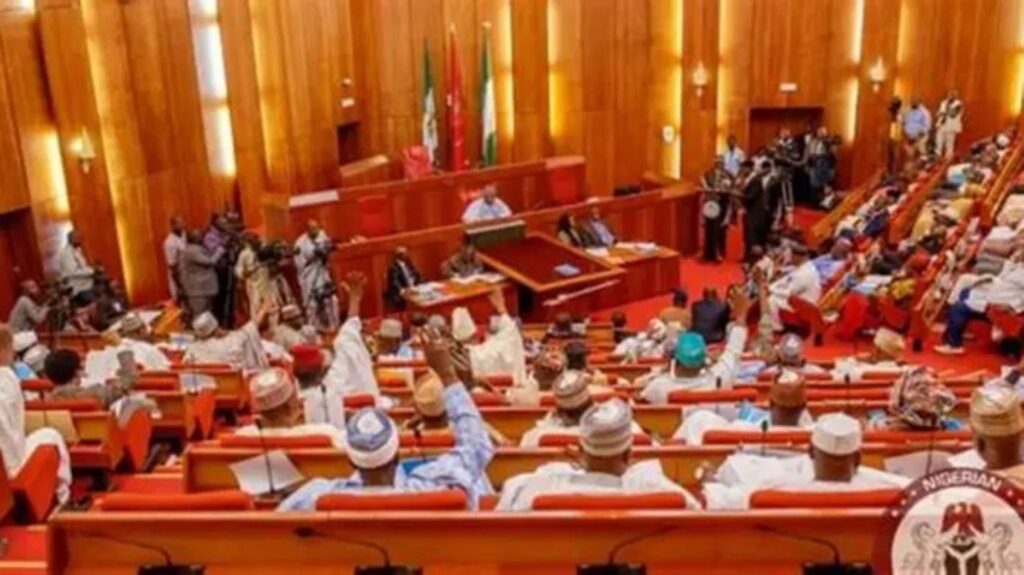

The Senate on Tuesday drew a constitutional battle line with government agencies and oil companies accused of disregarding legislative summons, as Senator Abdul Ningi declared that the National Assembly was “not an appendage of the Executive” and warned that those summoned must respect its authority.
Ningi, representing Bauchi Central and a member of the Senate Public Accounts Committee, issued the warning during a stormy session in which the committee gave Seplat Energy Plc, Network E&P Nigeria Limited, All Grace Energy Limited and Aradel Energy Limited 48 hours to appear and answer queries arising from the 2021, 2022 and 2023 audit reports of the Nigeria Extractive Industries Transparency Initiative (NEITI).
The committee, chaired by Senator Ibrahim Hassan Dankwambo, warned that failure by the affected companies’ Managing Directors to appear could trigger the full invocation of the legislative powers of the National Assembly.
Ningi’s intervention followed the absence of Seplat Energy’s Managing Director, who was represented by senior officials of the company.
The representatives explained that the Managing Director was unavoidably absent because of another official engagement.
But the explanation did little to soften the senator’s position, as he used the occasion to deliver a broadside against what he described as the growing tendency of institutions and organisations to treat the legislature with disdain.
“It is very important for all of us to understand the role of this body. The National Assembly, as an institution, has a constitutional responsibility to exercise oversight over the Executive, which is headed by the President and Commander-in-Chief.
“I want this to be placed on record: this Parliament is not an appendage of the Executive.”
Ningi insisted that the legislature was an independent arm of government with powers derived directly from the Constitution, not from the goodwill or discretion of the Executive.
“If you look at the Constitution, you will understand how important the legislature is. The Constitution has vested this institution with oversight powers, not only over government agencies but, in certain circumstances, over the Executive itself.”
He said the growing refusal or reluctance of some officials and corporate organisations to honour legislative invitations posed a threat to democratic accountability.
“We do not understand why some people are no longer taking the legislature seriously. The powers of the National Assembly are constitutionally guaranteed and should not be undermined.”
For Ningi, appearing before a legislative committee is not optional courtesy but part of the accountability obligations imposed by Nigeria’s constitutional order.
“This is why we are insisting on accountability. Representatives of organisations and agencies come before us, interact with us and listen to the issues we raise. What we are seeking is transparency, accountability and the protection of the public interest.”
The confrontation intensified when Network E&P Nigeria Limited reportedly informed the committee that the Nigerian Upstream Petroleum Regulatory Commission (NUPRC) was the regulatory body to which it was accountable.
Ningi described the position as “disturbing and provocative”, insisting that submission to NUPRC’s regulatory authority could not place an oil company beyond the scrutiny of the National Assembly.
He invoked Sections 88 and 89 of the 1999 Constitution, saying the provisions empowered the legislature to summon individuals, companies and agencies to explain issues arising within its oversight mandate.
“The Senate and, by extension, the National Assembly, is the custodian of Nigerian law that has power to invite anybody or agency for explanations on issues raised against them,” he said.
The senator’s position received backing from Senator Shehu Kaka Lawan, representing Borno Central, who urged the committee to move beyond warnings and invoke its constitutional powers against repeat offenders.
The committee subsequently directed Network E&P’s Managing Director to appear on Thursday.
Dankwambo delivered an unequivocal warning,
“Having failed to honour the invitation of this committee two consecutive times, the Managing Director of Network E&P Nigeria Limited should appear before us unfailingly on Thursday this week or risk full invocation of legislative powers against him.”
Similar 48-hour ultimatums were issued to the Managing Directors of Seplat Energy, All Grace Energy and Aradel Energy.
Amid the confrontation over legislative summons, Dubri Oil Company Limited appeared before the committee and challenged a $3.025 million liability attributed to it in the NEITI audit report.
According to the report, information supplied by NUPRC in 2025 showed that Dubri Oil had an outstanding liability of $3.025 million, comprising $2.378 million in gas-flare obligations and $646,605.55 relating to oil production.
But the company’s representative, Soyode Olusoji Clement, rejected the figures.
He explained that the liability resulted from a reconciliation problem between Dubri Oil and NUPRC when the information was compiled, insisting that the matter had since been resolved.
According to Clement, no outstanding debt remained against the company.
He submitted supporting documents to the committee.
The lawmakers said they would scrutinise the documents before deciding whether to grant Dubri Oil a clean bill of health in respect of the NEITI query.
The proceedings marked a significant assertion of legislative authority, with Ningi’s declaration providing the defining message: the National Assembly will not accept a subordinate role in Nigeria’s constitutional structure.
The senator’s remarks came as the committee tightened its grip on oil companies facing queries over revenue, royalties, gas-flaring obligations and other matters contained in NEITI’s audit reports.
The 48-hour ultimatum therefore goes beyond the attendance of four Managing Directors. It represents the committee’s attempt to test whether its constitutional summons will be obeyed—and whether institutions operating in Nigeria’s lucrative oil sector will submit to the same accountability mechanisms expected of other public and private entities.
Ningi’s message was unmistakable: the Executive may exercise executive power, regulators may exercise regulatory authority, and companies may conduct their businesses—but none can place itself above the constitutional oversight of the National Assembly.