

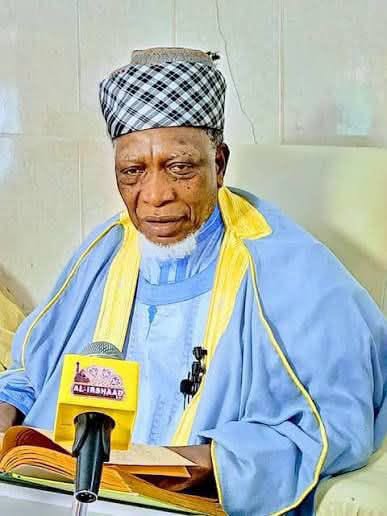

Former Minister of Youth and Sports, Solomon Dalung, has challenged the reported comments of Sheikh Yahaya Jingir on the Muslim-Muslim presidential ticket, warning against reducing Nigeria’s democracy to a contest over religious numbers.
Dalung, in a strongly worded reaction, questioned the reported argument that continued support for a Muslim-Muslim ticket should be justified by the numerical strength of Muslims in the country.
He described such reasoning as a dangerous departure from the central questions of democratic governance, arguing that the value of a political ticket should be measured by what it delivers to citizens rather than the religion of the individuals occupying the offices.


According to reports cited by Dalung, Jingir had urged Muslims to continue supporting the Muslim-Muslim ticket on the grounds that it demonstrated that Muslims were more numerous than Christians in Nigeria, while also reportedly calling on Muslims to “show infidels their limit.”
Dalung said such language risked deepening religious divisions in a country whose political stability depends heavily on citizens recognising one another as equal stakeholders.
“So, according to Sheikh Yahaya Jingir, a Muslim-Muslim ticket is now a census?” Dalung asked.
“This is where political argument becomes dangerous nonsense.”
He argued that religious identity, by itself, could neither feed families nor solve the problems confronting Nigerians across faiths.
“A Muslim-Muslim ticket does not put food on a Muslim family’s table. It does not secure a kidnapped Muslim farmer. It does not give a Muslim child a good school. It does not reduce the price of fuel, food or medicine,” he said.
“It does not create jobs. It does not fix a broken road or keep electricity on.”
For Dalung, the argument over the religious composition of political leadership should therefore not be allowed to overshadow the issues that directly determine the quality of life of citizens.
He said Nigerians facing insecurity, unemployment, inflation, poor infrastructure and declining purchasing power were unlikely to regard the religious identity of political office holders as a substitute for effective governance.
Dalung was particularly critical of the reported use of the term “infidels”, asking who, in the Nigerian context, should be regarded as falling within such a category.
“Who exactly are these ‘infidels’ in Nigeria?” he asked.
“Your fellow citizens? Your neighbours? The people whose taxes help fund the government? The Christians who have voted for Muslim candidates? The Muslims who reject religious politics? The millions of Nigerians who simply want competent leadership regardless of whether the candidate prays in a mosque or a church?”
He argued that Nigeria’s diversity should be treated as a national asset rather than a basis for religious competition.
“Nigeria is not a religious battlefield where one faith must establish its superiority over another,” Dalung said.
The former minister acknowledged that supporters of a Muslim-Muslim ticket were entitled to make a case for it, but insisted that the argument should be based on measurable issues such as competence, justice, security, economic development and good governance.
“If a Muslim-Muslim ticket is supposed to be defended on the basis of competence, justice, security, economic progress and good governance, then defend it on those grounds,” he said.
“But if the argument has now become ‘we are more in number, therefore we should dominate,’ then we have moved from democracy into religious arithmetic.”
Dalung’s criticism comes against the backdrop of continuing political debate over the religious composition of presidential tickets in Nigeria, particularly ahead of the 2027 general elections.
The issue has remained politically sensitive because Nigeria’s electorate is religiously diverse, with political parties routinely balancing religious, ethnic and regional considerations when selecting candidates.
But Dalung argued that electoral politics should ultimately be about the interests of citizens rather than the numerical superiority of one faith over another.
He maintained that Nigeria belongs equally to Muslims, Christians and citizens who subscribe to neither faith.
“Nigeria belongs to Muslims and Christians, and also to Nigerians who do not subscribe to either faith,” he said.
“Nobody needs to be ‘shown their limit’ because of the religion they profess.”
According to him, the real test of political leadership should be whether Nigerians are shown tangible improvements in their daily lives.
“What Nigerians should be shown is good governance, justice, security, jobs, affordable food, functioning hospitals and schools, and a government that treats every citizen as equal,” he said.
Dalung said this was the form of majority that should matter in a democracy.
“That is the kind of majority that matters in a democracy,” he said.
“Not the majority in a mosque. Not the majority in a church. The majority of Nigerians who want a country that works.”
He warned that turning religious demographics into a political weapon could weaken national cohesion and distract from the responsibility of political leaders to deliver for citizens irrespective of their faith.
For Dalung, the fundamental question before Nigerians should therefore not be which religion has more followers, but whether those entrusted with political power can provide security, economic opportunity and equal treatment for all.
The former minister’s intervention effectively reframed the Muslim-Muslim ticket debate as a question of what should constitute political legitimacy in a plural society: **religious numbers or the ability to deliver competent and inclusive governance.**