

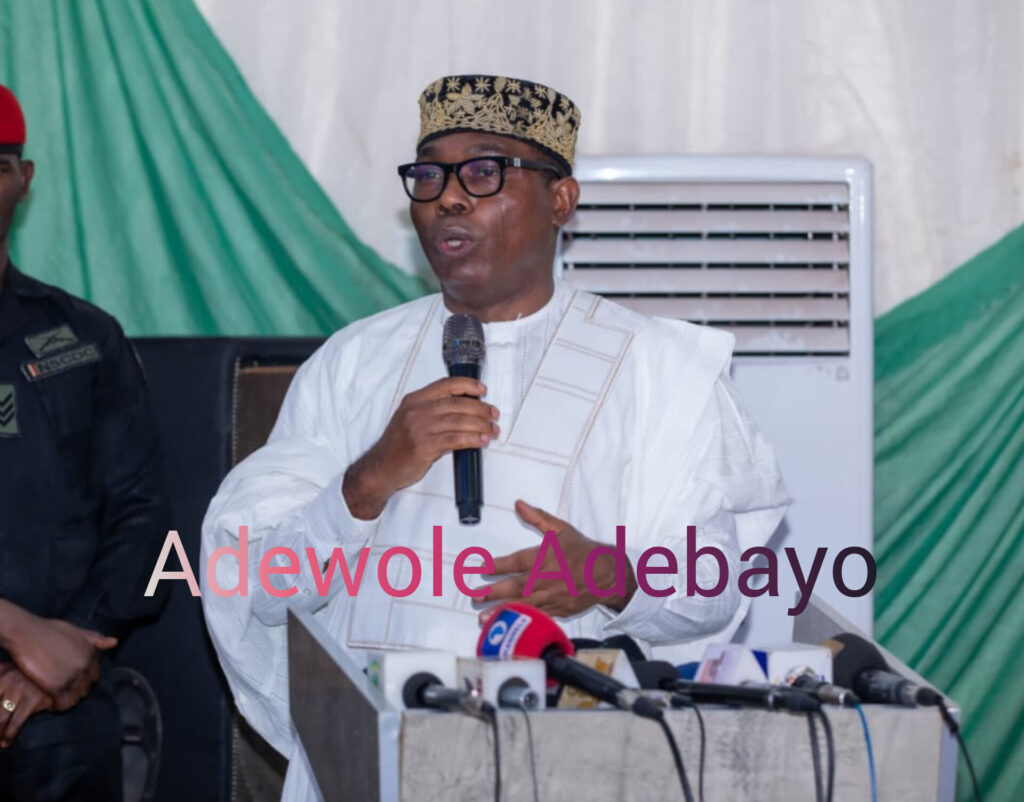

The 2027 presidential candidate of the Social Democratic Party (SDP), Prince Adewole Adebayo, has presented a reframed assessment of Northern Nigeria’s challenges, arguing that the region’s core issue is not insecurity, poverty, or demographic growth, but a persistent deficit in leadership, accountability, and governance culture.
Speaking at the Arewa Awareness Summit on Unity Against Insecurity in Kaduna, Adebayo challenged the prevailing perception of Northern Nigeria as a national burden. Instead, he described the region as a vast reservoir of human and economic potential capable of driving Nigeria’s development and contributing significantly to progress across the Sahel and West Africa.
Addressing an audience comprising traditional rulers, academics, political stakeholders, and civil society representatives, the SDP flag bearer observed that public discourse on the North often emphasizes its challenges while neglecting the existing pathways to transformation within the region.
“Nobody is too blind or too deaf not to know that these problems exist. The real challenge is finding the solutions, and the solutions are already within Northern Nigeria,” he said.
Adebayo, who described himself as a “Northerner by choice,” noted that his long-standing engagement with the region—through residence, professional activity, and investment—has provided him with a deep appreciation of its underutilised strengths.
Reframing the dominant narrative, he stated: “The North is not Nigeria’s problem. The North is Nigeria’s greatest asset. It is the future not only of Nigeria but of the entire Sahel and West Africa.”
He also addressed concerns about population growth, arguing that what is often portrayed as a burden is, in fact, a strategic advantage in a global context.
“Countries such as Japan, China and many European nations are grappling with declining populations and ageing workforces. Some are incentivising citizens to have more children due to shortages in human capital. Northern Nigeria already possesses what those countries are seeking. Our challenge is not population; our challenge is leadership.”
According to him, Nigeria’s governance challenges are not structurally insurmountable, but are largely dependent on the quality of leadership and political will.
“There is no problem Nigeria is facing today that good governance and responsible leadership cannot substantially resolve within three years,” he said.
Adebayo further called for a shift in electoral behaviour, urging Nigerians to move beyond identity-based politics and prioritise competence, capacity, and measurable performance.
“In a democracy, nobody comes to power except through the will of the people. If we elect leaders who understand our problems and assess them strictly by their performance, they will be compelled to deliver.”
He described elections as a peaceful mechanism for national renewal, enabling citizens to replace ineffective leadership without conflict or instability.
Corruption, he warned, remains a critical impediment to progress, capable of undermining even the most well-designed policies and institutions.
“It does not matter how well you design government policies or institutions. If corruption remains unchecked, the system will continue to fail,” he said.
Turning to economic development, Adebayo advocated increased investment in agriculture and other productive sectors, citing his own agricultural engagements in Northern Nigeria as evidence of the sector’s capacity to generate employment and sustain livelihoods.
He said his farming ventures currently provide direct employment to hundreds and indirectly support thousands across the region.
He also called for a restructured education system that integrates Western and Islamic learning traditions, aimed at producing young Nigerians who are both intellectually equipped and grounded in cultural values.
According to him, such integration would expand educational access while preserving the identity and moral foundations of Northern communities.
Concluding his remarks, Adebayo urged citizens of the North to reject fatalism and embrace their democratic agency.
“We are not as powerless as we think. If we vote according to our conscience, insist on accountability, and choose leaders based on what they can do—not what they promise—Nigeria will triumph,” he said.