

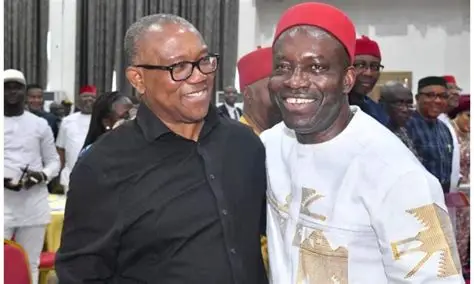

LAnambra State Governor, Chukwuma Charles Soludo, is facing a wave of criticism following his decision to mobilise support for President Bola Tinubu’s re-election, with angry reactions to his announcement exposing the political risks of his alliance with the ruling All Progressives Congress (APC).
Soludo had announced the inauguration of an Anambra State structure to coordinate support for Tinubu’s second-term bid, describing the move as a strategic decision to secure the South-East’s political relevance and attract federal infrastructure projects.
But the governor’s attempt to sell the alliance has met stiff resistance from many commenters on his social media page, who questioned his political judgment, commitment to Igbo interests and the implications of aligning APGA with the APC.


Rather than welcome the announcement, many respondents used the opportunity to vent their frustration, with some warning that Soludo could pay a heavy political price for his decision.
Defending his position, the governor argued that politics should be guided by reason rather than emotion, insisting that the Igbo must build relationships with the political centre instead of remaining on the sidelines.
He cited the political traditions of Nnamdi Azikiwe, Alex Ekwueme and Evan Enwerem Okadigbo, arguing that previous Igbo leaders understood the importance of engaging with the centre.
Soludo also maintained that APGA and APC share progressive values, including true federalism and shared prosperity, adding that Anambra cannot deliver major infrastructure projects such as railways and gas pipelines without federal support.
He further argued that Tinubu had supported Anambra despite receiving just over 5,000 votes in the state during the 2023 presidential election.
According to him, a stronger electoral endorsement could position the state to attract greater federal benefits.
However, it was his argument about the future rotation of presidential power that appeared to generate another layer of controversy.
Soludo warned that after the South completes its second term, power would return to the North before potentially rotating back to the South around 2039.
He questioned where the Igbo would stand if they failed to build alliances with political forces at the centre.
But critics were unimpressed, with some accusing the governor of using the argument of regional inclusion to justify an alliance they consider contrary to Igbo political interests.
The reactions also went beyond the Tinubu endorsement, exposing wider dissatisfaction with Soludo’s administration.
Some commenters questioned the state of projects and campaign promises, including the Ekwulobia flyover and the governor’s earlier references to Dubai and Taiwan.
Francis Oruche, for instance, challenged Soludo over the reported non-functionality of the Ekwulobia flyover despite its completion.
Adaora Nriezedi Otti urged the governor to pay attention to the comments, arguing that the reactions showed he was losing the confidence of many people.
Miracle Ozoagu also warned that betraying political allies could make it difficult to earn their trust.
Although the comments do not constitute a scientific assessment of public opinion in Anambra, their tone points to the political difficulty Soludo may encounter in persuading voters to embrace his new alliance.
The controversy has equally placed APGA in an uncomfortable position.
Soludo’s decision to mobilise for an APC president has raised questions about the party’s independent identity and whether its supporters will accept an arrangement that brings it closer to the ruling party.
Some commenters openly warned that the alliance could damage APGA’s electoral fortunes, with one describing the emerging relationship as “APCGA”.
Others predicted that the party could lose its political relevance if it became too closely identified with the APC.
For Soludo, the calculation appears to be that political access to the centre will translate into federal projects and greater influence for Anambra.
But the growing criticism suggests that many of those he hopes to convince are demanding more than promises of access and political relevance.
They want evidence that the alliance will deliver tangible benefits and advance the interests of the South-East.
The governor may see his decision as a strategic investment in Anambra’s future. His critics, however, see a political gamble that could weaken his standing and deepen divisions within APGA.
With the 2027 elections approaching, Soludo faces the difficult task of convincing voters that his support for Tinubu serves the interests of Anambra rather than his own political calculations.
The ultimate test will be at the ballot box, where neither political calculations nor social media declarations can substitute for voters’ verdict.