

By Douglas Baye-Osagie
_dbayeosagie@yahoo.com_
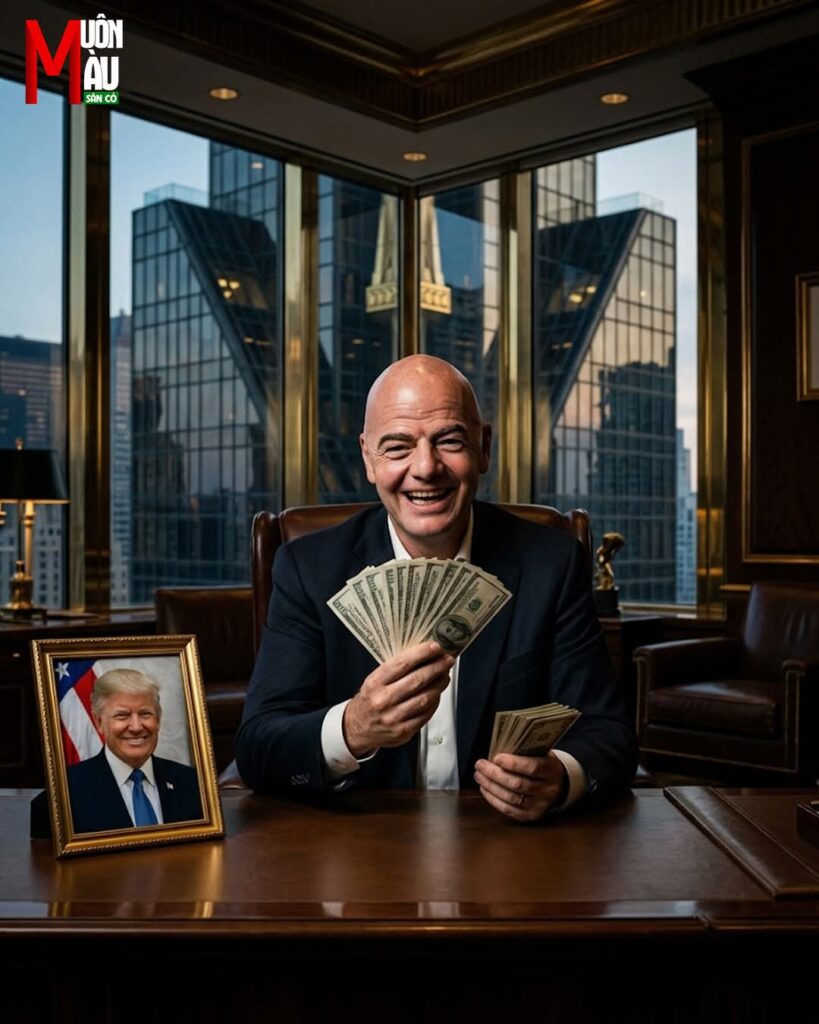
Donald Trump, the self-styled mighty overseer of world politics, has laid his hands on Gianni Infantino’s forehead. All we hear now is more money from commercials, a redefining of the rules of the game, the expansion of the World Cup, and more money to football federations for “the development of the game.”
Yet when corrupt football administrators, like some we have in Africa, receive these huge flows of millions of dollars, they cannot even clear the grass to get a stadium off the ground. We have seen it before. That money will be diverted into non-football ventures. The cheques arrive, the grass stays tall, and the “development” never reaches the pitch.

When Donald and Infantino are done and have their way, real fans will be priced out of the game. World Cup matches will cost a lifetime’s pension to attend. This is not good for the game. Football was never about the money to be won, but about fans coming together and building a united world.
Football is not a balance sheet. It is not a sponsorship deck. It is 90 minutes, a ball, and people who have loved it since childhood. Yet under Gianni Infantino, FIFA has decided football is primarily a product to be sold, packaged, and auctioned to the highest bidder.
The numbers are staggering, and they tell you everything. FIFA has generated record-breaking revenue of about $15 billion in the 2023–2026 financial cycle leading into and concluding the 2026 World Cup. That is nearly double the $7.57 billion from the 2022 Qatar cycle.
This marks the most financially lucrative cycle in the history of international football. And it was not an accident. It was a design. A design built on expansion, extraction, and excess.
The 2026 World Cup was ground zero for this experiment. Expanded to 48 teams and 104 matches, the tournament created dozens of extra commercial windows. More games meant more ads. More ads meant more money. Fans were an afterthought.
Broadcasting rights alone brought in approximately $3.9 billion to $4.2 billion. Ticket sales and hospitality surpassed $3 billion, driven by massive price hikes and the giant stadiums of North America.
Sponsorships and marketing contributed over $2.8 billion in corporate partnerships. Every corner flag, every interview backdrop, every minute of stoppage time was monetized.
FIFA allocated a record $655 million to $727 million in payouts to teams. The 2026 champions, Spain, took home $50 million. Roughly $10 billion was designated for “football development” and the 211 member associations.
FIFA’s take-home profit in 2026 alone surpassed its earnings in the last decade. So we must ask: with all this money, why is Infantino so bent on further over-commercialization of football?
Because $15 billion is not enough. Because once you start treating the World Cup like a tech IPO, the pressure to grow never stops. More matches. More tournaments. More pay-per-view. More.
But at what cost? The 2026 World Cup was the most commercialized in history. Real fans could not afford to go. Ticket prices skyrocketed to unprecedented amounts. A family of four was priced out before they even looked at flights.
Travel restrictions were like never before. Host cities spread across three countries. Visas, costs, and logistics turned what should be a festival of the world into an event for corporations and the wealthy elite.
The soul of the tournament was lost in the noise of hospitality lounges and VIP zones. The people who built football’s culture — the ones who sing, who travel on buses, who save for years — were locked out.
And where were the guardians of the game? Where were the small nations and confederations who should be shouting the loudest?
The near silence from Africa’s football house is deafening. While Europe and North/Central America are drawing lines in the sand against the sale of 20% of the World Cup and the endless commercialization, CAF is busy clapping for more “development funds.”
It’s the same old story: the daughter is impressed by gifts, the mother is calling out the tricks.
Oceania has been quiet. Confederations that represent the majority of FIFA’s 211 members have said almost nothing as the game is carved up and sold.
These are the same confederations that rely on FIFA development funds. That dependency has bought silence. When you take $10 billion in “development” money, it is hard to criticize the hand that writes the cheque.
But development without voice is not development. It is patronage. Small nations have been reduced to clapping while decisions that change the game are made in boardrooms thousands of miles away.
They accepted 48 teams as “inclusion” but did not fight for inclusion of fans. They accepted more money but did not demand more access. They accepted the expansion and called it progress.
This is how privatization works. Not by selling the World Cup outright, but by slowly turning every part of it into a revenue stream until the public no longer recognizes it.
That is why we must all support UEFA’s stand that the drive to sell 20 percent of the World Cup must be stopped. If we allow even a fraction of our greatest tournament to be privatized, we open the door for investors to dictate fixtures, kick-off times, and who gets to watch. The World Cup cannot become shares on a stock market.
Infantino’s money mongering will destroy football if we let it. Not tomorrow, but bit by bit. Fewer real fans in stadiums. More games that mean less. More tournaments that exist only to fill a broadcast slot.
Football does not belong to FIFA. It does not belong to sponsors. It belongs to the kid in Lagos kicking a ball barefoot. To the community in Fiji watching at 3am. To the people.
Fans must take their sport back. We must demand caps on ticket prices. We must demand tournaments that prioritize access over profit. We must demand that confederations like CAF and Oceania represent people, not just collect checks.
We must all stop Infantino. Not because we hate money, but because we love football. And football is the people’s game. If we do not fight for it now, there will be nothing left to fight for except the price tag.