

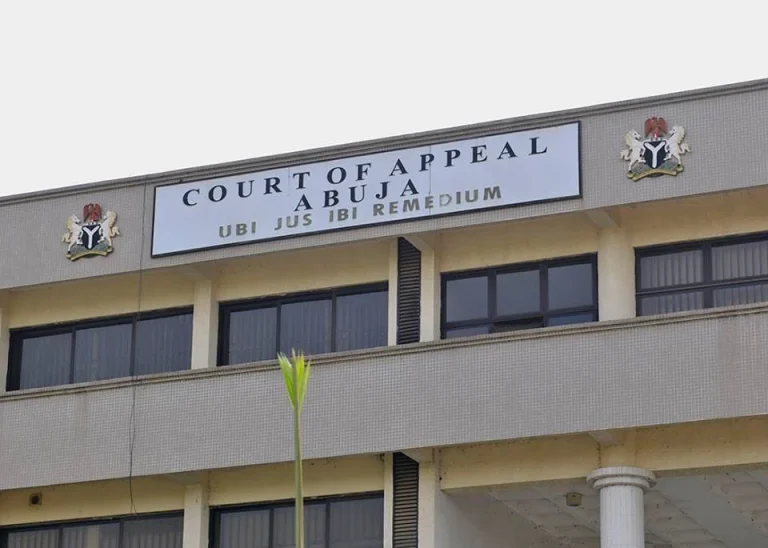

The Court of Appeal in Abuja has cleared a major legal hurdle confronting the African Democratic Congress and four other political parties ahead of the 2027 general elections, setting aside a Federal High Court judgment that ordered their deregistration.
In a unanimous decision delivered on Tuesday by a three-member panel led by Justice Abba Mohammed, the appellate court held that the Federal High Court lacked jurisdiction to entertain the suit that culminated in the deregistration order.
The court declared the June 15 judgment of Justice Peter Lifu a nullity, ruling that the case was incompetent because it was instituted by a non-juristic entity.


The decision effectively restores the legal status of the African Democratic Congress, Action Peoples Party, Action Alliance, Accord Party and Zenith Labour Party, all of which had faced the prospect of being shut out of the 2027 electoral process.
The Court of Appeal also faulted the conduct of the Federal High Court in proceeding with the matter despite an earlier order directing a stay of proceedings pending the determination of an interlocutory appeal.
The panel noted that Justice Lifu had been made aware of the May 22 order but proceeded to deliver judgment in the substantive case.
The appellate court described the action as “a form of judicial impertinence” and said existing Supreme Court authorities regarded such conduct as amounting to judicial rascality.
It consequently held that the Federal High Court ought to have dismissed the suit for want of jurisdiction and merit.
Beyond the jurisdictional issue, the appellate court also faulted the lower court’s assessment of evidence, particularly its failure to properly consider evidence that the affected parties had won elective positions in previous elections.
The Court of Appeal consequently allowed the separate appeals filed by the political parties, vacated the Federal High Court judgment in its entirety and awarded costs against the National Forum of Former Legislators, which instituted the suit.
The court further declared that all five political parties remain duly registered.
The judgment reverses the far-reaching consequences of the Federal High Court’s earlier ruling, which had directed the Independent National Electoral Commission to deregister the parties and barred the electoral commission from recognising them, accepting candidates sponsored by them or giving effect to their activities ahead of the 2027 elections.
The appellate court had earlier, on June 16, stayed the execution of the Federal High Court judgment pending the determination of the appeals.
Justice Lifu had based his judgment on arguments that the five parties failed to satisfy constitutional requirements for continued registration under Section 225A of the 1999 Constitution, the Electoral Act 2022 and relevant electoral regulations.
The plaintiff had argued that the parties failed to meet prescribed electoral performance thresholds, including securing at least 25 per cent of votes in a state during a presidential election or winning an elective seat at the national, state or local government levels.
The National Forum of Former Legislators further contended that the parties’ performance in the 2023 general elections and subsequent by-elections rendered their continued registration unconstitutional.
The Attorney-General of the Federation and Minister of Justice, Lateef Fagbemi, SAN, who was joined as a defendant, had supported the plaintiff’s position.
But the affected parties and INEC challenged the judgment at the Court of Appeal, asking the appellate court to overturn the deregistration order.
With Tuesday’s ruling, the Court of Appeal has now restored the five parties to the political battlefield, removing a major legal uncertainty surrounding their participation in the 2027 elections.
The judgment is particularly significant for the ADC, which has emerged as one of the opposition platforms attracting considerable political attention ahead of the next general elections.