


By Tunde Olusunle
With just over three months to go until Nigerians vote in the 2027 general elections, the script that the All Progressives Congress, (APC), has circulated — that Nigerians may grumble about President Bola Tinubu but will re-elect him anyway — is beginning to fray. _The Economist_ of Thursday, October 1, 2026, made that proposition in “Nigerians Dislike Their President, But May Re-elect Him Anyway.” It rests on three tired assumptions: incumbency is invincibility, a divided opposition is a defeated opposition, and cynicism will keep turnout so low that money and machinery can finish the job. Borno tells a different story. And Lagos, on Tuesday, September 29, 2026, told another. Tinubu returned that afternoon from Paris after a month-long sojourn billed as a working holiday. What awaited him on the streets of Lagos was not the choreographed welcome of old, but booing — raw, irreverent chants from young Nigerians. Lagos does not boo its son lightly. When it does, it is saying something has snapped.
To understand why that rupture may become a national tide, you must travel North. Borno, APC-governed, remains in the grip of an insurgency that has become an economy of its own — extortion, abductions for ransom, looted grain stores, farmers taxed until farms are abandoned. A 27-year-old grain trader in Maiduguri told me he now takes grain to Chad to sell because kinsmen cannot afford to buy. Young men pack and leave for Chad, Cameroon or Ghana, “because if you sit down here, there is no food.” This is the context in which Tinubu’s pitch — subsidy gone, naira floated, revenue up, inflation easing to about 15% in August, growth projected at 4.1%, collapses. Food inflation still hovers near 20%. One litre of petrol averages N1,500; diesel, which powers generators, is over N2,000 per litre; kerosene, when available sells for N1,950. In a country where minimum wage is N70,000. The World Food Programme, (WFP), says malnutrition is at its worst in ten years.

Dr Nura Tukur, who runs a _Save the Children_ clinic, reports a sharp spike in severely malnourished babies and anaemic mothers in three years, July being the worst since 2016. Aisha Umara arrived months ago with two of her triplets — one died on the road — each weighing 2.5kg at six months. She can now breastfeed, but to what home? A village policed by gunmen, a hut without food. What does a mother say to a child who survived starvation only to return to nothing? The weight of that was captured not by opposition but by one of Tinubu’s oldest allies. Senator Babafemi Ojudu — comrade from the anti-military struggle, wrote in an open Independence Day letter that hardship had become “the defining experience of too many Nigerians,” and progress must mean “food on the table, a child in school, treatment for the sick,” not projections. When a friend must publicly beg a President to “widen the circle” and commission independent polls because official briefings no longer capture reality, the fortress has cracked. His line, “No farmer should have to choose between tending a field and staying alive,” nationalises what the Maiduguri trader said.
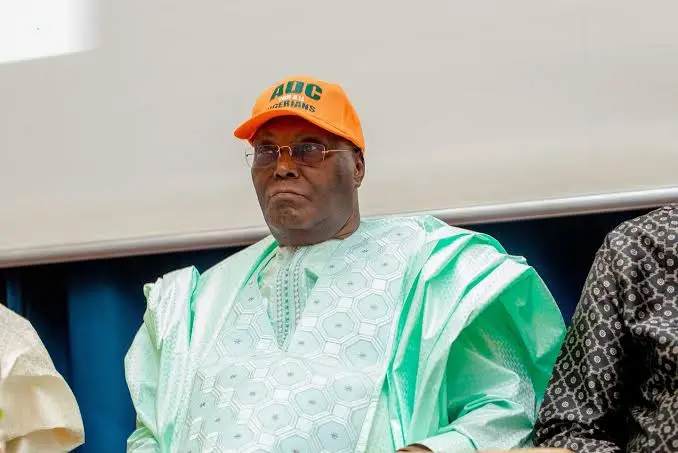
All this has cratered Tinubu’s standing in the North, where his party, not necessarily he himself, once had goodwill from the Buhari years. In 2023, he reportedly polled 54% in Borno. Recent SBM Intelligence polling now places him behind Atiku and Obi in that state. That is not a blip; it is a mood swing — articulate, historic bile against APC. The party that came in 2015 promising change is seen by many northerners as having institutionalised pain: markets of lies, politics as palliative rice, governance as press release. “Renewed Hope” has not provided succour even in its fourth year. In Maiduguri today, people don’t say they have given up on voting; they say they will “fight back” with the ballot. This is where Atiku’s final shot acquires potency. If Tinubu has no organic base in the North-East, Atiku is its native son — former Vice President, businessman with pan-Nigerian rolodex, who knows every emirate by name. He is not parachuting in. He is returning at a time northern Nigeria feels orphaned.
Atiku’s challenge rests on four pillars. First, memory and economic nostalgia. Northern traders, farmers, civil servants remember Obasanjo-Atiku years between 1999-2007 not as utopia but as relative predictability — debt relief, telecoms revolution, security, budgetary discipline, a sense government tried to make life cheaper, not dearer. That nostalgia is powerful when a mother must say thank you for paracetamol. Second, political arithmetic. Obi is popular with the urban youth and in the South-East, but the constitutional path to Aso Rock still runs through the North-West and North-East — Kano, Kaduna, Sokoto, Maiduguri, Yola, Bauchi. Atiku does not need a formal coalition with Obi to consolidate anti-APC vote, resentment itself is coalition. As Joachim MacEbong of _Control Risks_ put it, anti-APC vote may not be coalesced on paper, but on the ground is driven by hunger and humiliation needing no MoU. Third is the symbolism of presence versus absence. Tinubu’s long absence and manner of return have become campaign issues.
From his first interview upon landing on Tuesday, to his Independence Day engagements on October 1, to the premiere of the documentary on Chief Moshood Kashimawo Olawale Abiola, acclaimed winner of June 12, 1993, public commentary focused on energy, demeanour and delivery. At that premiere, widely circulated images showed him flanked closely by his wife, Senator Remi Tinubu, and aides. Whether fair or not, perception of a presidency being “managed” between foreign trips has become a political fact. Ojudu, with tenderness, opened his letter with “I hope your time away has brought you some rest.” Politeness from a friend confirming the month-long sojourn is now a political fact. Fourth, Atiku’s finality. This is his last shot, and Nigerians know it. There is moral clarity in a final battle. He is not building dynasty, he is closing circle, offering what Tinubu can probably no longer credibly offer to many: a bridge to the North that does not insult the North, market-friendly economics that does not punish the poor first, and a calm temperament that feels less combustible in a fraying nation.
But disaffection is no longer northern monopoly. That makes 2027 different. In the South-East, the terrain remains firmly Obi country. Every vote that goes to Obi in Anambra, Enugu, Imo, Abia, Ebonyi is a vote that will not return to the APC column. In the South-South, revolt has taken visceral, infrastructural form. Decrepit federal roads — where commuters spend nights on highways triggered open protests in Edo and Delta. A government that cannot move goods can not promise growth. And South-West itself, long presumed a given for Tinubu, is no longer given. In 2023, he lost Lagos to Obi, was flattened in Osun, and the Osun electorate voted against APC again in the most recent governorship, a local referendum of sorts. Oyo is tougher because incumbent Seyi Makinde, formidable operator, is himself pitching for presidency on the platform of the Allied Peoples Movement, (APM), and controls structures that will not be warehoused for Abuja. All these fractures whittle Tinubu’s numbers ward by ward.
Atiku, by contrast, is not without friendships across the Niger. Having spent substantial parts of working life in the South, customs postings, business, politics — he has built formidable relationships where his name does not sound foreign. Renowned banker and businessman, Akin Kekere-Ekun from Lagos State, was Chairman of the Board of Trustees of the American University of Nigeria, (AUN), Yola, owned by Atiku. Ben Ndidi Obi, CON, a revered statesman from Anambra State, is the Pro-Chancellor and Chairman of Council of the same institution. Atiku is, therefore, not a sectional candidate learning South; he is man with former colleagues, partners, friends, and godsons across it. The old argument says northern cynicism will keep turnout below 20% in Borno, 27% nationally in 2023, thus helping the incumbent because people who expect nothing won’t vote. That was true when suffering was resigned. It is less true when suffering is angry. Hunger, unlike disappointment, mobilises. APC strategists bank on religion, believing the Muslim-Muslim ticket with Kashim Shettima still insures North. Governor Uba Sani of Kaduna has moved smartly to redress the secular injustice of Nasir el-Rufai, his predecessor, by picking Christian running mate Jerry Adams for 2027.
But northern voters are not voting catechism. They are voting survival. At some point, as Cheta Nwanze of SBM argues, people stop trusting God and government and start trusting their own rage. That rage needs vessel. What if that vessel is Atiku? If the Lagos boos of September 29 were the sound of a fortress cracking, and Independence Day optics of October 1 were picture of presidency that looked laboured and tired to many viewers, then January 2027 may not be the expected coronation. It may be reckoning. Ojudu ended his letter with prayer that Tinubu should “finish well” and a reminder that credible election must be protected, security neutral, INEC truly independent, and President ready to accept verdict. That too reminds us democracy, the very freedom Ojudu and Tinubu fought for under Abacha, is larger than any incumbent. It may be the moment Nigeria decides it does not have to re-elect a man it “dislikes” because it is told there is no alternative.
There is an alternative. He is from Adamawa. He has waited thirty years. He will be 80 on November 25, 2026, a milestone he intends to mark with the Founder’s Day and groundbreaking of specific projects in AUN, Yola And this time, the wind may finally be at his back. In that final accounting, two outcomes become plausible where once only one was imagined: an outright Atiku triumph on the wave of cross-regional discontent, or, for first time in presidential annals in Nigeria, a runoff, the type engendered by the Brazilian presidential election which has compelled the scheduling of a rerun for Sunday October 25, 2026. There, the myth of invincibility may finally meet the arithmetic of rejection.
Tunde Olusunle, PhD, Fellow of the Association of Nigerian Authors, (FANA), is also a Fellow of the Nigerian Guild of Editors, (FNGE)