A convergence driven less by convenience and more by urgency has pushed former presidential candidate Peter Obi and former Kano State Governor Rabiu Musa Kwankwaso into the Nigeria Democratic Congress (NDC), in what is fast becoming the most consequential opposition realignment ahead of the next electoral cycle.
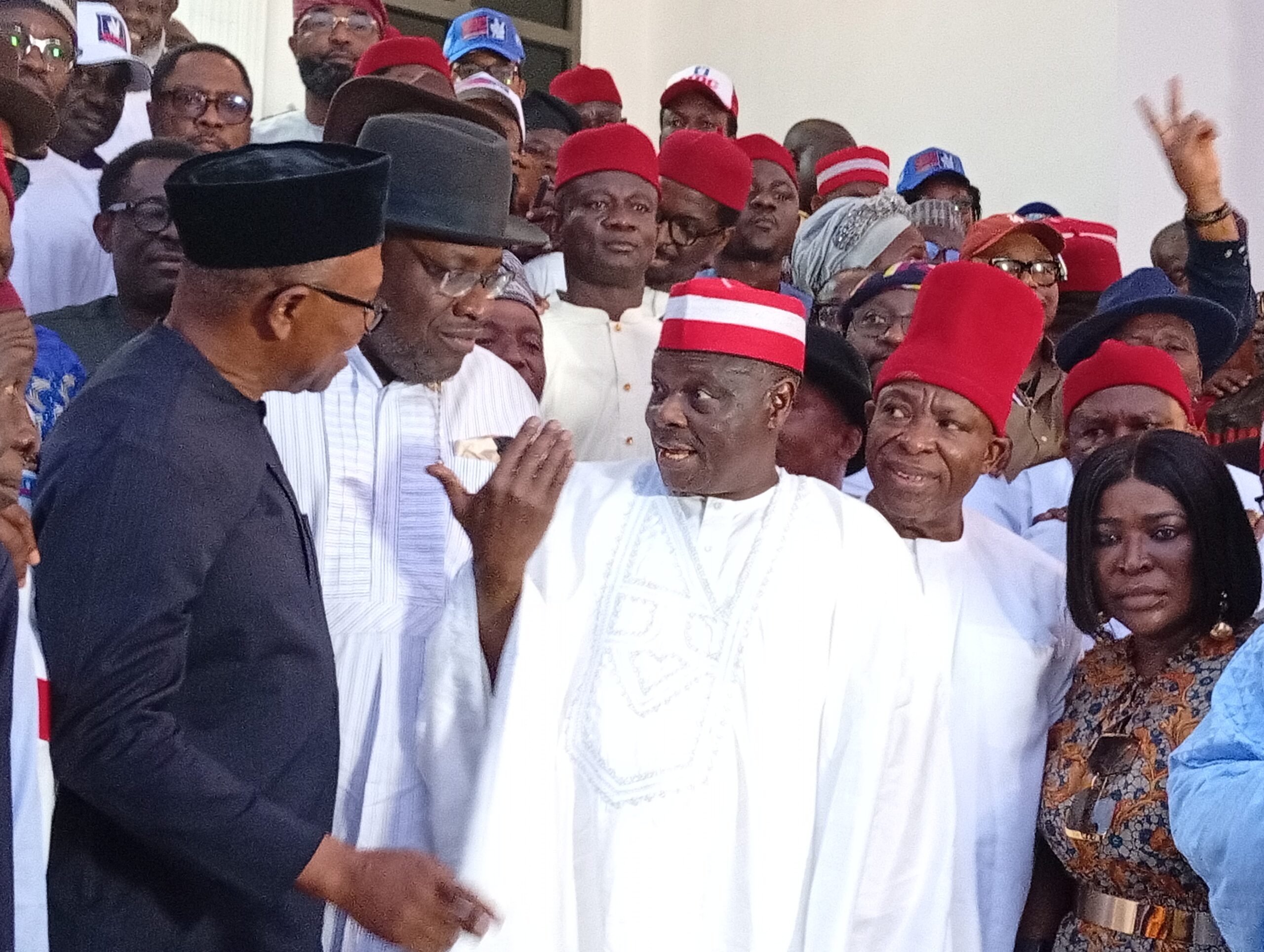
What began as months of speculation ended in decisive political action in Abuja, where both men formally aligned with the NDC after a series of consultations, signalling a shift from hesitation to necessity in Nigeria’s increasingly pressured opposition space.
The Obi–Kwankwaso entry is not merely another defection—it is the product of what both camps describe as a constricting political environment defined by internal party crises, prolonged litigation, and alleged destabilisation within opposition ranks.
Both leaders had, at different points, explored alternative platforms, including the ADC, but sources say persistent instability and uncertainty forced a rethink, narrowing their options as electoral timelines tightened.
The result is a move shaped as much by timing as by strategy.
Insiders describe it as “deadline politics”—a race against the clock to secure a viable, stable platform before procedural windows close.
At the Abuja engagement that sealed the alignment, Obi delivered what many interpreted as both a warning and an appeal—calling on political actors, particularly within the ruling establishment, to allow democratic processes to function without disruption.
“We must stop fighting ourselves and focus on the Nigerian people,” he said, cautioning that endless internal conflicts and court battles have diverted attention from insecurity, poverty, and economic hardship.
His message was clear: a democracy constantly in crisis cannot deliver governance.
Kwankwaso, more measured but equally deliberate, framed the decision as one rooted in alignment and viability. He pointed to shared priorities with the NDC leadership—education, youth empowerment, and national cohesion—while urging supporters to quickly key into the party’s structure given the limited window for participation.
Together, their messages revealed a dual logic: reform urgency and political survival.
The NDC’s sudden rise in relevance lies in what it offers at a moment of systemic instability—relative legal calm, organisational flexibility, and the absence of entrenched internal factions.
For two politicians navigating fractured political terrains, that combination has proven decisive.
Welcoming them, the party’s national leader, Seriake Dickson, cast the NDC as an ideological platform rather than a transactional vehicle, positioning it as a home for a new political direction anchored on inclusion and transparency.
Party chairman Moses Cleopas went further, framing the moment as part of a broader “national rescue mission,” an attempt to convert political frustration into structured mobilisation.
Beyond the formal alignment, the deeper shift lies in the fusion of Obi’s Obidient base and Kwankwaso’s Kwankwasiyya structure—two of the most organised political movements in the country.
Their coming together under a single platform signals the emergence of a coordinated grassroots bloc that cuts across regional and demographic lines, combining youth-driven mobilisation with northern political discipline.
This is not just a party story—it is a movement story.
Sunday’s development marks a departure from Nigeria’s long-standing pattern of fragmented opposition politics, where multiple weak platforms compete rather than consolidate.
What is emerging instead is a coalition defined less by party identity and more by shared pressure—pressure from timelines, from supporters, and from a political environment seen as increasingly restrictive.
Yet, the real test lies ahead.
Can this convergence hold under the weight of ambition?
Can a movement sustain coherence once power calculations begin?
Can urgency translate into structure?
In the end, Obi and Kwankwaso did not just choose the NDC—the moment chose them.
Faced with narrowing options, rising instability, and ticking political deadlines, the decision became inevitable.
And with it, Nigeria’s opposition landscape has shifted—from scattered voices to what could become a single, coordinated force.
Whether that force endures or fractures will define the next phase of the country’s political evolution.