

Nigeria’s National Bureau of Statistics (NBS) has announced plans to include previously unaccounted-for illegal and hidden activities in its GDP calculations.
This ground breaking move aims to provide a more accurate picture of the economy, which has seen a decline in global ranking, falling to the fourth-largest in Africa.
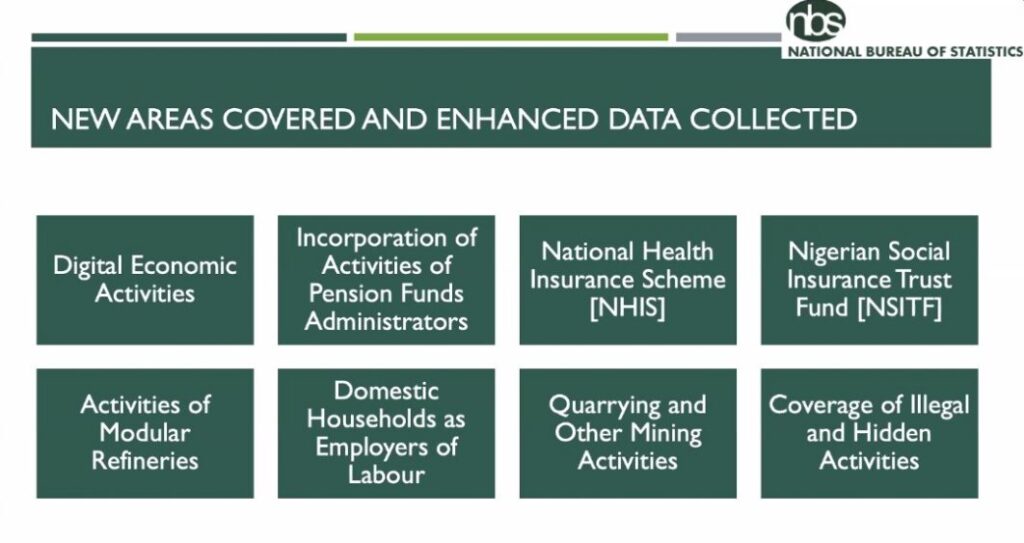
The new GDP framework will incorporate activities such as black-market dealings, the digital economy, and household labor, alongside conventional sectors.
Senior NBS official Moses Waniko highlighted the economic impact of informal and even illegal activities, like prostitution, on the formal economy.
Moses Waniko, a senior official at the National Bureau of Statistics (NBS), said the new exercise could show that Nigeria has a bigger economy than currently estimated.
“There are economic activities that have no legal backing,” he said, citing prostitution. “The practitioners earn income from them and sometimes live bigger than those in the formal sector. At the end of the day, the income earned impacts the formal economy,” Waniko said.

Waniko said a new calculation was necessary to reflect changing economic realities.
It will consider 2019 as the base year, he said, adding that new segments to be considered in the calculation include the digital economy, health and social insurance, pensions, modular refineries, mining and households employing labour.
“We expect that the size of the economy will be bigger,” he said.
“The tax-to-GDP ratio is something that people may want to see… Debt to GDP ratio of 18.5 percent as of September 2019 could also reduce with the bigger size of the GDP, and then per-capita income will increase after the rebasing.”
He said the contribution of the crude oil sector to the economy had reduced, dropping from third place to fifth.
The real estate sector is now in third place after agriculture and trade.
This recalibration, the first since 2014, could significantly expand Nigeria’s economic size, recalibrate tax and debt ratios, and potentially restore its position as Africa’s leading economy.