


Joohyun Moon
(Professor of Energy Engineering in the Department of Dankook University, ROK)
North Korea has recently shocked the international community by reportedly deploying troops to Russia amid the ongoing war in Ukraine. Though the exact scale and role of these soldiers remain unclear, experts suggest that North Korean involvement could significantly impact both the Russia-Ukraine war and the security dynamics on the Korean Peninsula. This deployment highlights the regime’s persistent prioritization of militaristic goals over the well-being of its people, raising critical questions about human rights abuses within North Korea.
North Korea’s troop deployment to Russia appears to be driven by several strategic motives, with the primary goal of solidifying its alliance with Moscow. In June, a “Comprehensive Strategic Partnership Treaty” was signed between North Korea and Russia, ratified by the Russian State Duma in October.
This alliance extends beyond mere diplomatic formalities; North Korea seems to believe that a “blood alliance forged on the battlefield will better secure its future. Kim Jong-un’s administration likely believes that only deep ties with powerful nations like Russia can preserve its regime.
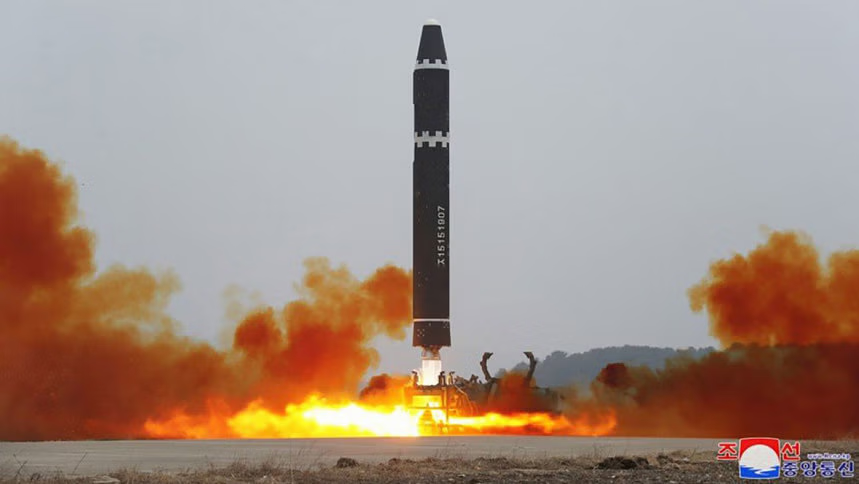
Additionally, Pyongyang’s relentless pursuit of nuclear and missile advancements has long overshadowed the welfare of its people. During the severe famine of the 1990s, known as the “Arduous March,” millions died of starvation while the regime prioritized nuclear development, culminating in its first nuclear test in 2006. Today, the state has achieved miniaturization and standardization of nuclear warheads, yet it continues to seek further advancements. Russia possesses critical technologies in re-entry capabilities for intercontinental ballistic missiles, reconnaissance satellites, and nuclear-powered submarines—all elements North Korea seeks to bolster its military power.
Possessing such technology would enable North Korea to pose a greater threat not only to South Korea but also to other neighbouring countries and even the U.S., further destabilizing the already fragile security landscape in the region. The North Korean regime’s decision to send its soldiers into a foreign war for combat experience marks another dimension of its strategic ambitions. North Korea’s forces, though numbering 1.2 million active-duty personnel, lack real-world battle experience. Engagement in intense warfare could provide its soldiers with valuable combat exposure.


If this deployment is paired with potential technology transfers from Russia, North Korea could significantly enhance its military capabilities, posing an even greater threat to South Korea and neighbouring countries. Financial motives likely play a role in this deployment. While it is not confirmed, each North Korean soldier is reportedly paid around $2,000 per month.
This means that if, as reported by the media, 12,000 soldiers are deployed, the total would amount to $24 million per month—funds that would almost certainly be funnelled to the regime. North Korea’s economy has long struggled under international sanctions, and though this deployment may offer some financial relief, these gains come at a tragic cost. Many young soldiers face a high likelihood of casualties, with former Ukrainian Défense Minister Andriy Zahorodnyuk estimating a 90% casualty rate for similar front-line forces.
For the North Korean regime, sending soldiers to fight in a distant war is a calculated exchange of lives for money, with little regard for individual safety or family consequences. Beneath these moves lies a much darker reality of widespread human rights abuses. Reports indicate that families of soldiers deployed to Russia are being forcibly relocated and isolated, likely to prevent desertion and dissent. Given that North Korea’s fertility rate is estimated between 0.9 and 1.2 as of 2024, it is likely that many of these soldiers are the only children in their family, dispatched into peril without just cause by the regime.
This grim tactic reflects a deeply engrained disregard for human life and familial bonds, raising moral questions that demand international attention. Human rights abuses in North Korea, however, extend far beyond these soldiers and their families. For decades, the North Korean population has endured extreme deprivation and systemic abuse.
Residents in regions near the country’s nuclear test site reportedly suffer from radiation exposure due to leaks and contamination of nearby rivers. This has led to increased health problems and even birth defects, a consequence of unregulated nuclear testing near civilian areas. According to South Korea’s Transitional Justice Working Group, over a million people live within 40 kilometers of the nuclear test site, relying on rivers that carry radioactive materials and compromising their health and livelihoods.
Furthermore, Kim Jong-un’s recent rhetoric surrounding a “two states concept, implying that reunification with South Korea is impossible, suggests an intention to deepen the country’s isolation from its southern neighbour. The recent destruction of inter-Korean transportation links aligns with this agenda. By controlling the flow of information from South Korea, North Korea aims to suppress awareness among its population of their own reality, particularly the stark contrast between North and South Korea. This isolation is enforced not only through physical barriers but also by a brutal system of control that includes public executions. Reports of teenage students being executed merely for watching South Korean videos illustrate that public executions have become routine in North Korea.
The international community must not merely bear witness to these abuses. Concrete actions can and should be taken to address the plight of North Koreans.
A stronger, united front of international pressure is crucial to compel the North Korean regime to improve the human rights situation for its people. This could include expanding existing sanctions, particularly those targeting the regime’s financial sources that fund its military programs. An increased focus on human rights abuses in North Korea in international forums, such as the United Nations, can help elevate awareness and mobilize diplomatic efforts.
Countries with diplomatic ties to North Korea should leverage their influence to push for greater transparency in Pyongyang’s human rights record. Humanitarian aid, when provided, should be carefully monitored to ensure it reaches those in need rather than the regime. Moreover, international media must continue to expose the North Korean regime’s oppressive practices to keep the global community informed and engaged.
Ultimately, creating lasting change in North Korea requires consistent, collective pressure. The world must not only monitor the regime’s future outward actions but also remain vigilant about ongoing abuses that threaten the lives and dignity of ordinary North Koreans. By shining a light on these hidden atrocities and urging action, the international community can play a pivotal role in advocating for the rights of the North Korean people. (The End]