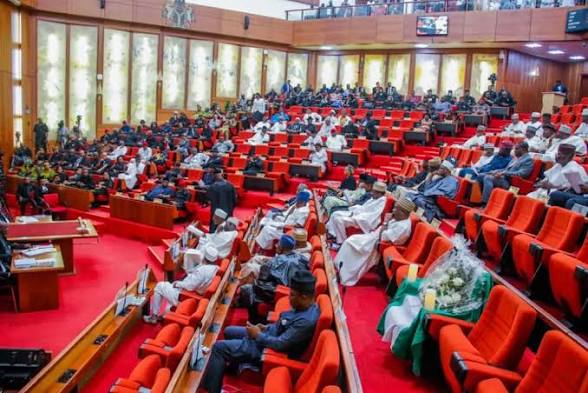
Nigeria’s push to redraw its economic geography took centre stage at the Senate on Wednesday as lawmakers began consideration of a $516.3 million external loan request for the proposed Sokoto–Badagry Superhighway — a 1,000-kilometre infrastructure spine designed to link the far north to the Atlantic coast.
The request, transmitted by President Bola Ahmed Tinubu, seeks approval for a syndicated financing arrangement structured through Deutsche Bank AG, with risk guarantees from the Islamic Corporation for the Insurance of Investment and Export Credit (ICIEC), under the Islamic Development Bank framework.
The proposed highway is more than a transport project. Stretching from Illela in Sokoto State to Badagry in Lagos, it is positioned as a strategic north–south trade corridor passing through Kebbi, Niger, Kwara, Oyo and Ogun States.
Government projections say the corridor will cut travel time between Sokoto and Lagos from about 13 hours to nearly six, while lowering logistics costs and improving national supply chains.
It also includes provisions for future rail expansion and utility infrastructure, signalling a long-term multi-modal transport corridor rather than a standalone highway.
Under the financing plan, the Federal Government will commit ₦265.5 billion in counterpart funding for land acquisition, compensation, and supporting infrastructure. The loan carries a nine-year tenor, a three-year grace period, and an interest rate tied to SOFR plus 5.3 percent.
The project has already received Federal Executive Council approval and is part of the administration’s Renewed Hope infrastructure agenda.
At plenary, Senate President Godswill Akpabio referred the request to the Committee on Local and Foreign Debts, directing a swift review within one week.
But rather than treat it as a routine borrowing request, lawmakers framed it as a generational infrastructure decision with long-term economic consequences.
Senator Adamu Aliero described the highway as a long-delayed national project that has lingered on planning tables for decades, arguing that its completion could fundamentally reshape trade flows between northern production zones and southern markets.
He noted that sections already under construction reflect modern engineering standards, including reinforced concrete pavements and solar-powered lighting systems.
While supporters argue the highway is a catalyst for trade, food distribution, and national integration, the scale of borrowing has also placed scrutiny on Nigeria’s debt strategy — particularly at a time of fiscal pressure.
Akpabio acknowledged the sensitivity but defended infrastructure borrowing where it delivers measurable economic returns.
“The question is not just borrowing, but what value the borrowing creates for the country,” he said.
With legislative review now underway, the Sokoto–Badagry Superhighway has become one of the most consequential infrastructure proposals before the current Senate — a project that could either redefine Nigeria’s economic connectivity or deepen debate over the country’s rising debt profile.
For now, the committee’s report will determine how quickly the ambitious corridor moves from paper to pavement.
Sokoto–Badagry Superhighway: Senate Weighs $516m Gamble on Nigeria’s Biggest Trade Corridor Push