
***Exit of Commissioner Signals Growing Internal Revolt Early 2027 Realignment Politics
Nigeria’s political terrain was jolted on Wednesday—not merely by another defection, but by what appears to be an early warning sign of a widening internal revolt within the ruling All Progressives Congress (APC) as 2027 approaches.
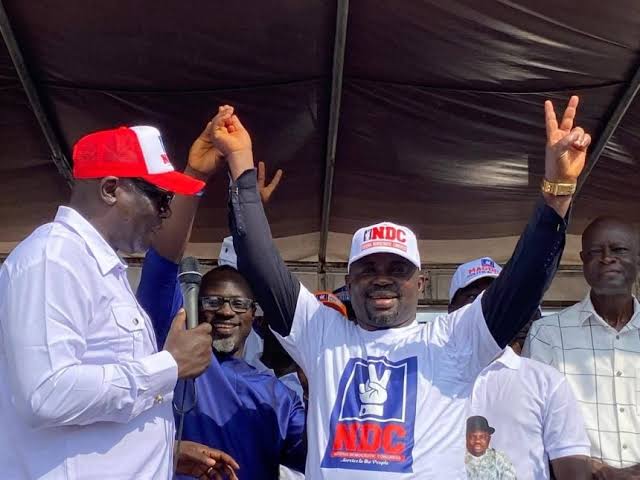
In Bayelsa State, Commissioner for Special Duties (Bayelsa West), Honourable Michael Magbisa, resigned from office and defected to the Nigeria Democratic Congress (NDC), delivering one of the most severe public indictments yet of internal party structure and control.
But beyond the switch itself, it was his language that sharpened attention nationwide.
“This is no longer a political party,” Magbisa said. “It is a system where destinies are controlled—and in many cases destroyed.”
The statement, delivered at the NDC secretariat in Yenagoa, went beyond political disagreement. It framed his departure as an escape from what he described as a suffocating structure of centralized control.
“How can one person decide everything?” he asked. “I have not known peace since I joined. Today, I am free.”
He resigned from the state cabinet on the spot, marking a complete break from the administration he once served.
But analysts say the significance of the moment lies less in the resignation itself and more in what it signals: a growing pattern of elite exits that reflect deeper dissatisfaction within established party structures.
Magbisa warned that his move is not isolated, but part of a quiet build-up of frustration inside the APC.
“Many are tired. Many want to leave,” he said. “They are only waiting for courage. I have taken the first step.”
That claim, whether symbolic or strategic, has intensified speculation that Nigeria’s political parties may be heading into a phase of accelerated realignment ahead of the 2027 elections.
Flanked by supporters drawn from multiple political backgrounds, Magbisa also positioned the emerging NDC as a fast-rising alternative platform for disaffected politicians seeking political space outside traditional power blocs.
“The NDC may be new, but it is becoming a political home for many,” he said.
He further alleged that punitive measures, including salary suspensions, had been used against individuals based on political affiliation, promising redress under the new alignment.
Receiving the defectors, Bayelsa NDC Chairman, Hon. Dauprebo Ikuromo, framed the development as evidence of a shifting political tide.
“This is not just a defection—it is a statement,” he said. “It shows people are beginning to choose conviction over fear.”
He urged politicians to rethink their political alignment in what he described as a changing national landscape.
While defections are a familiar feature of Nigerian politics, what distinguishes this episode is the tone, timing, and intensity of the allegations—coming at a moment when political actors are increasingly repositioning ahead of 2027.
More broadly, Magbisa’s exit underscores a growing theme in Nigeria’s evolving political cycle: not just competition between parties, but internal pressure within them—driven by questions of control, inclusion, and political survival.
As 2027 draws nearer, the real story may not be who joins or leaves a party, but how many more see exit as the only remaining form of political expression.