


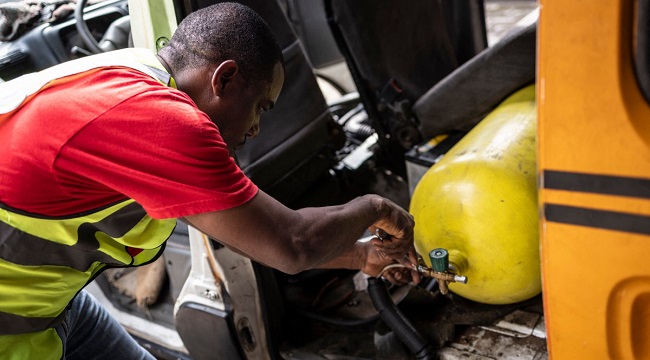
President Bola Tinubu has set October 1 as the target date for Nigerians to begin feeling the impact of cheaper transportation, following his directive for the rollout of 500 additional Compressed Natural Gas (CNG) refuelling stations nationwide.
The new stations will expand the Federal Government’s planned CNG network to 1,000 stations as the administration intensifies efforts to reduce the cost of running vehicles after the removal of petrol subsidy.
Tinubu announced the directive after a meeting with state governors, who agreed to work with the Federal Government to bring down transportation costs in their respective states.

The President said the focus would be on ensuring that savings from cheaper energy are passed directly to commuters through lower fares.
“From October 1, our goal is that Nigerians begin to partake in those savings through lower transport fares,” Tinubu said.
He said CNG-powered vehicles could operate at between 60 and 80 per cent lower fuel costs than petrol-powered vehicles, creating room for transport operators to reduce fares.
Tinubu particularly identified intra-state transportation as a major concern, noting that state governments have a crucial role to play in delivering immediate relief to commuters.
The President said more than 120,000 vehicles had already been converted to CNG across the country, while over 100,000 additional conversion kits were being processed.
He added that the Federal Government was financing more than 100 gas infrastructure projects through the Midstream and Downstream Gas Infrastructure Fund.
The projects include 15 CNG mother stations and 86 daughter stations, alongside other facilities designed to increase access to cheaper gas-powered transportation.
The expansion comes more than three years after Tinubu announced the removal of petrol subsidy in May 2023, a decision that pushed up fuel and transport costs and intensified pressure on household incomes.
Although the government has promoted CNG as a cheaper alternative, limited refuelling infrastructure and the cost of vehicle conversion have remained major challenges to widespread adoption.
The October 1 target therefore places fresh pressure on both federal and state authorities to ensure that the promised reduction in operating costs translates into actual fare cuts.
The development also comes as the economic impact of subsidy removal becomes increasingly prominent in political debates ahead of the 2027 elections.
Former Vice-President and African Democratic Congress presidential candidate Atiku Abubakar has criticised the subsidy policy and pledged to restore a targeted petrol subsidy if elected president.
For millions of commuters struggling with high transportation costs, the key question now is whether the expansion of the CNG network will finally bring down the fares they pay daily.
