

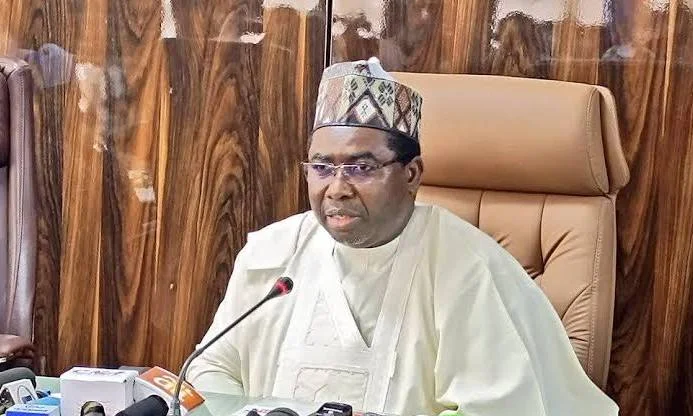

By Yahaya Etila
The Osun Guber election has come and gone and a winner declared. But who was the absolute winner of the election? Was it the security forces? Was it the vigilance of the voters? Or the control of the system by INEC? This is the third election conducted by INEC since Prof Joash Amupitan, SAN was appointed. And what have been the feelers so far? Are we in for a different regime? If yes, why, and if no, why?
I have written about INEC in recent times; interestingly, my postulations have manifested with regards to what to expect from the conduct of INEC under Prof Amupitan. This is against the narrative that politicians put out in the public. I argued that there is a need to give the INEC chair the benefit of the doubt with regards to how he intends to administer and conduct elections in the country.


He has fared well in three sensitive elections. In the three elections, the APC won one, APGA won one, and Accord Party won one. These feats were celebrated, but I didn’t read of commendations for INEC.
Free, Fair, and Credible
When is an election termed free, fair, and credible? Is it when an incumbent wins, or when the opposition wins? In our clime, an election is termed free, fair, and credible when the opposition wins. Do we agree with this? There are two examples in this regard. When APC was declared winner of the Ekiti State gubernatorial election, there were silent murmurs around the corner that it was not the wish of the people and that INEC must have aided it. This was said in hushed tones because there was no public evidence to support it.
In the Anambra gubernatorial election, APGA won. It was applauded as the will of the people and there were no murmurs around town. It was imagined that INEC could not manipulate the system because all eyes were on INEC, and it ended up doing the right thing.
In the case of the Osun State gubernatorial election, it would be stated that the election was free, fair, and credible. These three assumptions are what have defined elections as free, fair, and credible or otherwise. Why? Because the incumbent won, or because INEC was transparent and accountable? These are idiosyncrasies that shape public opinion. And very unfortunately, our idiosyncrasies are wired to believe what we want to believe at the expense of the truth.
The Truth
Our truth is that in the free, fair, and credible triangle, INEC’s role is more about the credibility of the process. Nothing can be free or fair if the system does not permit it, and in this case, INEC permitted it because of the pledge to do things differently by Prof Amupitan. We can argue this using several frameworks, but it can’t be disputed. The truth is that INEC has gotten its role right using these three elections. Were election materials delivered on time? Did voting start and end within the allocated periods? Were results uploaded on IReV in good time? Was the collation centre active? Were there lapses in the overall process? And was the result announced in good time? If all of these boxes are ticked, then what are we talking about? This is the leadership that Prof Amupitan has availed.
Leadership of INEC is not for the faint-hearted, and in my estimation, he has proved his mettle.
In all human endeavors, purposeful leadership does wonders. It is the difference between a rock and a hard place. It provides the vision, discipline, and strategic clarity necessary to carve a path through them. Without mincing words, this is what the INEC chairman has done, and he deserves some commendation. There is a popular Hausa idiomatic expression that goes thus: “Jumma’a mai kyau, tun daga Alhamis ake gane ta.” This literally means a good Friday is known/recognized right from Wednesday or Thursday.
This is the case of INEC that we must recognize as we go into the presidential election.
My verdict is that there is a different Sheriff at INEC who is bent on ensuring the credibility of electoral processes in the country. His mien and disposition say so. I know some might want to argue that it is too early to commend INEC. I would love to read their premise so long as it is not based on emotions or assumptions. I would also love to see an analysis that is rooted in the conduct of INEC in the three referenced elections.
An Appraisal of What?
This appraisal is not essentially about Prof Amupitan in his personal capacity, but an appraisal of the system he has put in place in a short period. We need to pause and reflect on the complexity of conducting elections in Nigeria. One of them is the perception that every appointee of the president must always do his bidding. This is tantamount to saying that some appointees of the president do not have a life before their appointments. In the case of Prof Amupitan, it would be an uncharitable presumption. And the politicians and political parties are responsible for the complexities in conducting elections in Nigeria.
Why do I say so? Politicians and political parties are notorious for cutting corners. Whether APC, ADC, APGA, PDP, or NDC, they all do the same thing in their quest for power, and INEC is always the scapegoat. In this circumstance, how can INEC be appraised objectively? From the lens of political whims and caprices? It would be uncharitable and counterproductive. All that is fair must be fair, and fairness is not political. What is good for the goose must be good for the gander.
INEC should be spared from political assumptions as it prepares for the heavyweight presidential contest. In my opinion, INEC is in proper stead to deliver a credible election.
Yahaya Etila, a public affairs analyst, wrote from Abuja and can be reached via Yahaya.etila@gmail.com