


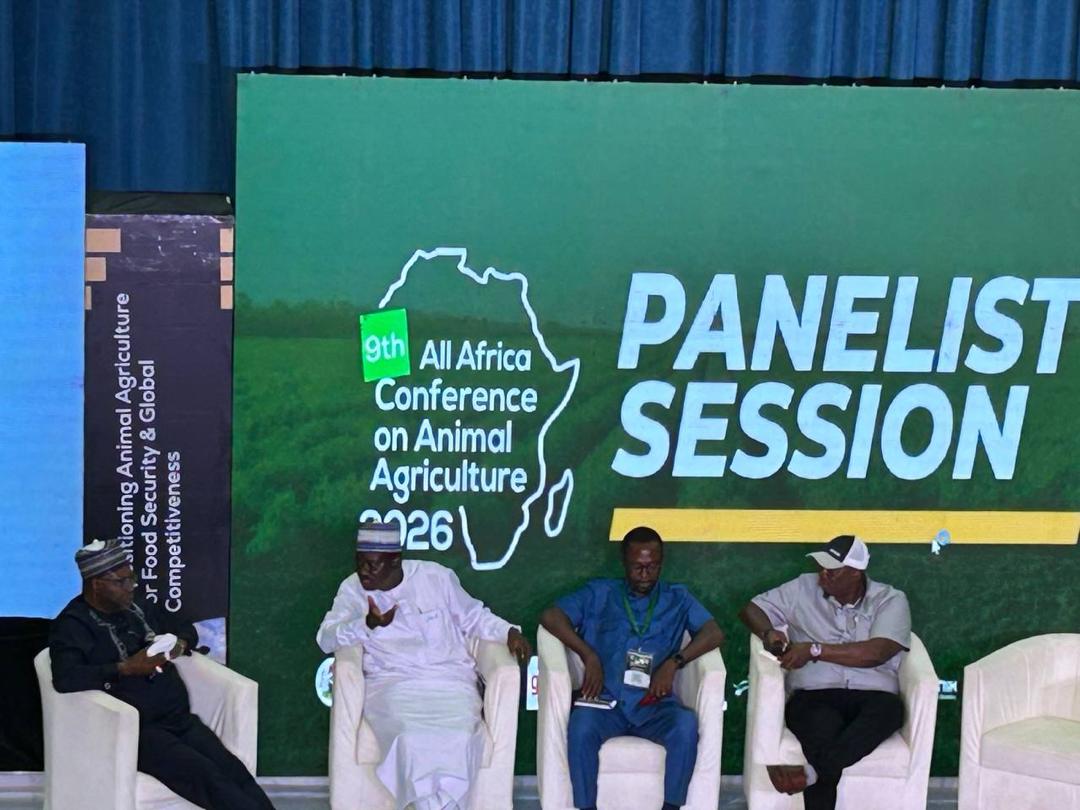
Africa’s livestock industry must move beyond traditional farming and deliberately position young people as the architects of a technology-driven agricultural economy, experts at the 9th All Africa Conference on Animal Agriculture have said.
The experts, who spoke during a panel session in Abuja, argued that Africa’s continued reliance on imported genetic materials and food commodities was unsustainable, especially with its large youthful population and vast agricultural resources.
They called for a new approach that combines practical training, affordable finance, technology and access to markets to turn young people—particularly agricultural graduates—into livestock entrepreneurs, innovators and service providers.

A member of the Presidential Livestock Implementation Committee, Prof. Demo Kalla, said Nigeria could no longer afford to treat its youthful population merely as beneficiaries of government programmes.
Instead, he said, young Nigerians should be deliberately positioned to drive innovation across the livestock value chain.
“Our youthful population is our greatest asset,” Kalla said, warning that failure to channel the creativity and energy of young people into productive ventures could create serious social and economic consequences.
He identified artificial intelligence, digital platforms, animal tracking, agribusiness, processing, engineering and logistics as some of the emerging areas where young people could build businesses around livestock without necessarily owning farms.
Kalla said the future of livestock production would depend increasingly on technology and systems capable of improving productivity, traceability and efficiency.
“For us in the livestock sector, our focus is to see youth take up innovative enterprises and innovative platforms, digital economy, digital platforms and AI-enabled systems to change the face of our current production systems,” he said.
He described animal agriculture as a largely untapped economic frontier, urging young Nigerians to see opportunities not only in producing animals but also in developing the infrastructure and services that support the industry.
From manufacturing animal identification tags and developing tracking systems to providing specialised services, he said the livestock economy could support thousands of businesses across the continent.
Kalla also linked livestock development to food and nutrition security, stressing that milk, meat, eggs and other animal-source foods were indispensable to a healthy food system.
Prof. Kawu Domako of Ghana, another panelist, said Africa’s agricultural problem was not a shortage of land but a failure to make farming sufficiently attractive and commercially rewarding to its younger population.
He advocated introducing agriculture at the basic education level to familiarise children with the sector early and change the perception of farming as a low-income occupation.
Domako also challenged African governments to confront the paradox of a continent with abundant arable land that still imports basic food commodities.
He said governments must back their youth-agriculture policies with financing that reflects the realities of young entrepreneurs.
“We need to create a conducive environment to let agriculture become attractive to young people,” he said.
Rather than relying solely on conventional bank loans that often require collateral and established financial records, Domako proposed youth-focused grants and affordable financing that could increase as beneficiaries demonstrate the ability to grow their businesses.
“Young people don’t have collateral. They may not have a record. They may not have cash flow. But we need to trust them and assist them to start agriculture,” he said.
According to him, many young farmers are forced to rely on personal savings because they cannot access affordable credit, while uncertainty over markets makes agricultural investment even riskier.
The panelists therefore called for a broader agricultural strategy in which training, finance, technology and guaranteed markets work together.
They argued that such an approach would not only attract more young people into livestock and agriculture but could also reduce Africa’s dependence on imported inputs, strengthen domestic food production and transform animal agriculture into a major source of jobs, innovation and wealth.
