

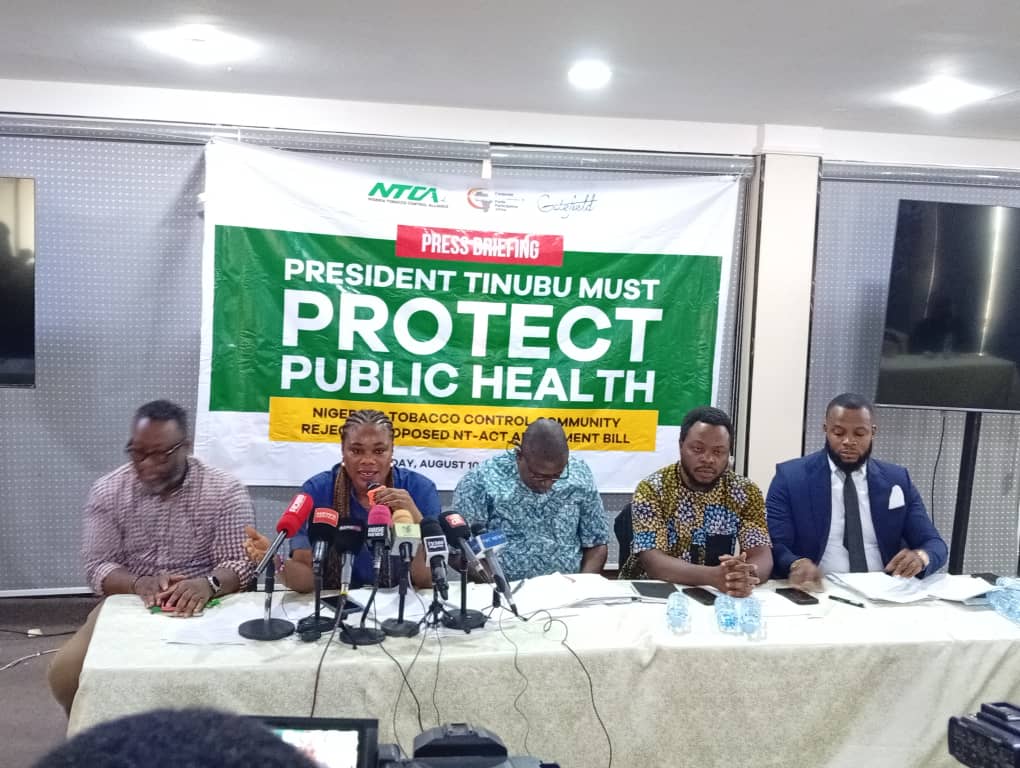

Nigeria’s tobacco-control regime is facing a fresh battle as more than 100 civil society organisations accuse the National Assembly of using a proposed amendment to create regulatory loopholes that could expand the tobacco and nicotine market, particularly among young Nigerians.
The coalition, operating under the Nigeria Tobacco Control Community, is demanding the immediate withdrawal of the consolidated National Tobacco Control Act (Amendment) Bill 2025, alleging that several provisions could weaken existing restrictions on advertising, promotion, online sales, product sampling, packaging and enforcement.
The groups, led by the Corporate Accountability and Public Participation Africa (CAPPA), warned that what is being presented as an update to Nigeria’s tobacco-control framework could ultimately become a “backdoor” for tobacco and nicotine companies to regain commercial space that existing regulations have restricted.
Speaking at a press briefing, CAPPA Executive Director, Akimbode Oluwafemi, described the proposed legislation as a serious public-health concern disguised as regulatory reform.


The coalition acknowledged the need to update Nigeria’s tobacco law to address emerging products such as vapes, heated tobacco products and nicotine pouches, but insisted that modernisation must not translate into weaker safeguards.
At the heart of the controversy is the proposed introduction of “tobacco harm reduction objectives” into the law.
The CSOs warned that the language could be used to create a regulatory distinction between conventional tobacco products and newer nicotine products, potentially giving manufacturers greater room to market and sell products capable of sustaining nicotine addiction.
“True harm reduction means breaking addiction, not enabling multinational corporations to recruit a new generation of youth,” the coalition said.
One of the most contentious provisions, according to the coalition, is Clause 7, which it said could create exceptions to Nigeria’s existing prohibition on tobacco advertising, promotion and sponsorship.
The groups alleged that the amendment could permit promotion of non-combustible products through adult publications, point-of-sale materials and online platforms, while also opening the door to sponsorship of cultural, social and recreational events.
The coalition questioned the proposed definition of an “adult publication”, particularly the provision that could allow a publication to qualify where at least 50 per cent of its readership is adult.
It argued that such a threshold could leave millions of young readers exposed to tobacco and nicotine marketing.
The CSOs also warned that regulating online promotion based on the intended age of an audience would be extremely difficult in Nigeria, where digital content can be rapidly shared across social-media platforms and messaging applications.
The proposed relaxation of restrictions on internet-based sales has also triggered concern.
The coalition said the amendment could permit online ordering, shipping, mail and courier delivery of non-combustible nicotine products, subject to age verification.
But the organisations questioned whether Nigeria currently has the enforcement capacity to prevent minors from accessing such products through online vendors.
They raised concerns over adults purchasing products on behalf of minors, misuse of identification documents and deliveries being received by persons other than the registered purchaser.
Beyond age verification, the groups questioned whether regulators could realistically monitor thousands of websites, social-media vendors, courier companies and delivery platforms involved in online commerce.
The coalition also took aim at provisions it said could permit point-of-sale promotional materials and indoor vaping for product sampling.
According to the groups, the combination could transform retail outlets from ordinary sales points into promotional centres where customers are introduced to products, encouraged to sample them and subsequently converted into buyers.
The organisations argued that such provisions could effectively shift tobacco and nicotine promotion from conventional advertising channels into everyday commercial spaces.
The coalition also expressed concern over proposed changes to health warnings.
It said conventional tobacco products currently carry graphic warnings covering 60 per cent of packaging, while the proposed framework would impose significantly weaker requirements on some novel nicotine products.
According to the groups, vape liquids could carry text-only warnings covering no more than 30 per cent of the front of packages, while nicotine pouches could carry warnings covering as little as 10 per cent.
The organisations further alleged that e-cigarette and heating devices could be exempted from carrying health warnings.
The CSOs described the proposed disparity as dangerous, arguing that products capable of creating nicotine dependence should not enjoy weaker public-health protections simply because they are marketed as newer or non-combustible products.
The coalition also challenged provisions dealing with safety dossiers for novel products.
It alleged that the proposed legislation would allow manufacturers to generate, hold and internally approve their own safety dossiers.
The organisations questioned why tobacco companies should effectively be allowed to generate and retain evidence relating to the safety of products from which they stand to make substantial commercial profits.
They argued that public-health decisions must be based on independently verifiable evidence rather than information controlled by the industry being regulated.
Another provision under scrutiny is Paragraph 21 of the Third Schedule, which the coalition said would grant the Health Minister broad powers to exempt non-combustible products from provisions of the law on undefined “public interest” grounds.
The groups warned that such discretionary powers could create opportunities for lobbying, regulatory capture and selective enforcement.
They questioned why a tobacco-control law should contain broad exemptions capable of weakening the very safeguards it was designed to enforce.
Perhaps the most explosive issue raised by the coalition is the alleged legislative history of the controversial provisions.
The organisations claimed that some of the provisions were not contained in the versions of HB 47 and HB 1151 presented during the public hearing of November 22, 2024, but appeared in the consolidated Bill now before the National Assembly.
The coalition is demanding an explanation of how the provisions entered the legislative text and who sponsored or introduced them.
“Who introduced these provisions, and which public-health institutions reviewed them?” the groups asked.
They said the question goes beyond tobacco regulation to the transparency and integrity of Nigeria’s legislative process.
The Nigeria Tobacco Control Community is consequently demanding the immediate recall of the consolidated Bill and a fresh, transparent review involving public-health experts, civil society organisations and other relevant stakeholders.
The coalition wants the National Assembly to publish the committee reports, voting records and stakeholder submissions used in developing the current version of the legislation.
It also called on the Federal Ministry of Health and Social Welfare to publicly disclose its position on the proposed amendments and insist on a recall if it was not adequately consulted.
The groups further urged President Bola Ahmed Tinubu to withhold assent should the Bill eventually reach his desk in its present form.
They are demanding a single, strong and product-neutral regulatory framework covering conventional tobacco products and emerging nicotine products alike.
For the coalition, advertising, sponsorship, product sampling, retail promotion and remote sales should not be reopened through exemptions that could give the tobacco and nicotine industry new routes to consumers.
The controversy has therefore evolved beyond a dispute over technical amendments to the tobacco law. It has become a test of whether Nigeria’s public-health policy will be driven by the protection of citizens or by commercial opportunities for an industry whose products are linked to nicotine dependence.
The coalition urged health professionals, parents, journalists, young Nigerians and civil society organisations to scrutinise the Bill and demand accountability from lawmakers.
Its message to the National Assembly was unequivocal: **a law designed to control tobacco must not become the mechanism through which the tobacco and nicotine market is quietly expanded.**
The groups want the Bill recalled, its legislative history exposed, every controversial clause subjected to public scrutiny and Nigeria’s public-health interests placed above commercial considerations.