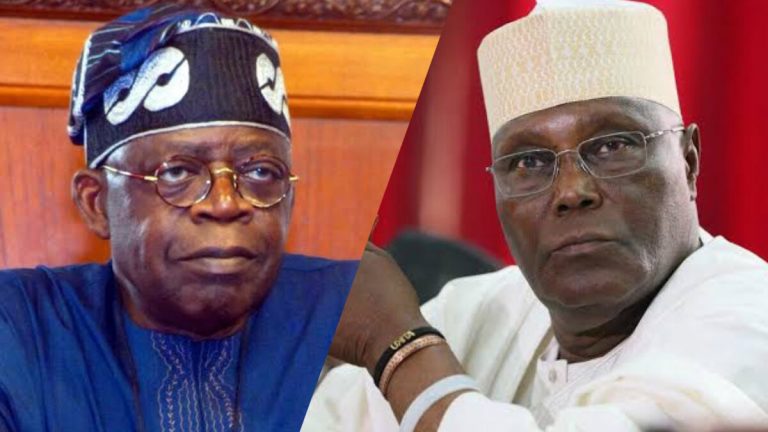

The economic debate under President Bola Ahmed Tinubu’s administration has taken a new turn, with former Vice President Atiku Abubakar arguing that the crisis is no longer confined to what Nigerians eat, but is increasingly reflected in what they can no longer afford to own.
In a statement issued by his Senior Special Assistant on Public Communication, Phrank Shaibu, the presidential candidate of the African Democratic Congress (ADC), said the latest Central Bank of Nigeria (CBN) Household Expectations Survey had exposed what he described as the erosion of the Nigerian dream, as households increasingly shelve plans to buy homes, vehicles and other major assets.
The former vice president based his argument on figures from the CBN survey showing weak household appetite for major purchases.
According to figures cited by Atiku, buying conditions stood at 28.7 points for motor vehicles, 28.9 for consumer durables and 30.0 for buildings and landed property.
More strikingly, willingness to purchase vehicles stood at 18.7 points, while willingness to acquire buildings and landed property was recorded at 19.2 points.
For Atiku, the significance of the figures goes beyond consumer behaviour. He said they reveal an economy in which households are increasingly forced to concentrate on survival at the expense of ownership, savings and long-term aspirations.
“These are not figures manufactured by the opposition. They are the verdict of Nigerian households captured by the Central Bank under President Tinubu’s own government,” Atiku said in a statement issued by his Senior Special Assistant on Public Communication, Phrank Shaibu.
He said the figures suggested that the economic pressure facing Nigerians had moved from the kitchen to the household balance sheet.
“A home is becoming a fantasy. A car is becoming a luxury. Household appliances are increasingly beyond reach,” he said.
According to Atiku, families are committing an increasing proportion of their income to food, transportation, electricity, school fees and other necessities, leaving little room for saving or acquiring assets.
The former vice president contrasted the situation with what he described as the traditional expectation that economic growth should progressively allow working Nigerians to improve their living standards.
He argued that an economy cannot be described as delivering prosperity if citizens are working but increasingly unable to convert their earnings into security, ownership and a better future.
Atiku also connected the CBN findings to the rising cost of food, citing the latest SBM Jollof Index, which he said placed the average cost of preparing jollof rice for a family of five at ₦29,578.
For a worker earning the ₦70,000 minimum wage, he said, that cost would consume more than 40 per cent of monthly earnings before other essential expenses are considered.
“Only recently, the Jollof Index told us what Tinubu’s economy has done to the Nigerian kitchen. Now the CBN survey is telling us what it has done to the Nigerian dream,” he said.
Atiku accused the administration of focusing too heavily on macroeconomic indicators while failing to sufficiently address the experience of households.
“Government officials can celebrate GDP growth, foreign reserves and other statistics from air-conditioned conference rooms, but ordinary Nigerians have become unwilling economists, calculating every cup of rice, every litre of fuel and every transport fare before deciding what their families can afford,” he said.
He argued that the consequences could extend beyond household hardship, warning that weakened purchasing power could undermine businesses dependent on consumer demand.
“When citizens cannot consume, businesses cannot sell; when businesses cannot sell, production falls; and when production falls, jobs and livelihoods disappear,” he said.
For Atiku, the measure of economic success should ultimately be whether citizens can translate income into a progressively better quality of life.
“An economy succeeds when citizens can work, earn, eat, save, invest and progressively improve their standard of living,” he said.
“Before there is GDP, there must be dinner. Before there is prosperity, there must be purchasing power.”
He also criticised the Federal Government’s presentation of economic performance, saying official statistics should not be allowed to obscure the financial reality confronting households.
“President Tinubu should stop governing Nigeria through PowerPoint economics. The real economy is the Nigerian family’s pocket, and that pocket is increasingly empty,” he said.
Atiku’s intervention effectively reframed the economic argument around a question of aspiration: not merely whether Nigerians can survive, but whether they can still plan for a future beyond survival.
He said an economy in which workers could no longer realistically contemplate buying homes, vehicles or basic household assets could not credibly claim to have delivered prosperity.
“A government under which families struggle to afford jollof rice, workers cannot contemplate buying cars and millions see home ownership disappearing beyond the horizon cannot proclaim prosperity,” Atiku said.
He then delivered his sharpest assessment of the administration’s economic record:
“Tinubu has not merely increased the cost of living. He has increased the cost of dreaming.”
The statement adds a new dimension to the opposition’s criticism of the Tinubu administration, shifting the argument from inflation and household hardship to the longer-term consequences of declining purchasing power on home ownership, asset accumulation and social mobility.
For Atiku, the central question is no longer simply whether Nigerians can afford today’s necessities, but whether the average Nigerian still has enough economic space to build tomorrow.