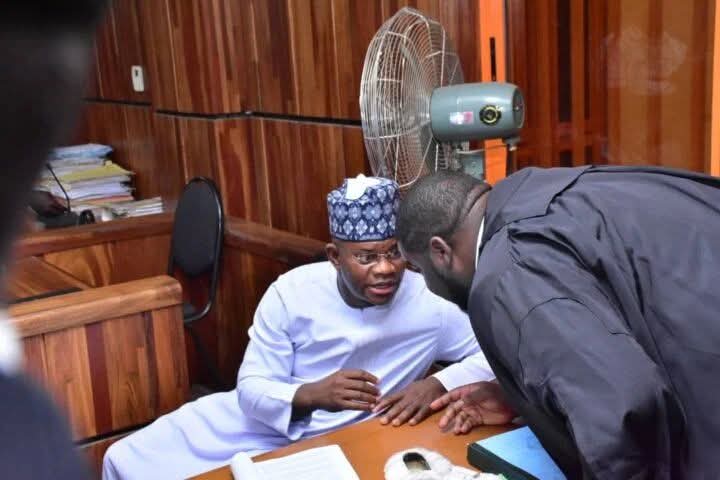
A senior operative of the Economic and Financial Crimes Commission (EFCC) on Monday told the Federal High Court in Abuja how billions of naira allegedly diverted from the Kogi State Government House Administration Account were used to acquire luxury properties across Abuja.
Testifying as the 17th prosecution witness, PW17, Deputy Superintendent of the EFCC, Ahmed Audu Abubakar, appeared before Justice James Omotosho and gave detailed accounts of how funds traced to the Kogi State treasury were allegedly laundered through cash payments, Bureau de Change transactions, and proxy accounts.
The EFCC is prosecuting Ali Bello, Chief of Staff to Kogi State Governor Ahmed Usman Ododo and nephew of former Governor Yahaya Bello, alongside Dauda Sulaiman and Abdulsalami Hudu, a former cashier of the Government House Administration Account who is currently at large. The defendants face a 16-count amended charge bordering on misappropriation and money laundering involving ₦10.27 billion.
According to the EFCC, the funds were withdrawn from government accounts and handed over to a Bureau de Change operator in Abuja, Rabiu Tafada, for conversion into foreign currencies and onward use for personal transactions.
Abubakar told the court that Ali Bello allegedly used ₦900 million to acquire a property at No. 35 Danube Street, Maitama, Abuja, currently housing Spring Hall School. He said the transaction was facilitated by a lawyer, Barrister Ramalan, acting on Bello’s instructions.
“The payment was made in cash at a Bureau de Change office in Zone 4, Abuja, after the naira equivalent was converted to United States dollars,” the witness said, adding that the funds were withdrawn in tranches from the Kogi State Government House Administration Account.
The witness identified Exhibit H as a Deed of Assignment between Pauchi Ventures Nigeria Limited and Y3 Nigeria Limited, explaining that Y3 Nigeria Limited was the company provided by the first defendant for the transaction.
On another count, Abubakar testified that ₦920 million was allegedly used to acquire a property at No. 2 Justice Chukwudi (also referred to as Oguta) Street, Asokoro, Abuja. He said the deal was brokered by former Governor Yahaya Bello, who negotiated directly with a contractor who had recently acquired the property through Wastle Motors, owned by Alhaji Sa’id Dantsoho.
The witness told the court that the property was purchased through a loan facility from Access Bank, with repayments allegedly funded through cash deposits and Bureau de Change transfers traced to the Government House account. He said the total loan facility stood at ₦808.69 million as of March 21, 2018.
Abubakar further detailed how, on April 8, 2020, multiple individuals made cash deposits at Access Bank’s Lokoja branch to service the loan. He listed over 25 separate deposits, ranging between ₦3.65 million and ₦9.6 million, all of which, he said, were traced to withdrawals from the Kogi State Government House Administration Account.
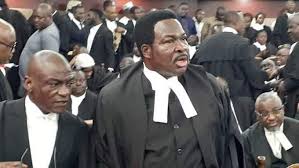
When asked by prosecution counsel, Rotimi Oyedepo, SAN, whether the payments were made in cash, the witness replied: “Yes, My Lord.”
On count five, Abubakar testified that ₦170 million was used to acquire a property on Marsin Street, Wuse Zone 4, Abuja, located directly behind the former governor’s residence on Benghazi Street. He said ₦100 million was paid into the seller’s account, while ₦70 million was converted to dollars through a Bureau de Change.
He also told the court that ₦100 million was allegedly used to acquire a property at No. 1773 Guzape Street, Abuja; another property at No. 176, Plot 4882, Lome Street, Wuse; and ₦66 million for a property at Plot 739 Aminu Kano Crescent, Wuse II. All payments, he said, were made in cash and sourced from the Government House Administration Account.
The EFCC witness added that the funds were not used for any official government purpose, but for personal acquisitions and renovations linked to the former governor’s family.
Justice Omotosho adjourned the matter to February 16, 17, 18, 19, and 20, 2026, for continuation of trial.
₦10bn Kogi Fraud Trial: EFCC Details Cash-Fuelled Abuja Property Buying Spree