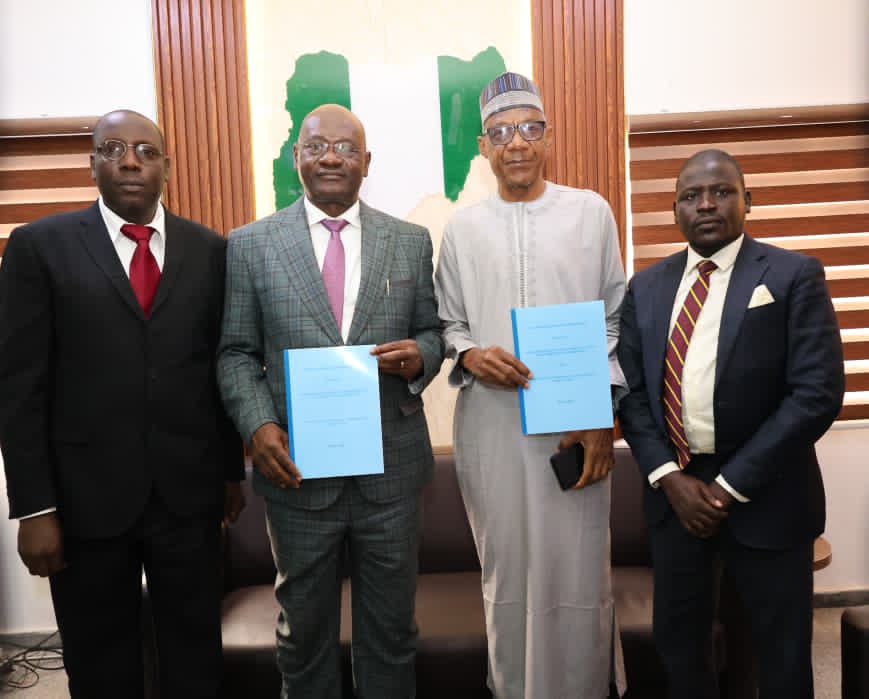

In a move aimed at strengthening institutional governance and enhancing conflict resolution mechanisms, the Jigawa State Public Complaints and Anti-Corruption Commission (JPCACC) has entered into a strategic partnership with the Institute for Peace and Conflict Resolution (IPCR) through the signing of a Memorandum of Understanding (MoU) focused on peacebuilding, mediation, capacity development and policy engagement.
The agreement, signed at the institute’s headquarters in Abuja, signals a growing recognition that effective anti-corruption institutions require robust conflict management frameworks and continuous investment in professional capacity to deliver sustainable public service.
Speaking at the ceremony, Executive Chairman of JPCACC, Barrister Salisu Abdu, described the partnership as a critical step in the Commission’s institutional development agenda, noting that it would provide a structured platform for training, research, technical cooperation and professional certification in mediation and conflict resolution.
He said the collaboration was conceived following discussions between both organisations during JPCACC’s visit to the institute in April, when they identified areas of shared interest and established technical teams to design a framework for long-term cooperation.
According to him, while the Commission is widely known for addressing public complaints and combating corruption, its Alternative Dispute Resolution (ADR) mechanism has increasingly become an important instrument for resolving communal, family, land and administrative disputes across Jigawa State.
Abdu argued that accountability, peace and development are mutually reinforcing, stressing that institutions charged with protecting public interest must continually improve the skills and competencies of their workforce to respond effectively to emerging governance challenges.
Under the agreement, both institutions will collaborate in specialised training programmes, professional certification of mediators, research, policy development, dialogue facilitation, technical exchanges and other initiatives designed to strengthen dispute resolution systems and institutional effectiveness.
He expressed confidence that exposure to national and international best practices would improve the Commission’s mediation processes and ultimately enhance public confidence in its service delivery.
The JPCACC chairman also acknowledged the support of Governor Umar Namadi for prioritising institutional reforms and capacity development, saying the administration’s commitment has created an enabling environment for governance institutions to evolve and perform more effectively.
On his part, Director-General of IPCR, Joseph Ochogwu, described Jigawa as one of Nigeria’s most peaceful states, attributing the achievement to consistent investments in proactive governance and conflict prevention by successive administrations.
He noted that the establishment of JPCACC had further strengthened the state’s peace architecture by providing a credible mechanism for mediation and dispute resolution between citizens and public institutions.
Ochogwu pledged the institute’s commitment to supporting the Commission through capacity building, policy dialogue, research collaboration and greater participation in national and international peacebuilding initiatives.
Beyond its immediate institutional benefits, the partnership reflects an emerging governance model that recognises mediation and conflict prevention as essential complements to anti-corruption efforts. Analysts have increasingly argued that public institutions capable of resolving grievances quickly and fairly are better positioned to promote accountability, strengthen public trust and reduce social tensions before they escalate into wider conflicts.
For Jigawa, the agreement represents another step towards integrating peacebuilding into the broader governance and public accountability framework, with both institutions expressing optimism that the collaboration will produce measurable outcomes for citizens and contribute to sustainable development.