


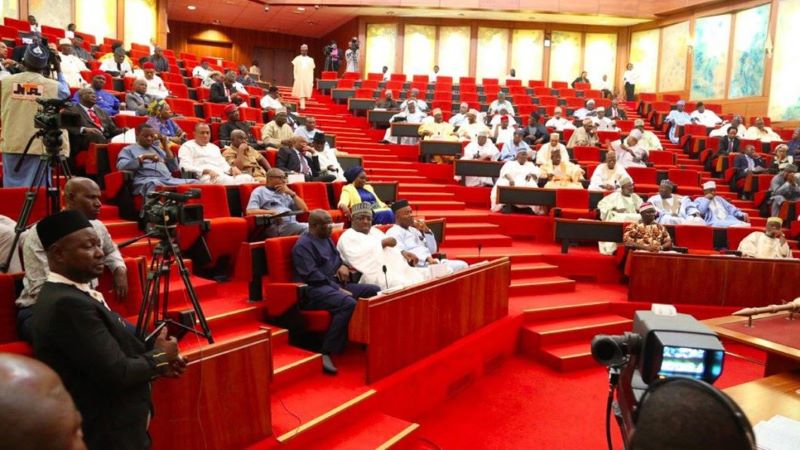
The Senate has moved to douse growing controversy over the proposed amendment to the Federal Road Safety Commission (Establishment) Act, clarifying that the bill does not seek to ban street preaching or introduce a fresh prohibition on hawking.
The clarification followed public concerns over provisions in the proposed legislation relating to preaching and hawking in commercial vehicles.
The Senate’s position was contained in a statement issued on Monday by the Directorate of Media and Public Affairs, Office of the Leader of the Senate.

According to the Senate, the practices being referenced were already prohibited under existing laws and regulations, long before the current amendment was introduced.
It cited Section 10(4) of the Federal Road Safety Commission (Establishment) Act, 2007, and Regulation 220 of the National Road Traffic Regulations, 2012, as provisions that already prohibit preaching and hawking in commercial vehicles.
The Senate explained that the provisions were initially listed as Item 36 in the Second Schedule of the 2007 Act but have been moved to Item 49 in the ongoing amendment.
It stressed that the provision should not be misconstrued as a broader attempt to restrict religious activities or preaching in public spaces.
“The Bill does not outlaw preaching on the streets as some interests have claimed in different fora,” the Senate said.
It added that the provision was primarily aimed at addressing safety concerns involving commuters, commercial vehicles and other road users.
The Senate also rejected claims linking the controversial provision to the Senate Leader, Senator Opeyemi Bamidele.
It explained that the legislation was a concurrence bill originating from the House of Representatives and was therefore before the Senate for consideration and approval.
“The Bill is not an initiative of Leader of the Senate, Senator Opeyemi Bamidele, CON. Rather, it is a concurrence bill first amended by the House of Representatives,” the statement said.
The Senate further noted that the amendment process had yet to be concluded, stressing that stakeholders with objections or concerns remained free to approach the appropriate legislative channels.
It said such engagement was an essential part of the democratic process and could influence deliberations before the bill is finally passed.
