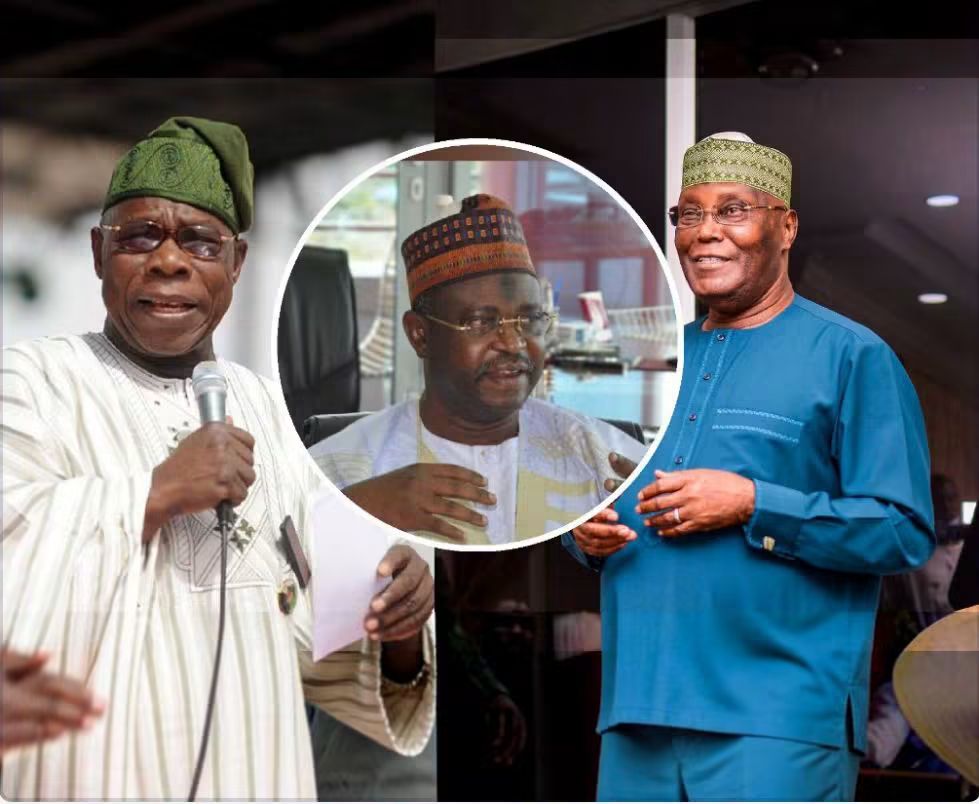

Former President Olusegun Obasanjo has alleged that his former deputy, Atiku Abubakar, orchestrated and financed the failed 2002 impeachment attempt against his administration, claiming the former Vice President was determined to succeed him “by hook or by crook.”
Obasanjo made the allegation in a letter addressed to former Ogun State Governor, Chief Olusegun Osoba, while responding to remarks attributed to Osoba concerning his relationship with Yoruba political leaders.
According to the former President, the impeachment campaign originated within the Presidency and was driven by Atiku, who he claimed had begun positioning himself for the presidency from the onset of their administration.
Obasanjo alleged that while he was away from the Presidential Villa on a Friday, Atiku invited the then Speaker of the House of Representatives, Ghali Umar Na’Abba, to his office and encouraged him to commence impeachment proceedings.
“Na’Abba’s impeachment plot began at the Presidency with the Vice President,” Obasanjo wrote.
He further alleged that Atiku provided Na’Abba with ₦5 million to initiate the process, adding that the development was reported to him by his Chief of Staff, whom he described as a professional intelligence officer.
“Atiku wanted that I should have only one term as President. This was the act of a man I brought from governor to Vice President,” Obasanjo stated.
The former President said he remained unconcerned by the impeachment threats because, in his view, he had committed no impeachable offence.
He also credited former President Shehu Shagari with helping to defuse the political crisis.
According to Obasanjo, Shagari approached him after learning of the impeachment moves and sought his permission to intervene.
“I gave him the go-ahead,” he said, adding that the elder statesman’s intervention contributed significantly to easing tensions.
The allegations revive one of the most turbulent episodes of Nigeria’s Fourth Republic.
In August 2002, the House of Representatives, under the leadership of Speaker Ghali Umar Na’Abba, issued President Obasanjo a 14-day ultimatum to address allegations of constitutional breaches or face impeachment proceedings.
The House subsequently compiled 17 allegations against the President, including claims of failure to faithfully implement appropriation laws, constitutional violations and authorising military operations without legislative approval.
The impeachment process, however, failed to progress after sustained political consultations and interventions by prominent national leaders, including Shagari, who urged restraint in the interest of preserving Nigeria’s fledgling democracy.
Atiku has not publicly responded to Obasanjo’s latest allegations. The claims also relate to events more than two decades old and reflect Obasanjo’s account of the political crisis that unfolded during their administration.