

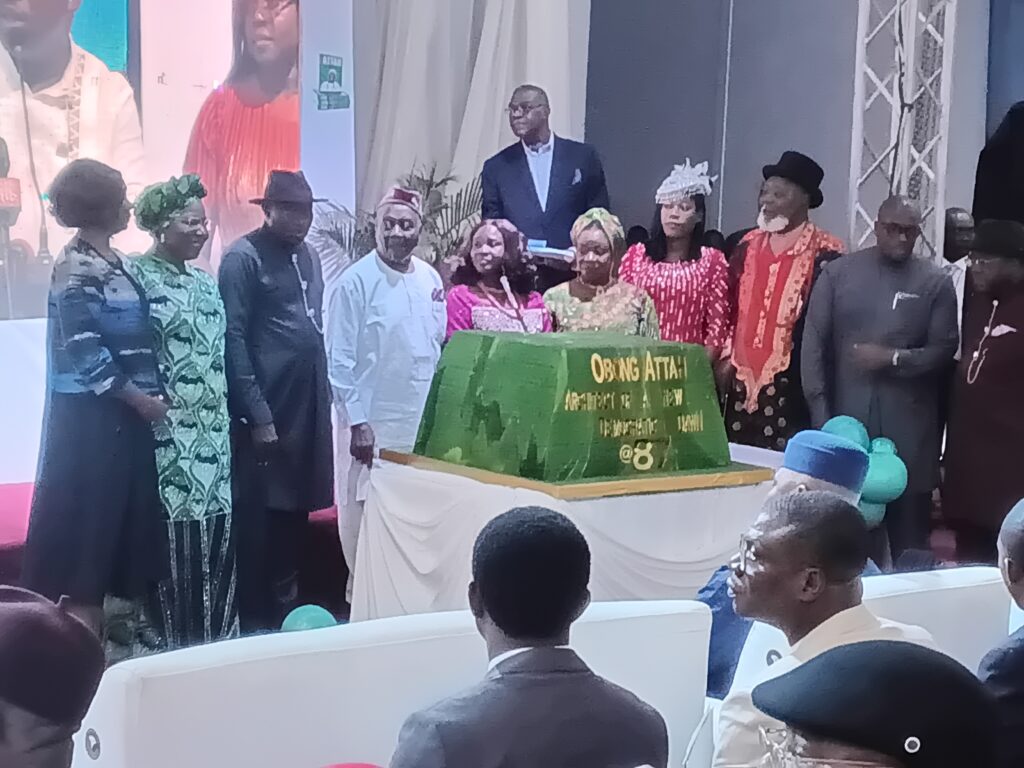

***As Leaders Celebrate His Legacy
At 87, Obong Victor Attah did not just mark a birthday, he issued a challenge to a nation in search of direction.
“Someday, we in Nigeria will get our priorities right; our democracy will be renewed, and then Nigeria will be great again,” he declared, his voice steady, his conviction unmistakable.
It was the emotional crescendo of an event that blended history, humour, and hard truths as friends, admirers, and national leaders gathered in Abuja to unveil a book 13 years in the making — a sweeping chronicle of Attah’s public life and private reflections.
But the former Akwa Ibom governor was not content with nostalgia. Instead, he reopened the old chapters with new meaning, drawing lessons from the moments that shaped his worldview.
He told the story of 1975 Kaduna, when a humble British engineer cycled to work daily at the Inter-Design Partnership firm he headed. Borrowing the bicycle for a day triggered quiet shock from his secretary, embarrassed that her “boss” would choose such simplicity.
“It shows you how Nigerians misunderstand leadership,” Attah said, smiling. “They expect the big man to live big.”
Another anecdote reached further back — to 1966 Barbados, where a young Attah designed a 25-room expansion of the iconic Sandy Lane Hotel. Decades later, as governor, he welcomed First Lady Stella Obasanjo to the hotel, only to be questioned by the EFCC about what they thought was an improper link.
“That tells you the type of Nigeria we have,” he mused, to knowing laughter.
Yet beneath the humour were the values he credited for his longevity and clarity: the prayer of “lowly toil, simple pleasures, courage, contentment, and gratitude,” taught to him and his siblings by their father, Chief Bassey Udo Bature.
The event’s chairman, former President Goodluck Jonathan, set aside personal celebrations to honour Attah — a gesture that drew warm acknowledgment from the crowd. Jonathan used the occasion to reflect on life after political office, echoing Attah’s quiet pride in returning to architecture after governance.
“I was a professional in politics, not a professional politician,” Jonathan said. “If Jimmy Carter could go back to the peanut farm after the White House, I can return to my profession after my tenure.”
By the time applause surged through the hall, it was clear that Attah’s message had travelled beyond the celebration of a life well lived.
It had touched something deeper, a yearning for the Nigeria that could be, and a belief that renewal is still possible.
At 87, Victor Attah is not just looking back.
He is still urging the nation forward.