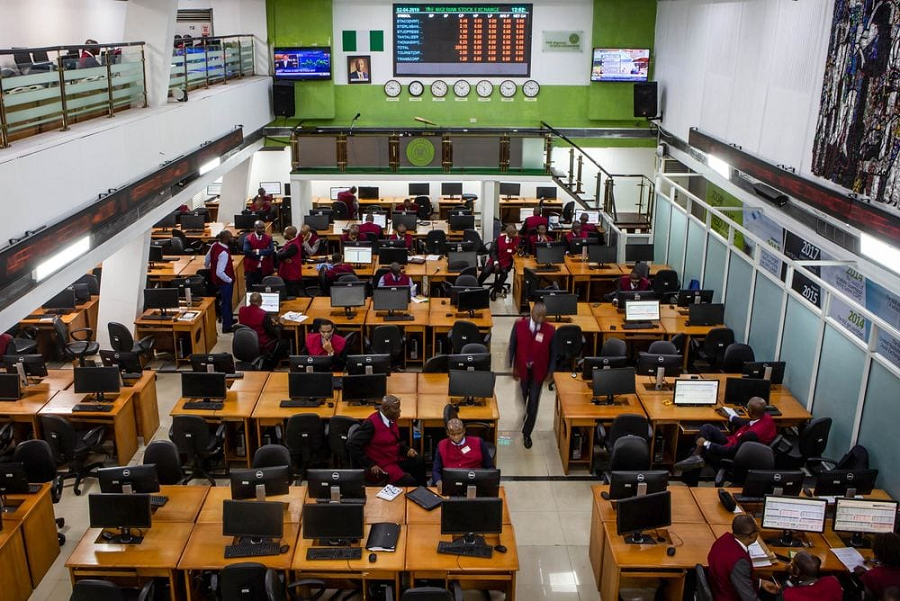

The Nigerian stock market endured one of its steepest weekly declines this year as jittery investors wiped off nearly ₦2.8 trillion from market value between November 3 and 7, 2025, following global tensions sparked by Donald Trump’s warning to Nigeria.
Data from the Nigerian Exchange Limited (NGX) show that market capitalisation slumped to ₦94.9 trillion, while the All-Share Index (ASI) fell by 2.99% to 149,524.81 points, from 154,126.46 points the previous week.
It was a bruising week across the board. Investors lost ₦245.88 billion on Monday, ₦611.96 billion on Tuesday, and a staggering ₦1.31 trillion on Wednesday — the week’s biggest drop. The sell-offs continued Thursday and Friday, with additional losses of ₦347.75 billion and ₦318.78 billion, respectively.
Trading activity also slowed sharply, with 3.58 billion shares worth ₦107.01 billion exchanged in 146,429 deals, compared to 7.48 billion shares valued at ₦145.43 billion the week before.
The financial services sector remained dominant, accounting for 2.95 billion shares worth ₦65.9 billion in 62,817 deals. Fidelity Bank, FCMB Group, and Aso Savings & Loans led the pack, jointly contributing over 36% of total volume and 18% of value traded.
Market breadth was negative as 75 stocks declined, up from 70 the previous week, while only 20 gained and 51 closed flat.
Top performers included NCR (Nigeria) Plc (+20.94%), Eunisell Interlinked Plc (+20.17%), and Union Dicon Salt Plc (+9.93%). On the laggards’ side, Sovereign Trust Insurance Plc led with a 28.21% drop, trailed by C&I Leasing Plc (-20.16%) and Skyway Aviation Handling Plc (-18.99%).
Analysts say the rout reflects a mix of profit-taking, macroeconomic uncertainty, and a crisis of confidence stoked by Trump’s remarks.
The former U.S. President had recently designated Nigeria a Country of Particular Concern over alleged killings of Christians and threatened possible military action — remarks that unsettled investors and rattled foreign sentiment toward Africa’s largest economy.
The NGX’s latest tumble underscores how swiftly political rhetoric abroad can ripple through emerging markets already battling inflation, currency pressure, and fragile investor trust.