


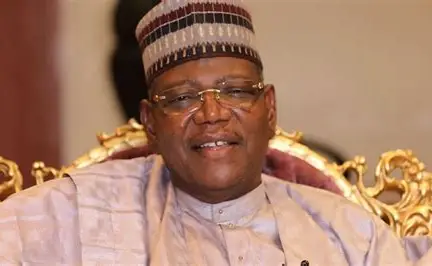
As Nigeria Tilts Toward One-Party Rule Amid Mass Defections
Nigeria’s political landscape may be on the brink of a seismic realignment as top political heavyweights — former Vice President Atiku Abubakar, ex-Kaduna Governor Nasir El-Rufai, and former Rivers Governor Rotimi Amaechi — are reportedly considering a return to the Peoples Democratic Party (PDP) if Sule Lamido, the former Jigawa State Governor, emerges as the party’s national chairman.
The development comes at a time when Nigeria’s multi-party democracy appears increasingly fragile, with the ruling All Progressives Congress (APC) tightening its grip through a wave of defections by PDP governors, lawmakers, and local power brokers.
A senior PDP insider told The Nation that Lamido’s potential leadership is seen as a rallying point for disillusioned politicians who crave credible, principled direction within the opposition.
“If Lamido becomes PDP chairman, expect a political earthquake,” the source said. “Atiku, El-Rufai, and Amaechi trust his leadership and believe he can rebuild the PDP into a real counterforce ahead of 2027.”
Lamido, a founding member of the PDP and former Minister of Foreign Affairs, has long been regarded as one of the few ideological purists left in Nigeria’s mainstream politics. Known for his loyalty and consistency since 1998, he is admired for his ability to bridge regional divides and maintain credibility across party lines.
Within the PDP, his name now symbolizes a return to discipline, values, and organizational coherence — qualities that many believe the party lost in its decade-long decline.
According to sources, Lamido’s candidacy has gained quiet but firm backing among reform-minded members of the PDP’s Board of Trustees (BoT) and among governors seeking a leader with both moral authority and political depth.
Since its defeat in 2015, the PDP — once dubbed Africa’s largest political party — has suffered an identity crisis marked by internal factionalism and high-profile defections.
Governors of Cross River, Ebonyi, Zamfara, and others have crossed to the APC, while several legislators have followed suit, leaving the opposition threadbare in the National Assembly and across key states.
Analysts warn that Nigeria’s political ecosystem is fast sliding toward de facto one-party dominance, with the APC controlling nearly all levers of power from the federal level to most state assemblies.
“Without a strong PDP or viable third force, Nigeria risks losing the essence of competitive democracy,” said Dr. Philip Ibe, a political analyst based in Abuja. “That’s why Lamido’s possible return to prominence is sparking such intense interest — it could revive multiparty contestation.”
Insiders reveal that Atiku and Lamido have maintained close political communication since the 2023 elections, and both share a belief that the PDP must reclaim its founding philosophy to survive.
Meanwhile, El-Rufai and Amaechi — two of the original architects of the APC — are said to be disillusioned with the ruling party’s internal dynamics, citing the concentration of power in a narrow political clique.
Their potential defection, one observer noted, would mark a symbolic reversal of 2013, when disaffected PDP members formed the coalition that birthed the APC.
“If Lamido takes charge, it could trigger one of the biggest political homecomings in Nigerian history,” the source said. “These men know what’s at stake — the future of democratic competition itself.”
For many reformists within the PDP, Lamido’s possible chairmanship represents more than an internal power shift. It is seen as a litmus test for whether Nigeria’s democracy can still sustain viable opposition.
Lamido’s reputation for integrity and cross-regional acceptability could help rebuild the PDP’s moral credibility — a critical advantage in a system where opposition politics has been reduced to survival tactics and personality clashes.
“Lamido offers something rare — ideological clarity,” said a senior PDP strategist. “He doesn’t bend with the wind. That’s the kind of leadership the party needs to challenge APC’s dominance.”
Although Lamido has yet to formally declare his intention, consultations are reportedly intensifying among PDP elders, ex-governors, and influential blocs seeking to reclaim the party’s lost identity before the 2027 elections.
Should he emerge, analysts predict his leadership could spark a wave of realignments not just within the PDP but across Nigeria’s wider political map — setting up the stage for a potentially competitive 2027 general election.
“Lamido’s emergence could restore balance to the system,” said political historian Dr. Amina Ojo. “Without that balance, Nigeria edges closer to a dominant-party state — and that’s not democracy.”

1 Comment
ghb053