

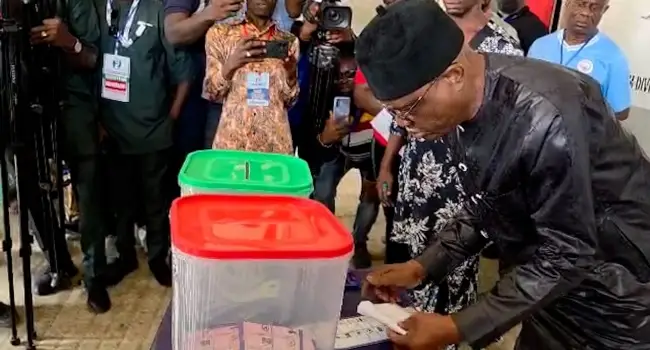
The political spotlight returned to Rivers State on Saturday as Federal Capital Territory (FCT) Minister, Nyesom Wike, cast his ballot in the state’s local government elections, portraying the exercise as a step toward restoring democratic order after months of turmoil.
At Rumepirikom, Ward 9, Unit 007 in Obio/Akpo LGA, the same ward where he launched his political career as council chairman in 1999, Wike described the polls as peaceful and credible, even as critics raised alarms over the non-deployment of the Bimodal Voter Accreditation System (BVAS).
“I am very happy. People are casting their votes peacefully. You have not heard of ballot box snatching or violence,” Wike said, waving aside fears of voter apathy and technological lapses.
This year’s LG elections carry unusual weight. They are the first major vote held under the state of emergency imposed by President Bola Tinubu in March, following the bitter power tussle between Wike and his successor, Governor Siminalayi Fubara.

Tinubu’s unprecedented move suspended the governor, his deputy, and the Rivers House of Assembly, replacing them with retired Vice Admiral Ibok-Ete Ibas as sole administrator. The President argued it was necessary to prevent a total breakdown of order, but the decision triggered fierce constitutional debates.
Wike now believes the local polls have cleared the path for a political reset.
“With this election, the coast is clear for the state of emergency to be lifted. Local governments now have representatives, and the state government has its own elected officials. We are good to go,” he declared.
Still, the absence of BVAS continues to overshadow the process. Civil society groups insisted that without the device, credited with curbing fraud in the 2023 general elections claims of credibility are shaky at best.
The Electoral College Director went as far as saying: “I don’t see democracy here.”
For Rivers, Saturday’s vote was more than a civic ritual. It was a stress test for peace and political legitimacy in a state long plagued by rivalries and oil-fueled contests for power.
Whether Tinbtaĺubu lifts emergency rule soon or prolongs the extraordinary measure may depend on how the LG polls are judged by citizens, opposition voices, and the wider Nigerian public.
And as always in Rivers politics, one question lingers: is Wike still the kingmaker, or is this just another round in a longer battle for control?
