

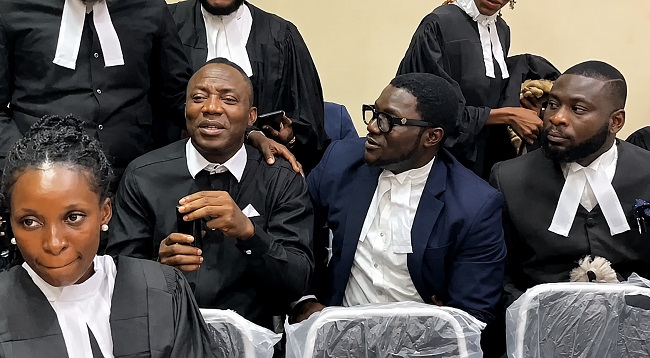

The Department of State Services (DSS) has asked the Federal High Court in Abuja to stop Omoyele Sowore from presenting further witnesses in his ongoing cyberbullying trial, accusing the activist of using repeated adjournments and legal applications to frustrate the proceedings.
The request, if granted, would effectively close the defence’s case and move the trial towards final written addresses and adoption, potentially bringing the proceedings closer to judgment.
DSS counsel, Akinlolu Kehinde, SAN, made the request on Tuesday before Justice Mohammed Umar, informing the court that the agency had filed a formal application seeking to foreclose Sowore’s defence.


In the motion dated November 23, the prosecution asked the court to bar Sowore from calling further witnesses and direct both parties to file and exchange their final written addresses within a specified period before fixing a date for their adoption.
Kehinde argued that the defence had exceeded the number of adjournments permitted under Section 396(4) of the Administration of Criminal Justice Act (ACJA), 2015.
According to him, Sowore had sought or procured adjournments on at least 14 occasions, including eight since he was called upon to open his defence.
The senior lawyer told the court that Sowore was re-arraigned on a two-count charge on January 19, 2026, and pleaded not guilty before the trial commenced.
He said the DSS called its witness and closed its case in March, while the court dismissed Sowore’s no-case submission on May 8, 2026, directing him to enter his defence.
However, Kehinde complained that since Sowore opened his defence on July 6, the proceedings had progressed only to the testimony of two defence witnesses.
He also accused the defendant of filing multiple applications and court processes that allegedly contributed to the delay, including a subpoena directed at the lead counsel to the complainant.
Kehinde argued that the constitutional right to fair hearing did not confer an unlimited entitlement to adjournments, insisting that the law also guaranteed the right to have criminal proceedings concluded within a reasonable time.
He relied on Section 36 of the Constitution and relevant provisions of the ACJA to urge the court to prevent further delays and grant the application in the interest of justice.
But Sowore’s defence team opposed the move, insisting that the court must first determine pending applications before considering the DSS request.
His counsel, Reuben Adakole, acknowledged receipt of the prosecution’s motion but argued that the application was premature because several issues raised by the defence remained unresolved.
Adakole specifically referred to an objection by the Chairman of the Independent National Electoral Commission (INEC), Prof. Joash Amupitan, SAN, concerning the defence subpoena, alongside a preliminary objection and an ex-parte application.
He maintained that the court should rule on those matters before entertaining any request to terminate the defence’s opportunity to present its case.
Kehinde, however, disputed the defence counsel’s position, insisting that the prosecution had formally filed an application seeking to foreclose the defence.
The court is expected to determine the competing applications as the dispute over the pace and conduct of the trial continues.