

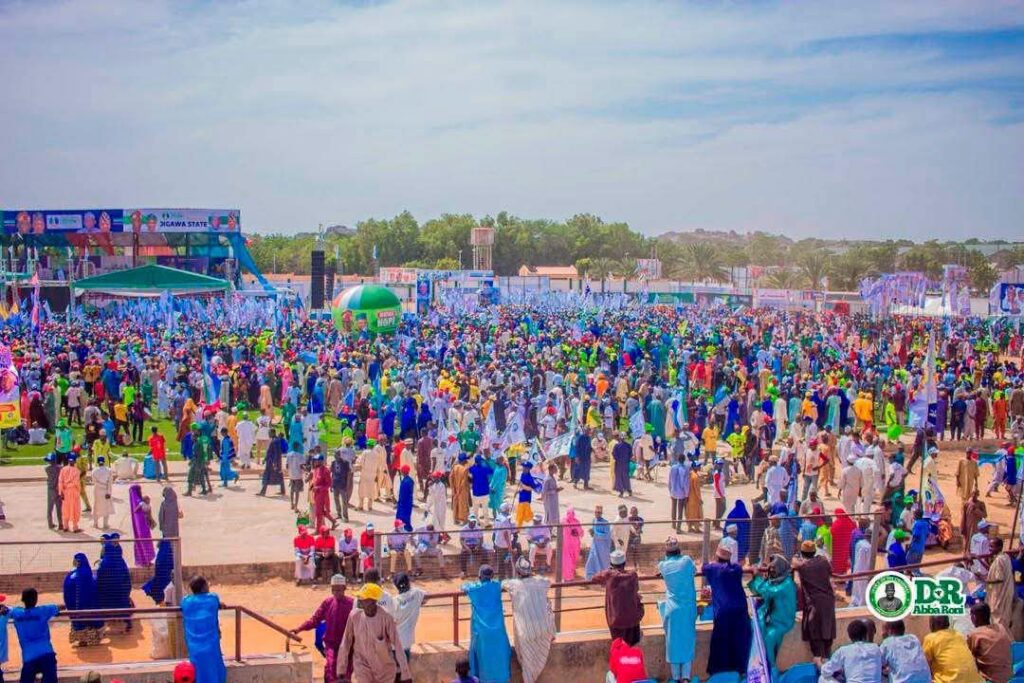

From the airport that received the President to the stadium that hosted his campaign, the roads, hotels and public facilities that made the APC presidential visit possible tell a remarkable story of a former PDP governor’s vision.
By Silas Yusuf
Sometimes, history makes its loudest statement without saying a word.
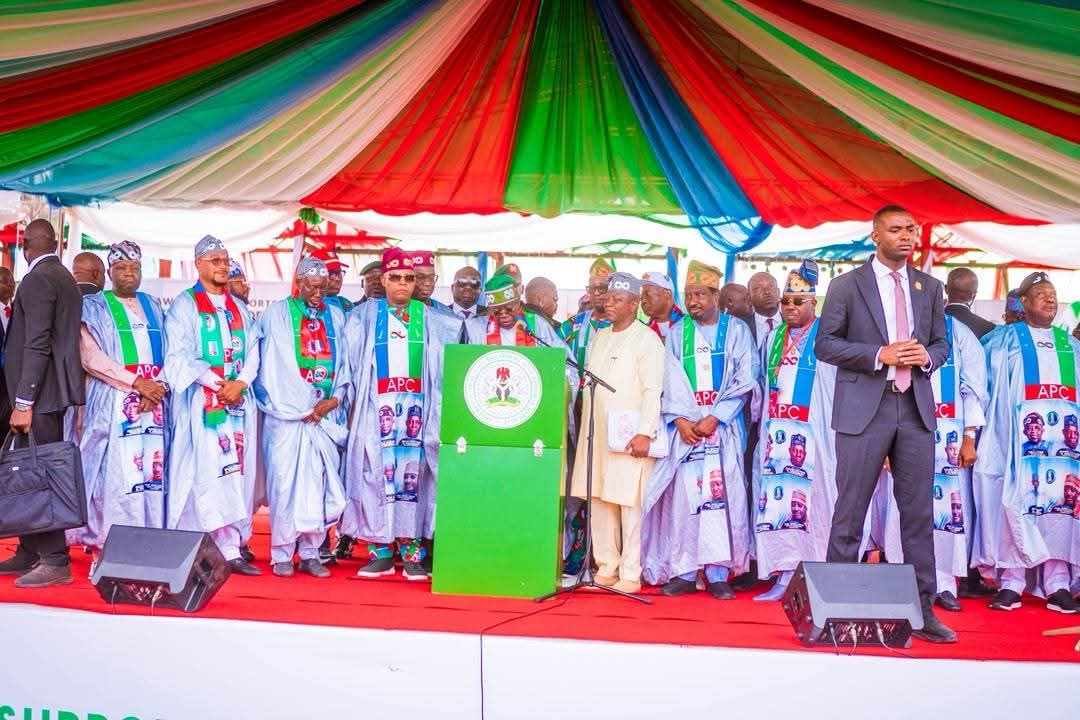
That was perhaps the message written across Dutse, the Jigawa State capital, as President Bola Ahmed Tinubu arrived for the All Progressives Congress (APC) presidential campaign rally.
The city was alive with political activities. APC flags and campaign banners adorned public spaces. Party leaders, ministers, government officials, security personnel and other dignitaries poured into the state capital. Private jets arrived at the Dutse International Airport, while hotels, roads and public facilities experienced an unusual surge of activity.
But beneath the excitement of the presidential visit was an extraordinary story of political irony and enduring vision.
The same city that rolled out the red carpet for an APC President was relying, at almost every turn, on infrastructure conceived, constructed or facilitated during the administration of a former PDP governor, Alhaji Sule Lamido.
It was a moment that brought into sharp focus why his admirers fondly describe him as the man who saw tomorrow.
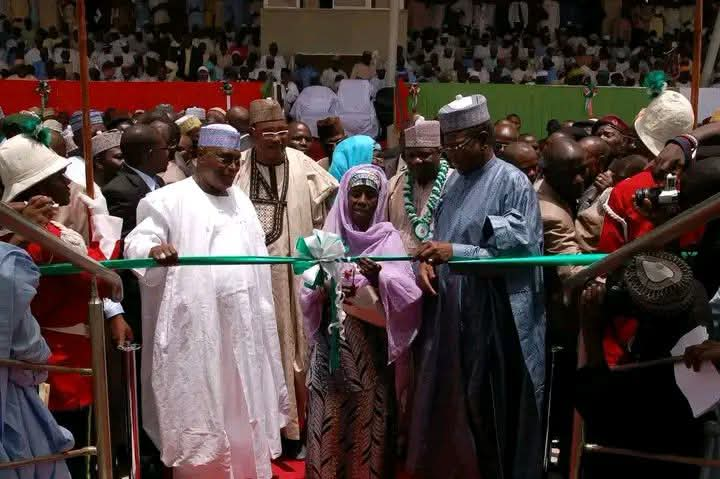
For Lamido, the development of Dutse was apparently not just about meeting the immediate needs of a state capital. It was about preparing a relatively young administrative centre for a future in which it would attract national attention, accommodate important visitors, support commercial activities and serve as a hub of government and political engagements.
Years after he left office, that vision was on display in a rather unexpected setting: a presidential campaign organised by the political party that succeeded his own.
The first chapter of this remarkable story began at the Dutse International Airport.
As Tinubu’s aircraft touched down, the facility was busy receiving the President and the array of political leaders and dignitaries accompanying him.
The airport, developed during Lamido’s administration, has become one of the strategic assets of Jigawa State. Its capacity to receive important visitors and private aircraft during a major political gathering demonstrated the importance of investing in infrastructure ahead of demand.
The symbolism was difficult to miss. The President of Nigeria had arrived at a facility built under a governor from a different political party, and the airport was performing precisely the kind of function for which such an investment was intended.
From the airport, the presidential movement through Dutse was expected to bring the convoy past another Lamido-era project: the skills acquisition centre in Limawa.
The facility, originally built during Lamido’s administration, has since been renovated and renamed after President Tinubu. Its new identity may reflect the current administration’s political moment, but its history remains connected to the former governor’s development programme.
The Dutse Stadium, the venue of the APC presidential campaign, provided another striking illustration.
Decorated with APC campaign materials and prepared for the ruling party’s political gathering, the stadium was constructed during Lamido’s second term in office.
The political banners may change with the times, but the physical structure remains.
Even the Aminu Kano Triangle, where tractors scheduled for the presidential launch had reportedly been kept for nearly two years, is part of the infrastructure developed during Lamido’s tenure.
It is an interesting coincidence that facilities created under a PDP administration have continued to provide the physical platform for activities organised by its political successor.
The story becomes even more compelling when the accommodation arrangements for the presidential entourage are considered.
The G9 Quarters, named after the founding members of the Peoples Democratic Party, was built during Lamido’s administration. Ministers and other senior government officials who arrived ahead of the President reportedly lodged there.
The Manpower Development Institute (MDI), another facility developed under Lamido, accommodated soldiers, personnel of other security agencies and some guests.
In other words, the facilities that provided accommodation for the people responsible for protecting, organising and managing the presidential visit were also part of the former governor’s development legacy.
The Ahmadu Bello Hall, where Tinubu’s support groups reportedly held a workshop ahead of the rally, was equally built during Lamido’s administration.
Even the Jigawa State Television premises, where members of the President’s advance team held a briefing with journalists, featured among the facilities associated with that period.
It is a remarkable chain of connections, stretching from the airport to the campaign venue, from accommodation facilities to the media infrastructure supporting the event.
Beyond individual buildings, Lamido’s development imprint is visible in the road network linking important locations in Dutse and other parts of the state.
The federal dual carriageway connecting the stadium area to the Malam Aminu Kano Triangle was constructed during the administration of the late President Umaru Musa Yar’Adua, when Lamido was governor and the late Hassan Muhammad Lawal served as Minister of Works, Housing and Urban Development.
The 38-kilometre Shuwarin-Kurna Huguma road was also dualised and completed during that period.
Within Dutse, the dual carriageway bypass linking the Federal University Dutse to Tahir Hotel was another significant road project associated with Lamido’s administration. Dantata and Sawoe handled the construction.
These roads were not merely constructed to beautify the state capital. They provided connectivity between institutions, commercial centres, accommodation facilities and other important locations.
Today, they continue to facilitate the movement of residents, visitors and government officials, including the presidential entourage.
Perhaps one of the less celebrated aspects of Lamido’s development philosophy was his effort to encourage private investment.
The influx of visitors for the presidential campaign placed considerable pressure on Dutse’s hospitality industry. Yet, the city has hotels and lodges that have helped accommodate the growing number of visitors.
Several of the establishments, including Tahir Guest Palace Hotel, Dutse Royal Hotel and the Federal University Dutse Hotel, emerged during Lamido’s administration.
According to accounts of the former governor’s development initiatives, land was made available to investors at no cost to encourage the establishment of hotels and expand the city’s hospitality capacity.
Other establishments, including B. Nakowa Hotel, Haitel and several smaller hotels and lodges, also emerged during the period.
The strategy was simple but significant: government alone could not provide all the facilities required by a growing state capital. Private investors needed encouragement, access to land and an environment in which their businesses could thrive.
The shopping centre, which has reportedly served members of the President’s advance team and other visitors, was established with support from Lamido’s administration.
The former governor reportedly provided the owner with land free of charge and facilitated dedicated electricity infrastructure, including a transformer and a special power line, to support business operations.
For years, the complex has remained one of Dutse’s major shopping destinations.
This was development beyond the construction of government buildings. It was an attempt to create an ecosystem in which private businesses could grow and serve the needs of an expanding population.
Lamido’s development record, as recalled by his supporters, also extended to the social and religious needs of residents.
The administration approved the establishment of Christian worship centres, creating room for churches such as Dunamis and Christ Embassy, among others, to operate in Jigawa State.
For a state capital with a growing and diverse population, such provisions were part of the broader responsibility of government to accommodate different communities and their needs.
The argument is that development should not be measured exclusively by roads, airports and stadiums. It should also be assessed by the opportunities created for businesses, religious communities, educational institutions and ordinary residents.
The real significance of Tinubu’s visit to Dutse may ultimately lie beyond the political spectacle.
It has reopened an important conversation about the continuity of governance, the preservation of public investments and what successive administrations have contributed to the foundations laid by their predecessors.
Lamido governed Jigawa State from 2007 to 2015. More than a decade after leaving office, the airport, stadium, roads, accommodation facilities, shopping complex and other institutions associated with his administration remain part of the infrastructure supporting the state’s public life.
For his admirers, the presidential visit was an opportunity for history to make its own assessment.
They argue that nearly every major location associated with the President’s activities in Dutse carried the imprint of Lamido’s years in office.
That is a powerful political talking point, particularly when the facilities are being used by a rival political party.
However, the larger lesson should not be lost in partisan exchanges. Public infrastructure belongs to the people, and successive governments deserve credit for maintaining, renovating and expanding inherited assets while adding new ones.
But history must also preserve the identities of those who initiated and delivered important projects.
The question that naturally follows is this: what comparable legacy will today’s political leaders leave behind for future generations?
As the APC campaign banners come down, the presidential entourage departs and the political excitement eventually fades, Dutse will remain.
Its airport will continue to receive visitors. Its stadium will host future gatherings. Its roads will carry commuters. Its hotels will accommodate guests, while its institutions will continue serving residents.
And in the middle of that enduring landscape will remain the imprint of Sule Lamido.
Perhaps that is the most compelling feature of his legacy: he is no longer in office, his party is no longer in power in Jigawa, yet the city continues to tell the story of what his administration built.
The political banners may belong to today, but much of the concrete beneath them belongs to yesterday’s vision. That is why, in Dutse, the man who saw tomorrow is still part of today’s story.