

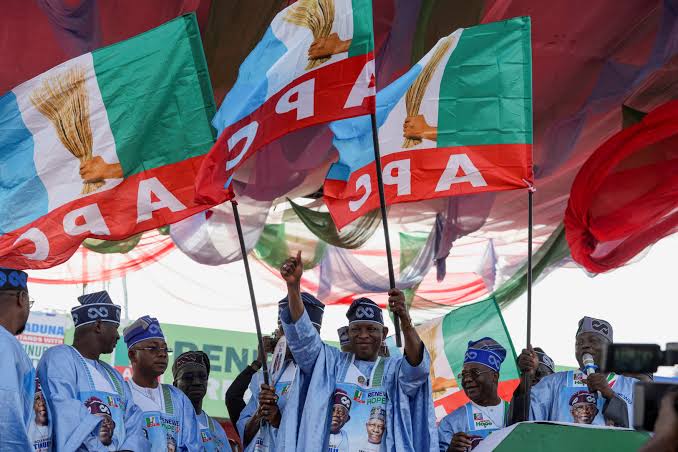

President Bola Tinubu has opened his 2027 re-election campaign with a promise to secure another term, but his bid faces mounting scrutiny over the rising cost of living, persistent insecurity and growing public demands for economic relief.
Tinubu launched the All Progressives Congress (APC) campaign on Saturday in Kaduna, urging supporters to return him to office in the January 16, 2027 presidential election.
“Come 2027, January 16, you must go out massively and elect me again,” the President told thousands of supporters gathered at the 10,000-capacity Ranchers Bees Stadium.

But the campaign’s opening rally also exposed the economic debate likely to shape the contest, as Tinubu defended his administration’s record and blamed previous political leaders for the hunger and poverty confronting Nigerians.
“They created the hunger. They created the poverty. We are trying to eradicate it,” he said.
The remark triggered a swift response from the camp of former Vice-President Atiku Abubakar, one of Tinubu’s principal challengers.
Atiku’s spokesperson, Phrank Shaibu, accused the President of shifting responsibility for the country’s economic difficulties instead of addressing the consequences of his administration’s policies.
“Mr President, blaming the opposition for hunger is either delusion or a staggering case of political amnesia,” Shaibu said.
The exchange highlights the political stakes surrounding Tinubu’s economic reforms, particularly the removal of petrol subsidies and the depreciation of the naira, which his administration says have improved public finances, foreign reserves and investor confidence.
However, the reforms have also increased pressure on households and businesses already struggling with high food prices, transportation costs and expensive essential services.
Petrol prices reached about N1,400 per litre in Lagos and Abuja in September and as much as N1,500 in parts of northern Nigeria, according to Reuters, further straining household budgets.
As the election approaches, Tinubu must convince voters that his economic policies will deliver tangible improvements in their living conditions, even as opposition parties challenge his handling of the economy.
Beyond the economy, persistent insecurity presents another major test for the President as banditry, kidnappings and attacks by armed groups continue to threaten communities across the country.
The North-West remains troubled by banditry and mass abductions, while the North-East continues to battle an Islamist insurgency that has lasted nearly 17 years.
Tinubu’s decision to launch his campaign in Kaduna places his re-election bid against the backdrop of security concerns affecting parts of northern Nigeria, where Atiku also maintains an established political base.
Former Anambra State governor Peter Obi, another leading contender, is also expected to challenge the President as political parties intensify preparations for the 2027 election.
Despite these challenges, Tinubu enters the campaign with substantial political backing. His camp claims the support of 32 of Nigeria’s 36 state governors, giving the APC a potentially formidable organisational advantage.
However, governors’ influence does not automatically translate into presidential votes, leaving the party with the task of converting its political network into broad voter support.
The President has indicated that he will not personally attend rallies in all 36 states, saying he must balance campaign activities with the responsibilities of governing.
Under the proposed timetable, Tinubu is expected to attend rallies in 12 states, with the campaign scheduled to culminate in Lagos, his home state, on January 9.
The strategy allows the APC to deploy its political structures across the country while limiting the President’s personal campaign appearances.
Ultimately, Tinubu’s second-term bid will face questions extending beyond the size of his rallies and the number of political leaders backing him.
Voters will weigh his administration’s economic record, its response to insecurity and its ability to ease the hardship affecting households as the presidential contest gathers momentum.