

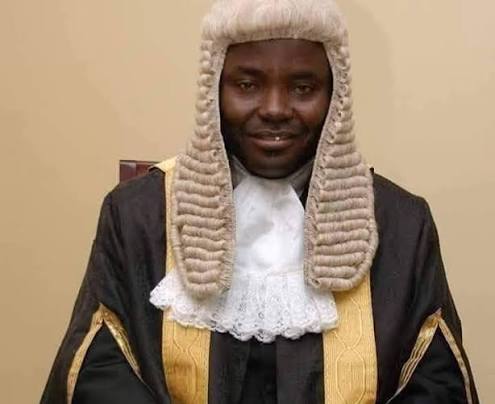

Senior lawyer, Jibrin Samuel Okutepa, SAN, has faulted the Imo State Attorney-General over his objection to the National Judicial Council’s (NJC) intervention in the appointment of a substantive Chief Judge for the state.
Okutepa described the Attorney-General’s position as misconceived, insisting that the NJC acted within its constitutional responsibilities by asking the Imo State Judicial Service Commission to include Justice Ijeoma Agugua in the list of candidates for consideration.
Justice Agugua is the most senior judge of the Imo State High Court and currently serves as Acting Chief Judge.


Okutepa said the NJC’s request did not mean that Justice Agugua must automatically become the substantive Chief Judge.
Rather, he said, it would give her a fair opportunity to be assessed alongside other eligible candidates.
The senior lawyer explained that the Constitution gives different responsibilities to the State Judicial Service Commission, NJC, governor and State House of Assembly in the appointment process.
He cited Paragraph 6(a), Part II of the Third Schedule to the Constitution, which empowers the State Judicial Service Commission to advise the NJC on suitable candidates.
He also cited Paragraph 21(c), Part I, which empowers the NJC to recommend a candidate from the names submitted to it.
Under Section 271(1), the governor appoints a Chief Judge on the recommendation of the NJC, subject to confirmation by the State House of Assembly.
Addressing the Attorney-General’s reliance on Section 202, Okutepa argued that the provision on the independence of the Judicial Service Commission should not be used to frustrate the NJC’s constitutional responsibilities.
He said the appointment process required cooperation between the institutions, with each respecting the responsibilities of the others.
Okutepa also noted that the NJC’s appointment guidelines recognise seniority at the Bar or Bench as an important consideration, alongside professional competence, legal knowledge and other qualifications.
He argued that excluding the most senior judge should require a clear and reasonable explanation based on established criteria.
However, he clarified that seniority does not automatically guarantee appointment as substantive Chief Judge.
He explained that Section 271(4) provides for the most senior High Court judge to perform the functions of Chief Judge under certain circumstances, but does not give that judge an automatic right to the substantive position.
Okutepa maintained that there was no legal justification for excluding Justice Agugua without properly explaining the reasons.
He urged the Attorney-General to support a transparent selection process in which all eligible candidates would receive fair consideration.
According to him, any concerns about Justice Agugua’s suitability should be presented and examined on their merits.
He said the office of Chief Judge was a public trust and that the appointment process must protect public confidence in the independence and integrity of the judiciary.
Okutepa concluded that the NJC was right to demand Justice Agugua’s inclusion, insisting that her exclusion without a valid legal basis was unjustifiable.