

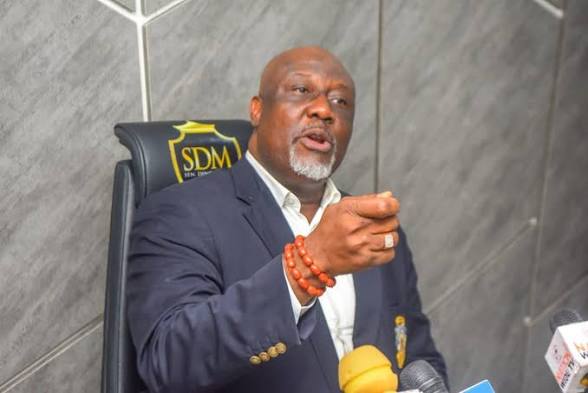
Former Kogi West Senator, Dino Melaye, has pointed to Germany’s decision to cut taxes on petrol and diesel as proof that government intervention remains a legitimate option when rising fuel prices begin to squeeze households and businesses.
Melaye said the German measure had strengthened the argument being advanced by former Vice President and African Democratic Congress presidential candidate, Atiku Abubakar, for a temporary government intervention to cushion Nigerians from the high cost of petrol.
Germany recently announced a temporary €0.17-per-litre reduction in taxes on petrol and diesel as part of measures to ease the impact of soaring energy prices.
For Melaye, the development is significant because it challenges the argument that government must completely withdraw from the fuel market and leave consumers to absorb the full impact of global price shocks.
His comparison comes as Atiku’s proposal for a temporary petroleum subsidy has become a major issue in the 2027 political debate.
Atiku has said he would restore subsidy, but his camp has clarified that the proposed intervention would not be a return to the old import-dependent system.
Instead, his aides said the plan would focus on supporting domestic crude production and refining, with the intervention designed to cushion consumers while Nigeria expands local refining capacity.
The former vice president has argued that subsidy, in itself, is not necessarily the problem, but that the real challenge is how such interventions are designed, managed and accounted for.
That position has attracted criticism from the ruling All Progressives Congress, whose Presidential Campaign Council has demanded details of how Atiku intends to finance and administer the proposed subsidy.
But Melaye’s Germany comparison has shifted the focus to a broader question: whether governments should absorb part of the shock when fuel prices rise sharply, or allow the entire burden to fall on consumers.
Nigeria’s experience since the removal of petrol subsidy on May 29, 2023, has kept that question at the centre of the country’s economic debate.
The policy ended the government’s direct support for petrol prices but was followed by a steep rise in transport fares, food prices and the general cost of living.
With Germany now deploying temporary tax relief to reduce pressure on motorists and businesses, Melaye said the development had given Atiku’s argument a fresh international reference point.
The emerging debate is therefore no longer simply about whether subsidy should exist, but about whether Nigeria can design a temporary, transparent and targeted intervention that protects consumers without recreating the weaknesses associated with the former subsidy regime.