


Douglas Baye-Osagie
dbayeosagie@yahoo.com
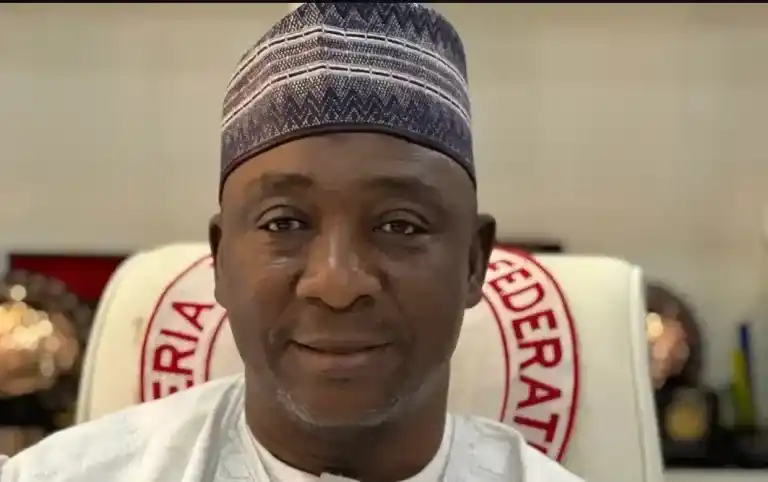
Ibrahim Gusau’s resignation as President of the Nigeria Football Federation should not be mistaken for an achievement. After four years in charge, he leaves behind a federation facing one of the darkest periods in Nigerian football history. His decision to finally step aside came only after mounting pressure, public anger and intense scrutiny following a succession of failures across Nigerian football.
Gusau may describe his departure as a patriotic decision taken in the interest of Nigerian football, but Nigerians are entitled to ask why he waited until the final stretch of his tenure to act. If reform was genuinely necessary, why was resignation not considered earlier? His departure looks less like a voluntary act of leadership and more like the inevitable conclusion of an administration that had run out of answers.

The record under Gusau is difficult to defend. The Super Eagles failed to qualify for the 2026 FIFA World Cup, continuing Nigeria’s worrying decline at the biggest stage of international football. For a country with Nigeria’s football resources, talent and history, consecutive World Cup absences should have been treated as an institutional emergency, not simply another disappointing result.
But the biggest stain on the Gusau era came from the Super Falcons. Nigeria failed to qualify for the 2027 Women’s World Cup, ending the country’s extraordinary record of appearing at every edition of the competition since its inception in 1991.
That failure was historic and unforgivable. The Falcons had survived generations of players, coaches and NFF administrations, yet the record finally collapsed under Gusau’s watch. Losing 2-1 to South Africa in the qualification play-off was not merely another defeat; it represented the destruction of one of Nigerian football’s most remarkable traditions.
The response was equally revealing. Instead of immediately accepting responsibility, the federation apologised to President Bola Tinubu and Nigerians and subsequently set up a fact-finding process. The question Nigerians should ask is simple: who ultimately takes responsibility when an institution fails at something it had achieved consistently for more than three decades?
The crisis was not confined to the senior teams. Nigerian youth football, once the envy of the world, also suffered under the Gusau administration. The Golden Eaglets repeatedly failed to reach the FIFA U-17 World Cup, while the country’s U-20 pathway suffered another major setback with failure to qualify for the relevant continental and world competitions.
This is perhaps the most troubling aspect of the Gusau legacy. Senior teams can sometimes be rescued by exceptional players, but youth football represents the future. Repeated youth failures suggest that the problem goes beyond one coach or one bad generation. They raise fundamental questions about scouting, grassroots development, competitions, coaching and the NFF’s long-term football strategy.
Nigeria once produced youth teams capable of dominating the world. The Golden Eaglets have won the FIFA U-17 World Cup five times. That legacy was built through systems that identified and developed talent. Under Gusau, however, Nigeria increasingly appeared to be living on the achievements of previous generations rather than producing a comparable pipeline for the future.
Gusau’s defenders will argue that he inherited serious problems. That is true. But every federation president inherits problems. Leadership is not measured by the problems you inherit; it is measured by the condition of the institution you leave behind. After four years, Nigerians have every right to ask whether the NFF is stronger, more professional and more credible than it was when Gusau took over.
Gusau has highlighted some achievements, including coaching education, refereeing development, infrastructure and the Super Falcons’ 2025 WAFCON triumph. Those achievements should not be erased. But neither should they be allowed to obscure the larger picture. Winning WAFCON while subsequently failing to qualify for the Women’s World Cup illustrates precisely why isolated achievements cannot substitute for institutional consistency.
The NFF also became increasingly surrounded by questions over governance and financial management. Reports of scrutiny surrounding the utilisation of a federal intervention fund added another layer to an already difficult final period. Such allegations must be investigated properly and should not be treated as proof of wrongdoing, but they demonstrate the level of distrust that had developed around the federation.
The timing of Gusau’s resignation is therefore significant. His tenure was already approaching its scheduled conclusion, with the NFF election expected in September. Yet he and other senior officials chose to leave earlier, after pressure surrounding the federation had intensified. Whatever explanation is ultimately given, Nigerians cannot ignore the political and institutional circumstances surrounding the decision.
There is also an uncomfortable contradiction in Gusau’s farewell message. He says his resignation will create room for comprehensive reform, yet his administration had four years to undertake that reform. If the system now requires such urgent restructuring, then the obvious question is why the leadership did not recognise the urgency sooner.
Calling Gusau the worst NFF president of the past 40 years is ultimately a judgement rather than an objective statistic. But it is a judgement that his record makes difficult to dismiss. Men’s World Cup failure, the historic women’s World Cup failure, repeated youth setbacks, governance controversies and the eventual collapse of his board’s leadership make his tenure one of the most disappointing periods in modern Nigerian football.
The greatest tragedy is that Nigeria possesses everything necessary to succeed. It has millions of football-loving citizens, exceptional players, world-class talent, strong commercial potential and an extraordinary football history. What it has repeatedly lacked is an administration capable of converting those advantages into sustainable success.
Gusau therefore leaves behind more than a resignation. He leaves behind a responsibility for the next administration to rebuild Nigerian football from the foundations. That means reforming youth development, strengthening women’s football, improving national-team preparation, professionalising administration, ensuring financial transparency and creating systems that are bigger than individual personalities.
The next NFF election must not simply produce another set of office holders. It must produce a new philosophy. Nigerian football does not need administrators whose greatest ambition is to win another election. It needs leaders whose ambition is to develop the next generation of Nigerian footballers and restore the country’s place among the world’s football powers.
Gusau’s resignation should therefore be treated as the beginning of accountability, not the end of the conversation. Let the records be examined, the finances scrutinised, the decisions reviewed and the failures honestly assessed. Nigerians deserve to know why a football federation blessed with so much talent repeatedly failed to deliver.
Ultimately, history will judge Gusau not by the language of his farewell press conference but by what happened to Nigerian football while he was in charge. The Super Eagles missed the World Cup. The Super Falcons missed the Women’s World Cup for the first time in history. The youth pipeline suffered serious setbacks, and the federation ended his tenure under enormous pressure. Whatever achievements he may point to, those failures will remain central to his legacy.
Gusau has walked away, but the consequences of his administration remain. Nigerian football now needs a genuine reset—not another change of names, promises and political alliances. The next leadership must understand that the NFF belongs to Nigerian football, not to the individuals who occupy its offices. After four years of disappointment, the country deserves nothing less than competent, transparent and accountable leadership.