


Abuja was conceived as a carefully planned capital—a city where residential districts, green areas, roads, drainage systems and natural waterways would function together as parts of an integrated urban system.
Yet the latest flooding in Maitama Extension has exposed a disturbing contradiction at the heart of Abuja’s development story: a capital designed to control urban growth is increasingly struggling to control the powerful interests reshaping its landscape.
The irony is difficult to miss.


The Abuja Master Plan provides designated corridors through which stormwater is expected to flow. Green areas are intended to provide environmental buffers, while drainage networks are supposed to protect communities from flooding.
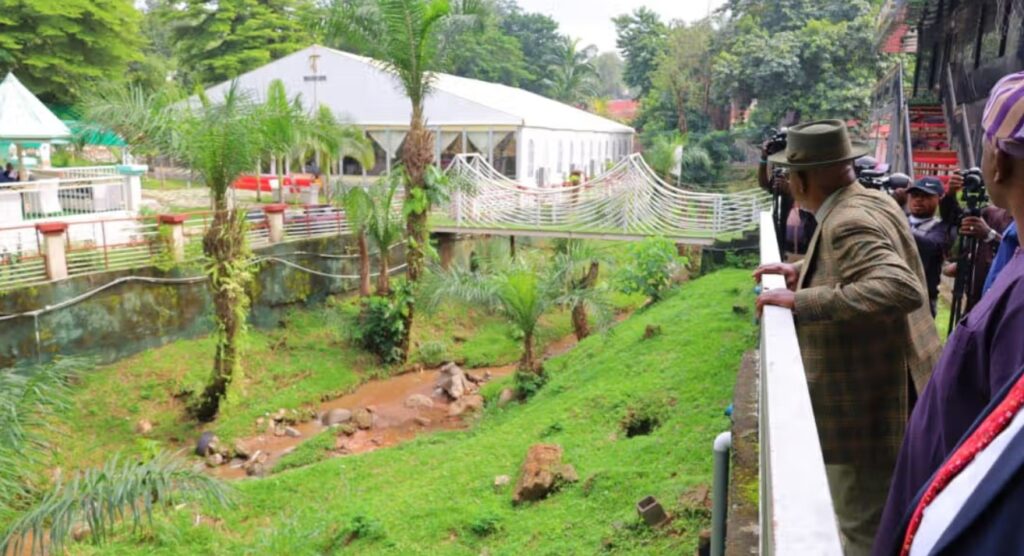
But according to FCT Minister Nyesom Wike, some property owners have built directly on channels designated in the Master Plan for stormwater.
The consequences became painfully visible when parts of Maitama Extension were submerged by flood.
Wike’s response was unusually blunt. He ordered the immediate demolition of structures obstructing waterways and declared that no senator, minister or other “big man” would be protected from enforcement.
“Any house that’s found on the water channel will go down,” he said.
The statement may sound like a conventional enforcement announcement, but it carries a much larger implication: if these structures are indeed illegal, how did they survive for years in one of Nigeria’s most closely watched districts?
That is the question Abuja cannot escape.
A city does not wake up one morning to discover that a major drainage corridor has disappeared beneath expensive buildings. Construction requires land allocation, planning processes, development approvals, inspections and, in some cases, years of government visibility.
So the real scandal, if the allegations are established, is not simply that wealthy Nigerians built where they should not have built.
It is that the system designed to prevent such construction may have failed—or looked away.
The controversy becomes even more serious where green areas are involved.
Abuja’s green spaces are not merely decorative pieces of land waiting for development. They form part of the ecological and planning infrastructure of the capital. They provide open spaces, environmental buffers and, depending on their location, can help accommodate stormwater.
When such spaces are converted or occupied without lawful planning approval, the consequences extend far beyond the boundaries of an individual property.
The flooding of one neighbourhood can therefore be connected to decisions made years earlier about land use.
A canal is covered.
A drainage corridor is narrowed.
A green area disappears.
A building rises.
Then heavy rainfall arrives—and the water searches for the route that development has taken away.
That is when what appeared to be a private land transaction becomes a public disaster.
Climate change and increasingly intense rainfall are genuine factors in the growing flood risk facing cities around the world. Wike himself acknowledged that flooding can be a natural disaster.
But natural rainfall becomes catastrophic when human development removes the city’s ability to absorb, channel and discharge water safely.
Blocked drains, refuse dumped into waterways, inadequate maintenance and construction across drainage corridors can turn heavy rainfall into a crisis.
That distinction is important.
Blaming flooding entirely on climate change risks allowing planning failures to escape scrutiny. Conversely, blaming every flood exclusively on illegal construction ignores the changing rainfall patterns confronting modern cities.
Abuja needs to confront both.
Wike’s decision to order demolition may therefore be necessary where structures are confirmed to have violated planning laws.
But demolition should not be the end of the investigation.
It should be the beginning.
For every structure removed from a waterway, Nigerians deserve to know:
Who allocated the land?
What was the original designated land use?
Was development approval granted?
Who inspected the site?
When did authorities first become aware of the encroachment?
Was the drainage corridor altered legally or illegally?
Who approved any change to the original planning designation?
And perhaps the most important question:
Why did enforcement wait until people’s homes were underwater?
If an ordinary Nigerian builds an unauthorised structure, government agencies can move swiftly.
The true test of Wike’s declaration will therefore come when enforcement reaches properties associated with influential politicians, businessmen and senior public officials.
His statement that “no senator, minister or big man” will be spared has created a standard against which the FCT Administration can now be judged.
The bigger Abuja contradiction
There is a deeper irony here.
Abuja was supposed to demonstrate what disciplined urban planning could achieve in Nigeria. Instead, parts of the capital are now confronting the consequences of the very disorder the city’s planning framework was designed to prevent.
The contradiction is stark:
A planned city is being damaged by unplanned privilege.
The city has a Master Plan, but powerful development pressures can challenge the plan.
It has designated waterways, but construction can obstruct them.
It has green areas, but land scarcity and commercial interests create pressure to convert them.
It has planning authorities, but illegal developments can apparently remain for years.
And it has drainage infrastructure, yet residents still find themselves asking where the water is supposed to go.
The Maitama flooding should therefore not be treated simply as another seasonal disaster.
It should become an opportunity to conduct a comprehensive audit of Abuja’s urban development.
Every major drainage corridor should be mapped.
Every designated green area should be identified and protected.
Every suspicious land-use conversion should be investigated.
Every structure built across a waterway should face the law.
And where approvals were improperly issued, accountability should not stop at the property owner.
Follow the water—and follow the paperwork
The most important lesson from the Maitama flooding is that water remembers the city’s original geography even when concrete tries to erase it.
If Abuja’s waterways have been covered, narrowed or blocked, the water will eventually find another route.
Sometimes that route will be a road.
Sometimes a neighbourhood.
Sometimes a mansion.
The question now is whether the FCT Administration will simply demolish some buildings and move on, or use the flooding crisis to expose the deeper network of planning failures that allowed development to invade the city’s environmental and drainage infrastructure.
Wike has declared war on structures obstructing Abuja’s waterways.
The next battle should be against the system that allowed those structures to get there in the first place.
Because if Abuja’s waterways are being reclaimed only after floods expose them, then the capital does not merely have a flooding problem. It has a planning, enforcement and accountability problem.