

Close Menu
National Update
    Facebook X (Twitter) Instagram
    Trending
    • Ganduje Questions Nigeria’s Capacity to Reform Judiciary
    • Wike Backs Tinubu for 2027, Says He Won’t Leave Rivers Empty-Handed
    • FFDGN Chairman Warns Nigerian Leaders Against Arrogance, Calls for Accountability
    • FG confirms Ebola case in Abuja, traces 44 contacts
    • Yari’s Buhari Remark Hands ADC a Ready-Made Campaign Weapon
    • Air Force Confirms Strike Hit the Heart of ISWAP’s Inner Circle in Lake Chad
    • Alia fires back at Wike: ‘Benue is not Rivers, I’m not Fubara’
    • ₦9tn NLNG Dividends: Makinde Challenges Presidency on States’ Shares
    Facebook X (Twitter) Instagram
    National UpdateNational Update
    Subscribe
    • News
    • Politics
    • Opinion
    • Economy
    • Entertainment
    • Health
    • Security
    National Update
    Home»Law

    Justice Ajileye draws fresh scrutiny over Electoral Act safeguards for 2027 polls

    By National UpdateJuly 5, 2026 Law No Comments3 Mins Read
    Share
    Facebook Twitter WhatsApp LinkedIn Email

    Fresh concerns are being raised about the strength of Nigeria’s electoral legal framework ahead of the 2027 general elections, following warnings that recent amendments to the Electoral Act may have weakened safeguards intended to protect the integrity of election results.

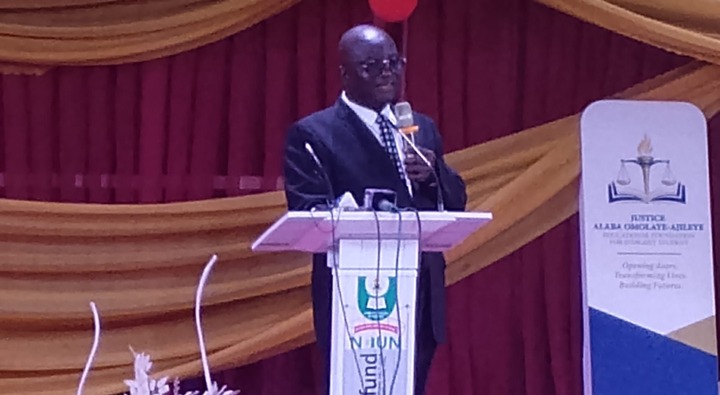
    The concerns were raised by retired High Court judge and electronic evidence expert, Justice Ajileye, who said the amended law expands the use of technology for voter accreditation but still leaves significant gaps in the transmission and collation of results.

    Speaking in Abuja at the public presentation of his books, Electronic Evidence (Second Edition) and Compendium of Cases on Electronic Evidence, Volume II (2020–2025), the retired jurist said the legislation contains provisions that could undermine the transparency the electronic reforms were meant to deliver.

    According to him, the amended Electoral Act makes the Bimodal Voter Accreditation System (BVAS) compulsory for voter accreditation, but still allows election officials to revert to manual procedures whenever electronic transmission of results fails.

    He said it is necessary to acknowledge technological limitations, but argued that the law does not set out strict conditions for abandoning electronic transmission.

    “The weakness of the amendment is not that it recognises the possibility of technological failure,” he said. “The defect lies in making manual recording or manual collation the automatic fallback without imposing strict safeguards.”

    Justice Ajileye warned that the absence of clearly defined procedures could create room for abuse, especially in politically sensitive polling units where claims of technical failure may be contested.

    He asked who should determine that electronic transmission has truly failed, how many attempts should be made before manual collation is permitted, and what documentary or digital evidence should be required before officials can abandon electronic transmission.

    In his view, the law does not adequately answer these questions, leaving legal grey areas that could weaken public confidence in election outcomes.

    To strengthen the process, he proposed several safeguards, including compulsory incident reports by presiding officers, multiple electronically logged transmission attempts, certification of any technical failure by party agents and security personnel, preservation of results on secure offline devices, and mandatory transmission from the nearest location with network connectivity before manual collation is allowed.

    He also urged the Independent National Electoral Commission (INEC) to publicly disclose every instance of failed electronic transmission, including the reasons, technical reports and digital logs tied to each incident.

    Without such measures, he warned, the amendment risks providing “statutory cover to the very opacity that electronic transmission was introduced to eliminate.”

    The retired judge’s intervention has revived debates that shaped legislative consideration of the Electoral Act amendment, during which lawmakers were divided over whether electronic transmission of results should be compulsory or whether INEC should retain discretion where technological challenges arise.

    Supporters of mandatory electronic transmission argued that it would reduce opportunities for result manipulation during collation, while others insisted that poor network coverage in parts of the country made an absolute requirement unrealistic.

    The final amendment retained electronic transmission but allowed manual alternatives where technical failures occur—a compromise that Justice Ajileye believes still requires stronger legal and operational safeguards.

    His remarks come as political activity gradually gathers pace ahead of the 2027 general elections and as election stakeholders continue to push for reforms aimed at deepening public confidence in the electoral process.

    The intervention is expected to renew calls for either further amendments to the Electoral Act or more detailed operational guidelines from INEC to ensure that manual fallback provisions are not exploited to undermine the credibility of election results.

    Previous ArticlePFIPC controversy deepens as Tietie alleges institutional collapse
    Next Article APC House of Reps primary faces legal challenge as court fixes July 9 hearing

    Keep Reading

    Mambilla: Agunloye Seeks Discontinuation of Trial After Paris Ruling

    Kebbi Court Convicts 19 for Terrorism, Illegal Arms, Cable Theft

    Kogi Court Sentences Abdulmutalib Abduljabar to Death for Murder

    N10bn Privacy Battle: Court Backs EFCC’s Search of Achimugu’s Home

    FG’s Case Against Alleged Fake Agency Boss Falters Over Court Jurisdiction

    El-Rufai’s bail battle deepens as Appeal Court weighs fresh legal challenge

    Add A Comment

    Comments are closed.

    Advert
    VGC Advert
    Most Viewed Posts
    • Breaking: Intrigues, as ADC suspends its presidential candidate, Kachikwu, accuses him of blackmail (1,841)
      The African Democratic Congress (ADC) has suspended its presidential candidate Dumebi Kachikwu, from the party, accusing him of false, misguided and defamatory video he made and circulated, among other infractions. The party also considered Kachikwu's action as "smacks of crass irresponsibility, gross indiscipline, disingenuous scandalization and blackmail, and completely unfit of someone who wants to
    • Ex-Kogi Gov’s Arraignment Stalled at the instance of EFCC Counsels (1,431)
      The arraignment of the former Governor of Kogi State, Yahaya Bello, on an alleged money laundering case instituted against him by the Economic and Financial Crimes Commission (EFCC), has been adjurned to June 27, by the Federal High Court, in Abuja, based on an agreement by the counsels to the two parties. A new date,
    • Concerned Religious Prayer Forum Responds to Criticism of National Prayer Initiative (1,301)
      The Concerned Religious Prayer Forum has issued a statement clarifying its mission and responding to recent criticisms surrounding its seven-day national prayer initiative. Established as a non-governmental organization on January 9, 2024, the Forum emphasizes that it is an independent group composed of citizens motivated by a shared desire to promote peace, unity, and prosperity
    • North Central Serving Governor withdrew N60 billion cash in six years ― EFCC (1,258)
      A serving Nigerian governor has allegedly withdrawn N60billion from his state’s purse. The Economic and Financial Crimes Commission (EFCC) said that he has lifted about N60 billion cash from state coffers in about his six years in office. The governor remains unnamed and his state, partially identified as domiciling in the North Central of the
    • Qatar Charity Empowers 60 Jigawa Widows, Vulnerable Persons with ₦300m (1,193)
      By Ahmed Rufa’i, Dutse The Qatar Charity Organization has donated economic empowerment equipment valued at over ₦300 million to 60 widows and vulnerable persons across the 27 local government areas of Jigawa State. The items were distributed during a ceremony held at the Banquet Hall of the Government House, Dutse, and presided over by the

    Latest News

    Ganduje Questions Nigeria’s Capacity to Reform Judiciary

    October 20, 2026

    Wike Backs Tinubu for 2027, Says He Won’t Leave Rivers Empty-Handed

    October 20, 2026

    FFDGN Chairman Warns Nigerian Leaders Against Arrogance, Calls for Accountability

    October 20, 2026

    FG confirms Ebola case in Abuja, traces 44 contacts

    October 20, 2026

    Yari’s Buhari Remark Hands ADC a Ready-Made Campaign Weapon

    October 20, 2026

    Subscribe to Updates

    Get the latest creative news from FooBar about art, design and business.

    National Update
    Facebook X (Twitter) Instagram
    © 2026 National Update. Designed by Lamark Cre8ives.

    Type above and press Enter to search. Press Esc to cancel.