

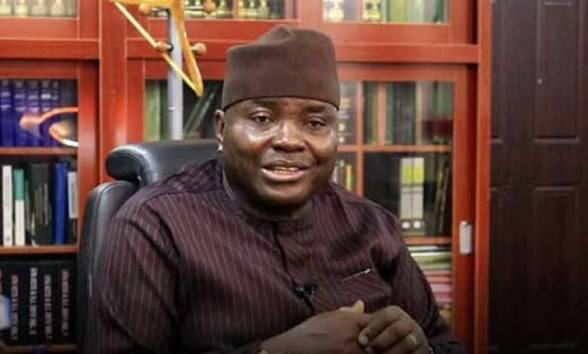

Senior Advocate of Nigeria (SAN), Jibrin S. Okutepa, has strongly criticized the Federal High Court’s handling of the controversial judgment ordering the deregistration of the African Democratic Congress (ADC) and four other political parties, arguing that the trial court acted in disregard of a subsisting order of the Court of Appeal.
Speaking during a television interview following the appellate court’s decision to halt the execution of the judgment, Okutepa described the development as a significant test of judicial discipline, constitutional order and respect for the hierarchy of courts in Nigeria.
The Court of Appeal had unanimously ordered the Independent National Electoral Commission (INEC) to suspend implementation of the Federal High Court judgment and further held that the lower court proceeded despite an earlier appellate order staying proceedings in the matter.
Okutepa, who clarified that he represented former Senate President David Mark and not the ADC itself, argued that the issue extends beyond the fate of a few political parties and strikes at the foundation of the rule of law.
According to him, the judicial system is built on obedience to superior court orders, regardless of whether a lower court agrees with such decisions. He maintained that once the Court of Appeal ordered a stay of proceedings, the trial court was legally bound to halt every aspect of the case, including judgment delivery.
Describing the situation in unusually strong terms, he said what occurred appeared to be “judicial insubordination” and “judicial impertinence,” stressing that no lower court has the authority to disregard a valid order from a superior court.
Okutepa explained that under established legal principles, decisions of the Supreme Court bind the Court of Appeal, while decisions of the Court of Appeal bind all lower courts. In his view, the doctrine of precedent and judicial hierarchy are essential pillars of legal certainty and constitutional governance.
He argued that even if a judge believes a superior court’s decision is erroneous, the proper course is obedience followed by legal challenge through appropriate appellate channels, not unilateral disregard.
The SAN further maintained that the constitutional requirement contained in Section 287 obliges all authorities and courts to enforce and comply with decisions of superior courts.
On the legal effect of the Federal High Court judgment, Okutepa noted that the Court of Appeal has already suspended its execution, emphasizing that parties dissatisfied with a judgment must challenge it through appeals rather than resort to self-help.
He stressed that the law does not permit individuals or institutions to disobey court orders merely because they consider them invalid, insisting that such orders remain binding until set aside by a competent court.
Turning to the role of INEC, Okutepa praised the electoral commission’s conduct in the proceedings. He pointed to affidavit evidence filed by the commission indicating that the affected political parties had satisfied constitutional requirements for continued registration.
According to him, INEC presented records showing that the parties met conditions stipulated by law and that the plaintiff lacked the legal standing necessary to maintain the suit.
He highlighted constitutional provisions introduced through electoral reforms which empower INEC to deregister political parties only under specified circumstances. He argued that the relevant constitutional provisions are disjunctive rather than cumulative, meaning a political party needs to satisfy any applicable constitutional requirement rather than all possible conditions simultaneously.
Okutepa cited examples allegedly contained in INEC’s records showing electoral victories secured by some of the affected parties in various elections, including representation in legislative bodies.
He questioned the legal standing of the plaintiffs who initiated the action and argued that there was insufficient basis for compelling INEC to deregister the parties.
The senior lawyer also raised concerns about the nature of the reliefs sought before the court. He suggested that where a public institution is alleged to have failed in carrying out a statutory duty, litigants are generally expected to demonstrate prior demand and refusal before seeking judicial intervention.
On the broader implications for the judiciary, Okutepa warned that public confidence in the justice system can be undermined whenever courts appear divided over obedience to superior court orders.
He emphasized that judicial independence depends not only on constitutional guarantees but also on public perception that judges act impartially and in accordance with established legal principles.
According to him, perceptions that judicial decisions are influenced by political interests can weaken faith in democratic institutions and damage the credibility of the courts.
Asked whether the conduct complained of could amount to judicial misconduct, Okutepa declined to make a definitive pronouncement but stated that it “appears to be so.” He said individuals who feel aggrieved by the actions of any judicial officer have established procedures through which complaints can be pursued.
The SAN also argued that accountability mechanisms within the legal profession and judiciary require greater effectiveness. He lamented what he described as the absence of sufficient consequences for professional misconduct and called for stronger enforcement of ethical standards.
While acknowledging that judges bear significant responsibility, he stressed that lawyers equally have obligations as officers of the court and must avoid conduct capable of bringing the administration of justice into disrepute.
Looking ahead to the 2027 elections, Okutepa urged judicial officers to exercise caution in politically sensitive matters and ensure that their decisions reinforce democratic development rather than create uncertainty.
He maintained that cases affecting political participation and democratic competition must be approached with exceptional care because of their far-reaching implications for governance and constitutional stability.
Ultimately, Okutepa argued that the more troubling issue is not merely the attempt to deregister political parties but the allegation that a lower court proceeded in the face of a valid order from a superior court. In his view, respect for judicial hierarchy remains indispensable to the survival of constitutional democracy and the rule of law in Nigeria.