
Close Menu
National Update
    Facebook X (Twitter) Instagram
    Facebook X (Twitter) Instagram
    National UpdateNational Update
    • News
    • Politics
    • Opinion
    • Economy
    • Entertainment
    • Health
    • Security
    National Update
    Home»Law

    Electronic evidence reshapes Nigerian jurisprudence through Omolaye-Ajileye scholarly contributions

    National UpdateBy National UpdateJune 23, 2026 Law No Comments3 Mins Read
    Share
    Facebook Twitter LinkedIn Pinterest Email

    Nigeria’s legal system is undergoing a quiet but profound transformation, driven less by statute books alone and more by the disruptive force of technology. At the centre of this shift is the growing body of jurisprudence on electronic evidence — an area that continues to redefine how courts interpret truth in the digital age.

    Against this backdrop, the forthcoming scholarly engagement with the works of Justice (Prof.) Alaba Omolaye-Ajileye offers more than an academic event. It represents a timely interrogation of how Nigerian law is adapting to evidence that now lives on servers, smartphones, and digital networks rather than in paper files.

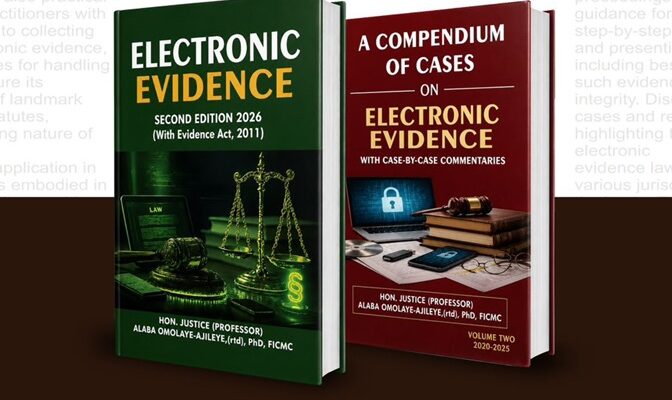
    The spotlight will fall on two major publications: Electronic Evidence (Second Edition, 2026) and A Compendium of Cases on Electronic Evidence, Volume Two (2020–2025). Together, they map both the doctrinal foundations and the evolving case law that continue to shape admissibility, authenticity, and reliability standards in Nigerian courts.

    What makes electronic evidence particularly complex is not merely its form, but its fluidity. Unlike traditional documentary evidence, digital material can be easily altered, duplicated, or transmitted across multiple platforms, raising persistent questions about integrity and chain of custody. Nigerian courts, like many across the world, are still refining how best to respond.

    The significance of Justice Omolaye-Ajileye’s work lies in its attempt to systematise this evolving terrain. The updated second edition builds on earlier jurisprudential analysis that has already become a reference point for judges, practitioners, investigators, and law students grappling with Section 84 of the Evidence Act and its practical application in an increasingly digital courtroom.

    Even more instructive is the companion volume, which compiles judicial decisions from 2020 to 2025 — a period marked by rapid expansion in cyber-related litigation, electronic transactions, and digitally sourced criminal investigations. The book effectively captures how appellate and trial courts are gradually constructing a coherent framework around electronic proof.

    The scholarly review of these works by Professors Alex A. Izinyon, OFR, SAN, and Dakas C.J. Dakas, SAN, further underscores their doctrinal importance. Both jurists bring complementary strengths: Izinyon’s expertise in advocacy and dispute resolution, and Dakas’ deep engagement with constitutional law and legal reform. Their perspectives are expected to sharpen debate on whether Nigeria’s current evidential standards are sufficiently robust for the digital era.

    Beyond the technicalities of admissibility and authentication lies a broader jurisprudential question: how does the law preserve fairness in an environment where information is both abundant and vulnerable to manipulation? This is where electronic evidence becomes more than procedure; it becomes a test of institutional trust.

    The event will also feature the unveiling of an educational foundation dedicated to indigent students — a gesture that situates the scholarly work within a wider philosophy of access and social justice. In many ways, this reinforces a recurring theme in modern legal thought: that law does not exist in isolation from society’s inequalities.

    As Nigeria’s courts increasingly confront disputes shaped by digital footprints, the relevance of structured, authoritative texts such as those authored by Justice Omolaye-Ajileye becomes more pronounced. They provide not only guidance but also a stabilising reference point in an area of law still in flux.

    Ultimately, the significance of the forthcoming engagement extends beyond book reviews. It reflects a legal system negotiating its place in a rapidly digitising world — where the credibility of justice may depend as much on how data is interpreted as on how law is written.

    National Update

    Keep Reading

    Supreme Court Tightens Party Rules, Backs Direct Primaries Ahead of 2027

    Supreme Court Ends Gabam’s SDP Leadership Fight, Party Turns to 2027

    Al-Mustapha loses bid to revive 2023 Asokoro property judgment

    How online romance allegedly cost 100 US women millions as six Nigerians face trial

    NBA, Police Clash Over Limits of Recording Officers on Duty

    Umahi Demands N2.5bn From Linda Ikeji, Okengwu Over Alleged Defamation

    Add A Comment

    Comments are closed.

    VGC Advert
    Most Viewed Posts
    • Breaking: Intrigues, as ADC suspends its presidential candidate, Kachikwu, accuses him of blackmail (1,444)
      The African Democratic Congress (ADC) has suspended its presidential candidate Dumebi Kachikwu, from the party, accusing him of false, misguided and defamatory video he made and circulated, among other infractions. The party also considered Kachikwu's action as "smacks of crass irresponsibility, gross indiscipline, disingenuous scandalization and blackmail, and completely unfit of someone who wants to
    • Concerned Religious Prayer Forum Responds to Criticism of National Prayer Initiative (629)
      The Concerned Religious Prayer Forum has issued a statement clarifying its mission and responding to recent criticisms surrounding its seven-day national prayer initiative. Established as a non-governmental organization on January 9, 2024, the Forum emphasizes that it is an independent group composed of citizens motivated by a shared desire to promote peace, unity, and prosperity
    • Wale Edun Hails Medicaid Cancer Foundation’s ₦100 Million Contribution to Patients (466)
      The Honourable Minister of Finance and Coordinating Minister of the Economy, Mr. Wale Edun, has applauded the Medicaid Cancer Foundation for disbursing ₦100 million to cancer patients and support organisations, calling it a shining example of how private-sector philanthropy can create meaningful social and economic impact. Speaking at the Cervical Cancer Day Commemoration in Abuja,
    • Aso Rock Dumps National Grid Over ₦47bn Annual Power Bill (453)
      The Presidency is set to disconnect the Presidential Villa from Nigeria’s national electricity grid and switch entirely to a dedicated solar power system, citing an annual electricity bill estimated at ₦47 billion. The move follows the completion of a solar mini-grid project at the Presidential Villa, approved under the administration of President Bola Ahmed Tinubu
    • COSFAN Launches ₦10m Research Endowment at UNILORIN, Honours Gambari (401)
      The Commonwealth Scholars and Fellows Alumni Association Nigeria (COSFAN) has unveiled plans to establish endowment funds in universities across the country as part of efforts to strengthen research, scholarship, and knowledge development in Nigeria's tertiary institutions. The initiative commenced with the inauguration of a ₦10 million endowment fund at the Centre for Peace and Strategic

    Latest News

    Court fixes October 13 to hear Atiku’s bid to amend Tinubu suit

    September 28, 2026

    Atiku: Show conviction, stop parading allegations — ADC fires back at Morka

    September 28, 2026

    Obi Laments Empty Stadium, Says Nigeria Is Wasting Sporting Talent

    September 28, 2026

    NDC plans UK launch with Obi, Kwankwaso ahead of 2027

    September 27, 2026

    ‘Where is Nigeria’s President?’ — Obi questions Tinubu’s absence from UNGA

    September 27, 2026

    Subscribe to Updates

    Get the latest creative news from FooBar about art, design and business.

    National Update
    Facebook X (Twitter) Instagram
    © 2026 National Update. Designed by Lamark Cre8ives.

    Type above and press Enter to search. Press Esc to cancel.