By John Akubo
In a political environment often defined by long-established structures, entrenched interests, and factional battles, the emergence of the Nigerian Democratic Congress (NDC) has introduced an unusual disruption. Barely three months after its formal recognition, the party is already projecting itself not as a fringe experiment, but as a rapidly consolidating national platform drawing attention, endorsements, and alignment from across Nigeria’s complex political geography.
What makes this development striking is not just the speed of its rise, but the coherence of its internal structure, ideological framing, and elite convergence—features that have historically taken Nigerian political parties years, sometimes decades, to stabilise.
At the core of the NDC’s early identity is what its leaders repeatedly describe as structural stability. Unlike many emerging platforms that quickly fracture into rival blocs, the party insists it has no factional crisis, no splinter leadership, and no litigation threatening its foundation.
That claim is politically significant in a system where internal court battles often define party survival. For the NDC, the absence of publicised legal disputes has become part of its branding—an attempt to present itself as a “clean slate” alternative in a crowded opposition space.
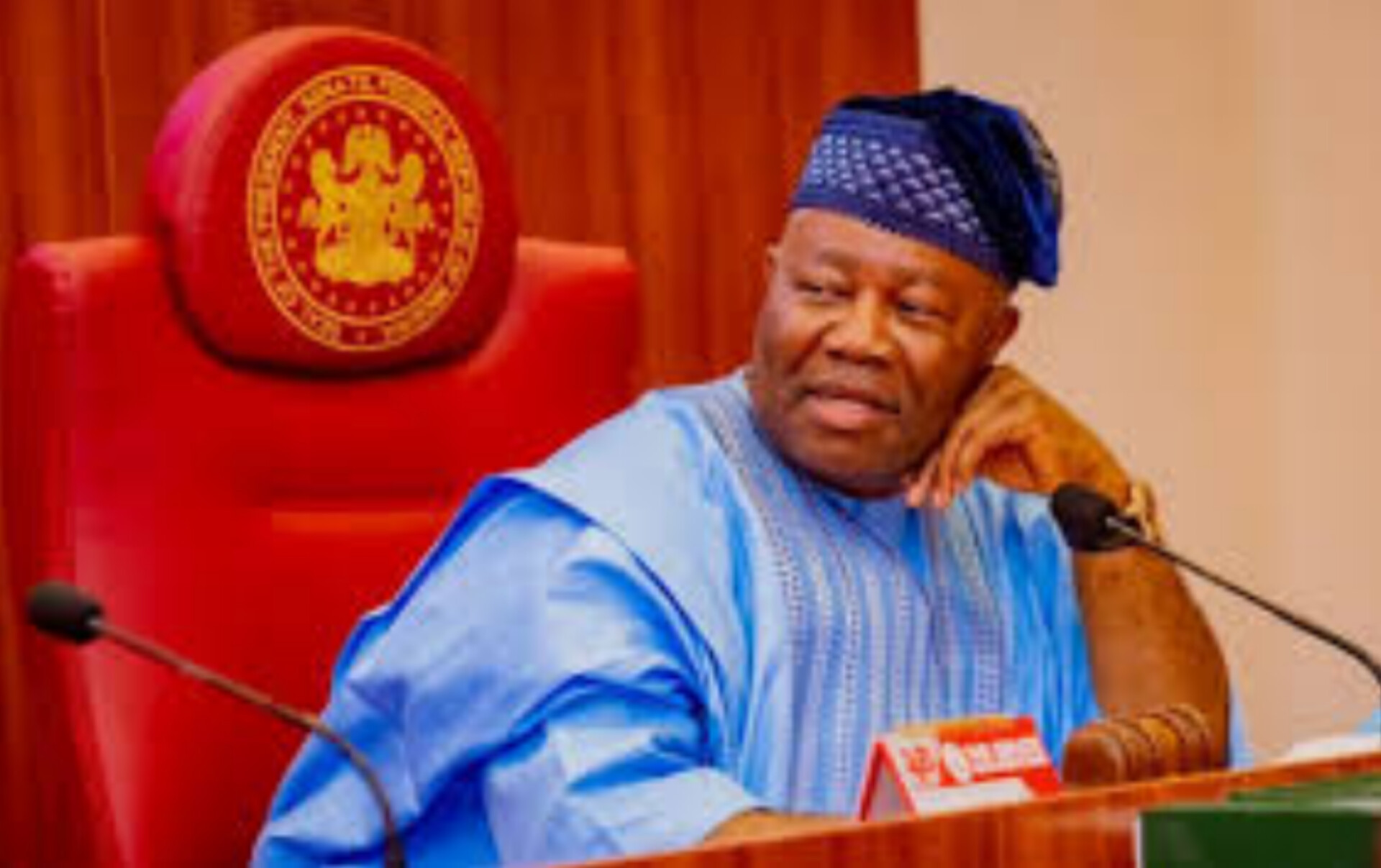
Its national leader, Senator Seriake Dickson, has reinforced this narrative, framing the party as an ideological movement rather than a transactional coalition. In his words at the maiden congress, the party is designed to “outlive all of us,” positioning it as a long-term institution rather than an election-cycle arrangement.
Dickson’s leadership style has also shaped the party’s ideological tone. Drawing from his long experience in opposition politics, he has repeatedly emphasised national unity, democratic survival, and resistance to one-party dominance.
His framing of Nigeria’s democracy as being under pressure has resonated within opposition circles, especially his warning that political consolidation without strong opposition would weaken democratic accountability.
Yet, beyond rhetoric, Dickson has positioned the NDC as inclusive rather than exclusionary—open to defectors, reformers, and political actors seeking a new platform. His consistent appeal to institutions like INEC and the judiciary underscores a broader institutional reform message: democracy must be protected not just by politicians, but by systems.
One of the most frequently repeated claims by the NDC leadership is organisational unity. In a political landscape where factional disputes often define parties even before elections, the NDC’s insistence on internal cohesion is being presented as a competitive advantage.
Party leaders argue that this early unity is not accidental but intentional—built through consensus leadership, shared ideological framing, and deliberate avoidance of personality clashes that often destabilise emerging platforms.
Whether this unity holds under electoral pressure remains an open question, but at this stage, it is part of the party’s strongest political messaging.
Perhaps the most politically consequential decision so far is the zoning of the 2027 presidential ticket to Southern Nigeria, with a structured agreement that rotates back to the North in 2031.
Far from being a routine internal arrangement, this decision places the NDC squarely within Nigeria’s long-standing power rotation logic. It is also strategically significant because it aligns with broader political calculations across the opposition spectrum.
The arrangement is widely interpreted as politically compatible with the ambitions of major figures such as Peter Obi and Rabiu Musa Kwankwaso, both of whom have built strong regional bases and national appeal narratives rooted in equity and restructuring of political power.
Within that context, the zoning formula is being read not just as internal party policy, but as a potential bridge across opposition tendencies.
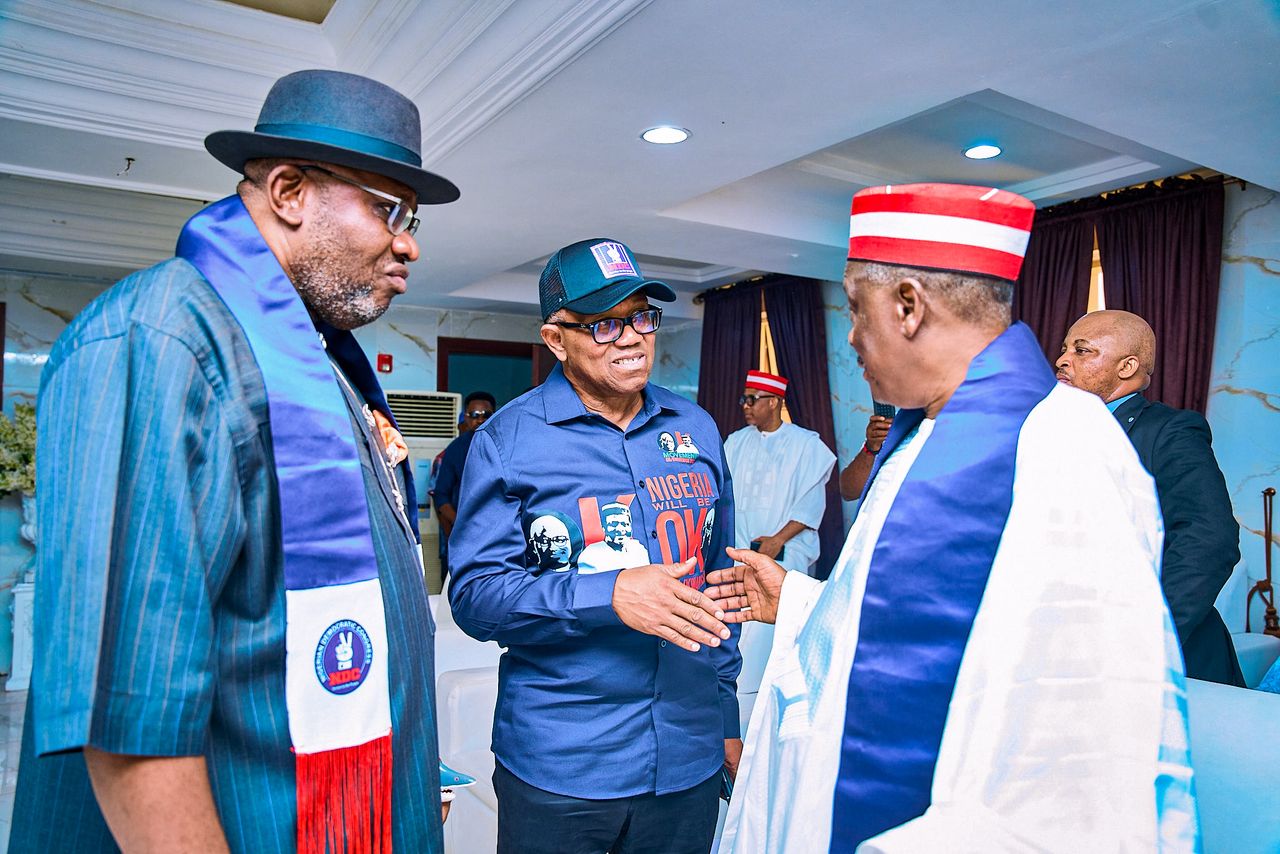
The presence and speeches of Peter Obi and Rabiu Musa Kwankwaso at the NDC congress added a layer of political legitimacy and visibility to the party’s emergence.
Obi’s intervention focused on governance failure, poverty, insecurity, and the urgency of national reset. His consistent emphasis on production over consumption, and inclusion over division, aligned closely with the NDC’s stated ideological direction.
Kwankwaso, on the other hand, brought historical depth and structural reasoning. His references to coalition politics in Nigeria’s past and his support for zoning reflected a pragmatic understanding of political balance and national cohesion.
Although both figures retain distinct political identities, their convergence at the NDC platform reinforced the perception that the party is becoming a meeting point for reform-oriented opposition forces.
One of the most ambitious claims made by the NDC leadership is its rapid nationwide acceptance. Party officials argue that within months of formation, it has attracted attention across all geopolitical zones.
While such claims are typical in early-stage political movements, the difference in this case lies in the profile of individuals publicly associating with the platform and the speed of its organisational rollout.
From North to South, East to West, the party is attempting to present itself not as regional, but national from inception.
A recurring theme in NDC messaging is rejection of what it calls “transactional politics”—a system where alliances shift based on short-term electoral calculations rather than ideology or principle.
Instead, the party is attempting to align itself with global political party models, referencing established democratic systems in the United States, United Kingdom, South Africa, and China as examples of ideological endurance and organisational stability.
While comparisons may be aspirational, they signal the party’s intention to be perceived as structured, institutional, and long-term.
The NDC has also positioned itself as a defender of multiparty democracy, repeatedly warning against political dominance by any single party. This framing places it within a broader national debate about democratic balance, electoral credibility, and institutional independence.
By consistently appealing to institutions such as INEC, the judiciary, and security agencies, the party is embedding itself within the language of constitutional democracy rather than street-level mobilisation alone.
Despite its youth, the NDC is already functioning as a strategic political actor. Its zoning arrangement, leadership composition, ideological messaging, and elite participation suggest a party attempting to bypass the slow evolution typical of Nigerian political organisations.
However, its durability will ultimately depend not on its early momentum, but on its ability to survive electoral competition, internal pressure, and the realities of coalition politics in a high-stakes environment.
The Nigerian Democratic Congress may still be in its infancy, but it has already inserted itself into the national political conversation in a way few new parties have achieved.
Whether it becomes a lasting political institution or another transient opposition experiment will depend on how it navigates the complex intersection of ambition, ideology, and Nigeria’s deeply competitive electoral system.
For now, however, it represents something rare in Nigerian politics: a new party that is not merely announcing its existence, but actively attempting to define its future before the first ballot is cast.