***Church Warns Against Systemic Neglect
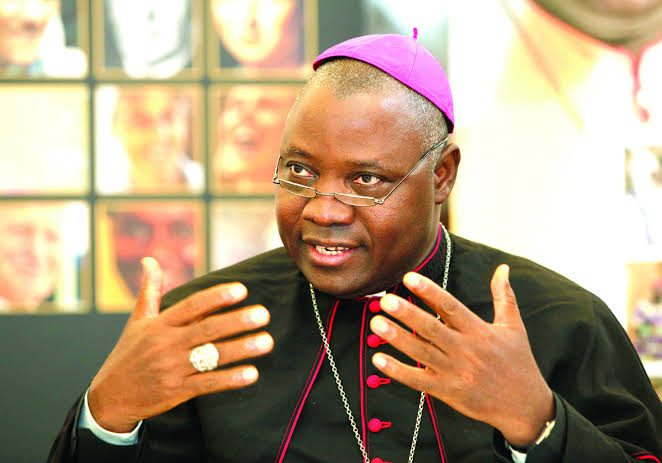
The Catholic Archbishop of Abuja, Ignatius Ayau Kaigama, has issued one of his strongest public rebukes yet to Nigeria’s leadership class, warning that the country risks deepening social instability if it continues to “manage poverty instead of ending it,” while ignoring growing anger among the poor and vulnerable.
Delivering a sharply worded homily at St. Catherine’s Pastoral Area, Giri Gauta, during the Fifth Sunday of Easter, Kaigama drew a direct line between biblical injustice in the early Church and what he described as modern-day governance failures in Nigeria.
Anchoring his message on readings from Acts of the Apostles, First Epistle of Peter, and Gospel of John, the Archbishop said Nigeria’s worsening inequality reflects a leadership culture that has normalised neglect while “celebrating token gestures as governance.”
“Modern widows” in a broken system
In a direct political analogy that cut through the liturgical setting, Kaigama described unemployed youths, underpaid workers, struggling farmers, retirees without pensions, and internally displaced persons as Nigeria’s “modern Hellenist widows”—citizens systematically sidelined in the distribution of national resources.
He warned that public anger over hardship is often met not with solutions but with irritation from those in authority.
“Our leaders must stop reacting with anger when citizens speak about hunger, insecurity, and poverty,” he said. “They must confront these realities with responsibility, not denial.”
The Archbishop criticised what he called a recurring pattern where resources meant for the vulnerable are diverted, while the same citizens are offered “occasional tokens” presented as generosity.
Governance failure disguised as charity
Kaigama was particularly critical of what he implied was institutionalised mismanagement of public welfare systems, including aid distribution to displaced persons, prisoners, and vulnerable groups.
He warned that without accountability, those entrusted with public service risk becoming what he described as “exploiters of the very people they are meant to serve.”
“The authorities must appoint true servants—people of integrity and wisdom—not those who convert public service into personal advantage,” he said.
The remarks were widely interpreted as a moral indictment of systemic corruption and weak oversight in governance structures responsible for social protection.
Early Church as mirror of modern Nigeria
Using the dispute in the early Christian community over neglected widows as a case study, Kaigama said the Church preserved the account in Acts of the Apostles not to romanticise conflict, but to demonstrate how leadership must respond to injustice.
He praised the apostles for acknowledging institutional failure and restructuring their governance system, stressing that modern leaders must show similar humility rather than defensiveness.
“Where leaders are wrong, they must admit it. The first response should not be self-defence, but reflection and correction,” he said.
A warning against national fragmentation
Beyond governance critique, the Archbishop warned that unchecked inequality and exclusion could deepen national fragmentation if left unaddressed.
He urged leaders to prioritise dialogue over confrontation and structural reform over symbolic gestures, cautioning that societies which ignore the grievances of the poor eventually face instability.
“Injustice that is ignored does not disappear—it grows,” he warned.
Faith, patience, and a restless nation
While acknowledging the resilience of faith among Nigerians despite economic hardship, Kaigama cautioned that spiritual endurance must not be used as an excuse for governance failure.
Quoting Christ’s words in the Gospel of John—“Let not your hearts be troubled”—he said faith should inspire action, not resignation.
He called for a national shift from “managed suffering” to deliberate reform, insisting that Nigeria’s moral and political credibility depends on how it treats its weakest citizens.
A Church increasingly vocal on state failure
The homily, delivered during a parish anniversary celebration marked by 93 confirmations, reflects a broader pattern of increasingly direct interventions by the Catholic hierarchy in national discourse.
While grounded in scripture, Kaigama’s message carried unmistakable political undertones—framing Nigeria’s governance crisis not as isolated inefficiency, but as a systemic failure of justice, accountability, and leadership ethics.
In effect, the Archbishop’s message was less a pastoral reflection and more a moral audit of the Nigerian state: one that insists that poverty is no longer an unfortunate condition, but a policy outcome.