Nigeria’s political landscape was jolted on Thursday as the Supreme Court of Nigeria nullified the November 2025 national convention of the Peoples Democratic Party (PDP), ruling that the exercise was conducted in defiance of subsisting court orders.
In a split decision of three to two, the apex court upheld earlier judgments of the Federal High Court and the Court of Appeal, declaring the Ibadan convention invalid for violating due process and judicial directives.
Delivering the lead judgment, Justice Stephen Adah held that the PDP proceeded with the convention despite a valid restraining order, an action the court described as contemptuous. The five-member panel, led by Justice Mohammed Garba, agreed that the party’s conduct went beyond internal affairs and entered the realm of disobedience to lawful orders.
“The issue transcends internal party matters,” the court ruled in essence, affirming that political parties must operate within the bounds of the law and respect judicial authority.
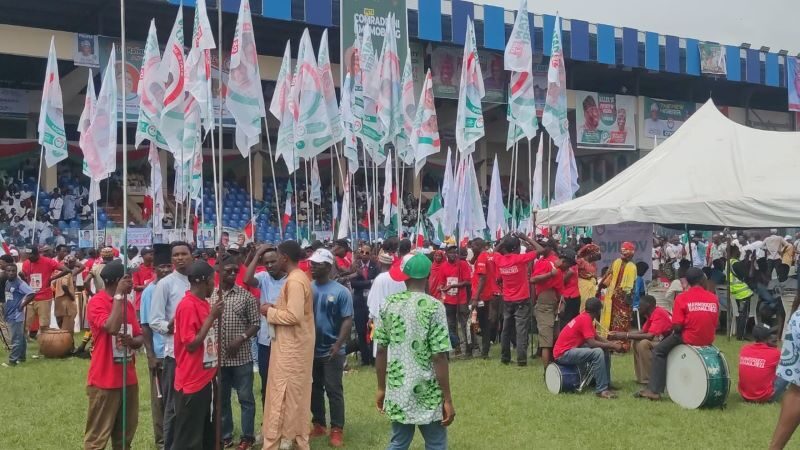
The disputed convention, held in Ibadan, Oyo State, had produced a factional leadership led by former Minister of Special Duties, Tanimu Turaki (SAN), amid deepening internal divisions within the opposition party.
However, the apex court found that the process leading to that convention was fundamentally flawed, noting that the PDP not only ignored restraining orders but also engaged in actions considered an abuse of court processes.
Consequently, the court dismissed the appeal filed by the Turaki-led faction and affirmed orders barring the Independent National Electoral Commission (INEC) from recognising the outcome of the convention.
The legal dispute that culminated in the Supreme Court ruling originated from suits filed by aggrieved party stakeholders, including former Jigawa State Governor, Sule Lamido. Lamido had challenged his exclusion from the race for national chairman, prompting judicial intervention.
At the trial level, Justice Peter Lifu had restrained the PDP from proceeding with the convention pending compliance with due process, particularly regarding inclusivity in the chairmanship contest. In a related decision, Justice James Omotosho faulted the party for failing to conduct valid state congresses as a prerequisite for a lawful national convention.
Despite these rulings, the PDP faction went ahead with the exercise—an action the courts consistently deemed unlawful.
Dissatisfied with the lower court decisions, the Turaki-led leadership approached the apex court, arguing that the matter was strictly an internal party affair beyond judicial interference. But the Supreme Court disagreed, holding that once a party disobeys a valid court order, the issue ceases to be purely internal.
Legal analysts say the ruling reinforces the principle that political parties, while autonomous, are not above the law and must adhere strictly to constitutional provisions, electoral regulations, and judicial directives.
The judgment is expected to deepen the leadership crisis within the PDP and reshape alignments ahead of the 2027 general elections, as stakeholders grapple with its legal and political consequences.
It also sends a strong signal to political actors on the limits of party autonomy, particularly where actions intersect with the rule of law and judicial authority.
Supreme Court Voids PDP Ibadan Convention, Affirms Illegality Over Court Order Breach