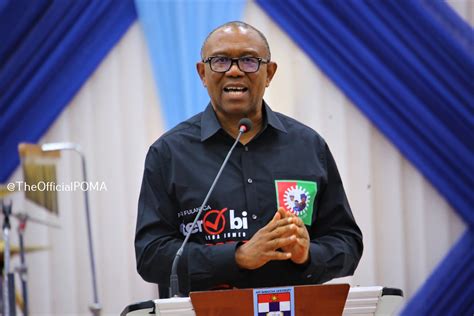
The media team of Peter Obi has raised alarm over what it describes as a coordinated effort to restrict his public engagements across Nigeria, particularly within tertiary institutions.
In a statement issued on Monday and signed by its spokesperson, Ibrahim Umar, the Peter Obi Media Reach (POMR) claimed it has credible information pointing to “surreptitious schemes” aimed at limiting Obi’s access to public platforms and, by extension, his interaction with Nigerians.
At the centre of the concern are repeated last-minute cancellations of scheduled appearances, including a recent lecture at Obafemi Awolowo University and earlier incidents at University of Nigeria, Nsukka.
According to the group, the pattern—said to have occurred more than ten times in recent months—suggests a deliberate trend rather than routine administrative decisions.
“This is no longer coincidental,” the statement said, describing the development as a reflection of a “deepening democratic malaise” in which institutions traditionally regarded as spaces for free thought are allegedly yielding to external pressures.
POMR stressed the importance of universities as centres of intellectual exchange, warning that restricting voices within such environments undermines both academic freedom and democratic values.
Quoting Obi, the statement noted that the recurring disruptions “should concern all well-meaning Nigerians,” insisting that institutions of learning must remain open platforms for dialogue, dissent, and diverse perspectives.
The group also highlighted what it described as a contradiction, noting that while Obi continues to receive invitations to speak at globally respected institutions such as University of Oxford, Harvard University, University of Cambridge, and Yale University, opportunities within Nigeria appear to be shrinking.
“What does it say about a country where its own citizens are denied platforms in its own institutions?” the statement queried.
The media office called on university authorities and governing councils to resist any form of political intimidation and uphold the independence of academic spaces, warning that suppressing voices in institutions often described as the “ivory towers” could have far-reaching implications for Nigeria’s intellectual and democratic development.
Reaffirming its position, the group said it remains committed to “an open Nigeria where the force of argument prevails over the argument of force,” urging stakeholders to defend free expression as a cornerstone of democracy.
Obi Media Office Alleges Clampdown, Warns of Shrinking Civic Space