A dramatic shift in Iran’s leadership unfolded Sunday as authorities in Tehran announced a transitional governing council following the reported killing of Supreme Leader Ali Khamenei, while fresh explosions echoed across key Gulf cities, deepening fears of a widening regional conflict.
The development marks a pivotal moment in Iran’s political history. For nearly four decades, Khamenei stood at the apex of the Islamic Republic’s power structure. His sudden death — reportedly resulting from coordinated strikes by the United States and Israel — has triggered constitutional mechanisms designed for such an emergency.
Under Article 111 of Iran’s Constitution, a three-member council now assumes interim authority until a permanent successor is chosen by the Assembly of Experts.
Named to the transitional body are Ayatollah Alireza Arafi, President Masoud Pezeshkian, and Chief Justice Gholam-Hossein Mohseni-Ejei. The council’s mandate is to manage state affairs and maintain continuity while the 88-member clerical Assembly deliberates on the next supreme leader.
The urgency is unmistakable. The constitution stipulates that a new leader must be selected “as soon as possible,” but the political calculus behind that decision is expected to be complex, involving religious authority, military influence and factional balance.
Complicating matters further, reports indicate that the commander-in-chief of the Islamic Revolutionary Guard Corps (IRGC) was also killed in the strike — leaving a vacuum within one of the country’s most powerful military and economic institutions.
While the transitional council provides formal governance, analysts suggest that security institutions, particularly the IRGC, will remain central in shaping the immediate direction of the state.
Explosions Across the Gulf
As Tehran grappled with succession, the broader region braced for impact.
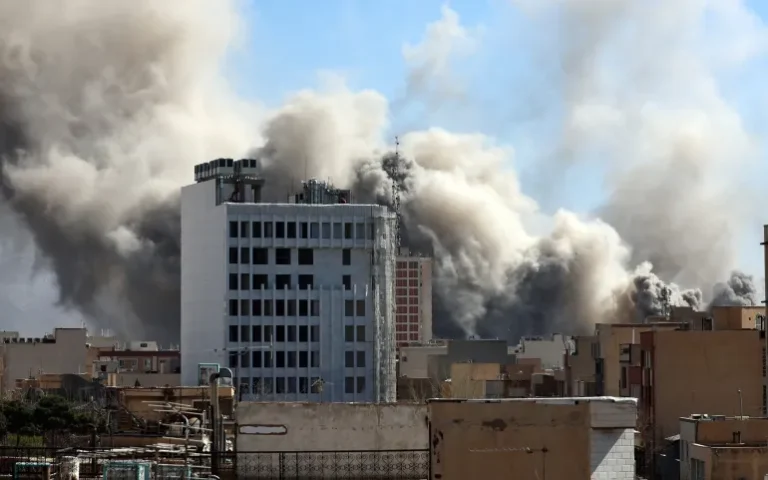
Fresh blasts were reported Sunday in Dubai, Doha, and Manama, following a day of extensive missile and drone exchanges.
In Doha, residents described hearing multiple loud explosions and seeing plumes of smoke rising against the morning sky. Dubai’s skyline showed visible signs of air defence interceptions, with smoke observed near Jebel Ali port, a major commercial hub.
In Manama, witnesses reported several blasts, though there were no immediate confirmations of casualties from Sunday’s incidents.
The previous day saw significant escalation. Emirati authorities reported that Iran launched over 130 missiles and more than 200 drones toward the United Arab Emirates. Qatar confirmed dozens of incoming projectiles, many intercepted, though injuries were recorded.
Air defence systems in Jordan and Kuwait were also activated as missiles entered their airspace. In northern Iraq, a drone reportedly crashed near Erbil International Airport, underscoring the conflict’s expanding geographic footprint.
The Gulf states, many hosting thousands of U.S. troops, now find themselves navigating heightened vulnerability. What was once considered a relatively stable economic corridor has become a theatre of strategic confrontation.
For Iran, the dual challenge is stark: managing a sensitive leadership transition while responding to external military pressure.
The formation of the interim council sends a signal of institutional continuity, yet uncertainty remains over how quickly a consensus candidate for supreme leader can emerge — and how that choice might recalibrate Iran’s domestic and foreign policies.
Amid the escalating hostilities, Nigeria’s Federal Government called for immediate de-escalation.
In a statement issued by the Ministry of Foreign Affairs, spokesperson Kimiebi Imomotimi Ebienfa urged all parties to exercise restraint and prioritise diplomacy.
“Nigeria calls on all parties to exercise maximum restraint and refrain from actions that could intensify hostilities,” the statement read.
The government emphasised adherence to the United Nations Charter and international humanitarian law, reaffirming Nigeria’s commitment to multilateral dialogue and peaceful resolution of disputes.
The Middle East now stands at a defining moment.
In Tehran, a leadership vacuum has triggered constitutional safeguards. Across the Gulf, cities known for commerce and stability are confronting the realities of regional warfare.
The coming days will test not only Iran’s political cohesion but also the resilience of regional diplomacy. The speed with which the Assembly of Experts selects a successor — and the nature of that choice — could shape the trajectory of tensions for years to come.
For now, the region holds its breath: a power transition at the heart of Iran, and a volatile security landscape stretching from the Persian Gulf to the wider Middle East.